


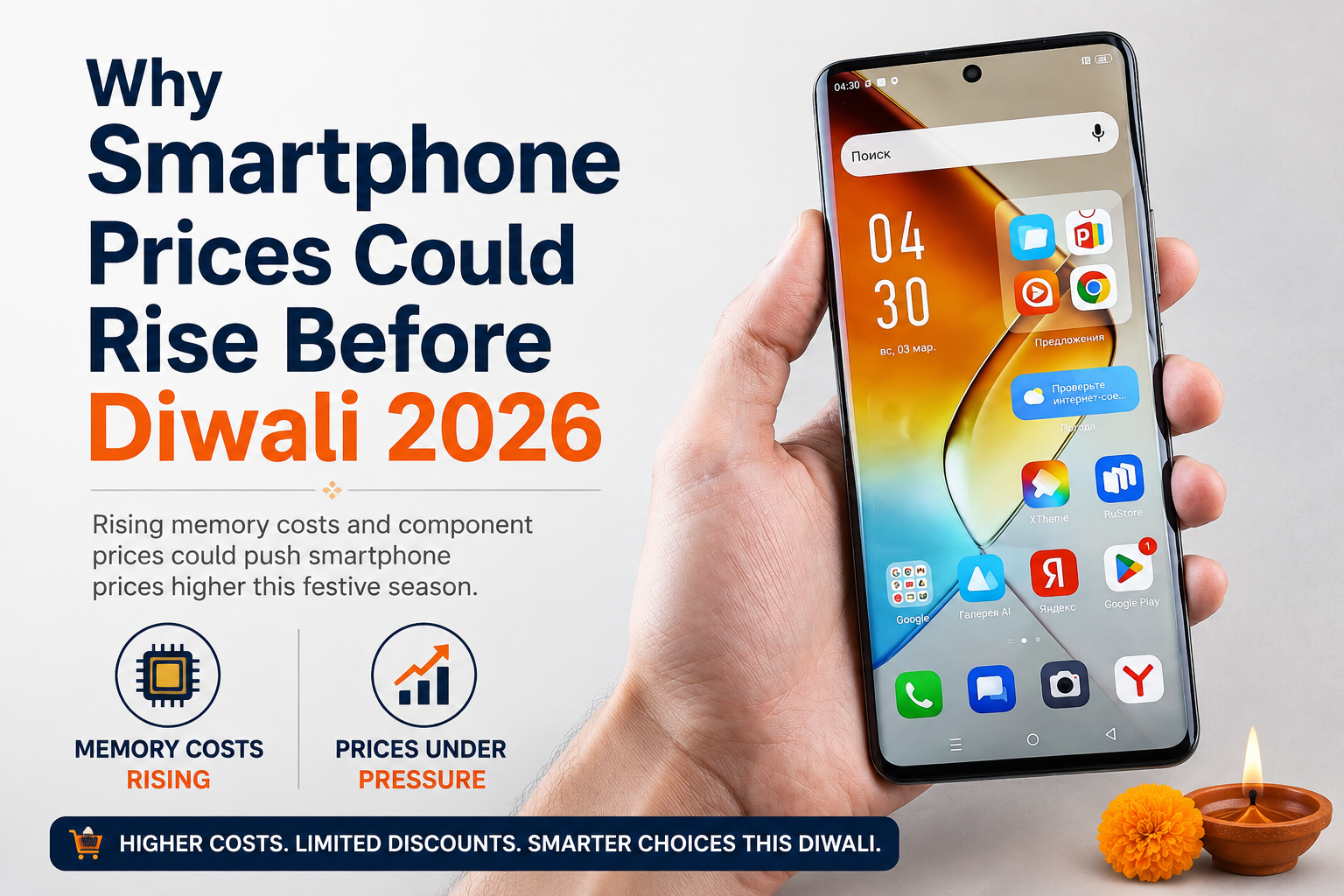
Aug 21: Indian consumers planning to buy a new smartphone before Diwali 2026 could face a tougher pricing environment than expected. While festive sales are traditionally associated with discounts, cashback and exchange offers, rising memory costs and higher component expenses are putting pressure on smartphone manufacturers.
The trend is already visible in India’s smartphone market. According to IDC, smartphone shipments in India declined 4.1% year-on-year to 31 million units in Q1 2026, while the average selling price (ASP) increased 10.4% to a record US$302. IDC attributed the increase partly to persistent memory-cost inflation.
This could become increasingly important as the Diwali shopping season approaches. If manufacturers continue to face higher production costs, they may have less room to absorb those expenses through aggressive discounts.
IDC Report Shows Smartphone Prices Are Already Moving Higher
IDC’s India smartphone market data provides a clear indication of the changing pricing environment.
Despite lower shipment volumes in Q1 2026, India’s smartphone market recorded a higher average selling price. The ASP reached a record US$302, up 10.4% year-on-year.
IDC identified persistent memory-cost inflation as one of the factors contributing to the increase.
The research firm also noted that aggressive discounting and channel-led promotional activity remained limited as rising input costs reduced brands’ ability to use pricing interventions to stimulate demand.
For consumers, this could mean that Diwali smartphone prices may not fall as sharply as they have during previous festive seasons.
Memory Costs Are Becoming a Major Concern
One of the biggest challenges facing smartphone manufacturers is the rising cost of memory components.
Smartphones use DRAM for tasks such as running applications and multitasking, while NAND storage is used for photographs, videos, applications and other data. When these components become more expensive, manufacturers face higher production costs.
TrendForce’s research highlights the scale of the increase. The market research firm estimated that average selling prices for LPDDR4X mobile DRAM could rise 70–75% quarter-on-quarter in Q2 2026, while LPDDR5X prices could increase 78–83%.
These increases can have a significant impact on smartphone manufacturers, particularly in the budget and mid-range segments where margins are generally tighter.
Manufacturers therefore have several choices: absorb the additional cost, reduce promotional spending, adjust specifications or increase retail prices.
Why Memory Costs Could Affect Smartphone Prices in India
Memory is not a minor component of a smartphone. RAM and storage directly influence the device’s performance and user experience.
As consumers increasingly expect higher RAM, larger storage and AI-enabled features, manufacturers are also under pressure to include more memory in new devices.
This creates a difficult equation for smartphone brands. They need to deliver better specifications while dealing with higher component costs.
For consumers, this could translate into higher smartphone prices in India, particularly for models with larger RAM and storage configurations.
Why This Matters Before Diwali
Diwali is one of India’s biggest shopping periods, and smartphones are among the products that typically attract significant consumer interest during the festive season.
Brands and retailers are expected to compete through bank discounts, exchange offers, cashback schemes and no-cost EMI plans. However, higher component costs could affect how aggressively these promotions are priced.
If manufacturers are already dealing with higher memory costs, they may have less room to support deep discounts.
Consumers could therefore see a different type of festive offer. Instead of a major reduction in the listed price, brands may rely more heavily on exchange bonuses, bank offers, bundled accessories or limited-period promotions.
In other words, a Diwali sale does not automatically mean every smartphone will become cheaper.
Will Smartphone Prices Rise Across Every Segment?
Not necessarily.
The impact is likely to vary depending on the smartphone’s specifications, memory configuration, price segment and manufacturer.
Budget Smartphones
Budget devices could face greater pressure because component costs account for a larger proportion of the overall device cost.
Manufacturers competing in this segment have limited room to increase prices because consumers are highly price-sensitive.
Mid-Range Smartphones
The mid-range segment could experience a combination of higher prices and changing specifications. Brands may offer different RAM and storage configurations to manage costs.
Premium Smartphones
Premium devices could have greater pricing flexibility because manufacturers generally operate with higher margins. However, premium smartphones with high RAM and storage capacities could also be affected by rising memory costs.
Why Diwali Discounts May Not Be as Deep
Festive discounts are generally supported by manufacturers, retailers, banks and e-commerce platforms. When manufacturing costs increase, however, there may be less money available to fund large discounts.
IDC’s findings are relevant here. The research firm said rising input costs had limited aggressive discounting and channel-led promotional activity in India’s smartphone market.
If cost pressures remain through the second half of 2026, consumers could see a similar trend during the Diwali shopping period.
That does not mean there will be no bargains. Rather, shoppers may need to look beyond the headline discount to determine whether an offer represents genuine value.
Smartphone Prices Could Rise Even as Competition Remains Strong
There is an important difference between a higher listed price and a higher final purchase price.
For example, a smartphone’s official price could increase while a retailer offers a bank discount or exchange bonus that keeps the final price attractive.
Similarly, a device could retain its listed price but receive a smaller discount than it did during the previous festive season.
Consumers should therefore calculate the effective purchase price after all applicable offers.
Exchange value, cashback, bank discounts, EMI benefits and bundled accessories can all affect the final cost of a smartphone.
What Should Consumers Do Before Diwali 2026?
Consumers planning a smartphone upgrade can take several practical steps.
Track Prices Early
Start monitoring the price of the preferred smartphone several weeks before Diwali. This creates a baseline and makes it easier to identify genuine discounts.
Compare Previous-Generation Flagships
Older flagship models could offer excellent value if newer models become more expensive.
A previous-generation premium smartphone may provide better cameras, displays or processors than a similarly priced new mid-range model.
Compare RAM and Storage
With memory costs becoming an important factor, buyers should pay close attention to RAM and storage configurations.
Two smartphones with similar names can have significantly different configurations and prices.
Calculate the Final Purchase Price
Do not rely only on the advertised discount. Add bank offers, exchange benefits and cashback to determine how much you will actually pay.
Compare Online and Offline Offers
E-commerce platforms may offer larger headline discounts, while offline retailers could provide exchange bonuses, accessories or additional services.
Comparing the complete package can reveal the better deal.
Don’t Assume Diwali Means the Lowest Price
Festive sales are competitive, but consumers should not automatically assume that Diwali will offer the lowest price of the year.
The current cost environment could limit how much manufacturers and retailers can discount certain models.
What IDC and TrendForce Tell Us About Diwali 2026
The findings from IDC and TrendForce provide a useful picture of why smartphone prices could rise before Diwali 2026.
IDC’s India data shows that average smartphone selling prices have already increased, even though shipment volumes declined.
TrendForce’s data provides a key explanation for the cost pressure, with mobile DRAM prices recording substantial increases.
Together, the reports point to a challenging environment for smartphone manufacturers.
Brands will continue competing for India’s festive-season customers, but higher component costs could make it more difficult to combine higher specifications with aggressive pricing.
The Bottom Line for Smartphone Buyers
The possibility of higher smartphone prices before Diwali 2026 does not mean consumers should rush to buy a phone immediately.
Instead, it means buyers should start tracking prices early and compare the complete value of each offer.
The market is already showing signs of pricing pressure. IDC’s data shows that India’s smartphone average selling price has increased, while TrendForce’s research highlights sharp increases in mobile memory costs.
If these pressures continue into the festive season, consumers could still find attractive Diwali deals—but they may have to look more carefully to find them.
For smartphone buyers, the smartest strategy may not be simply waiting for the biggest Diwali sale. It may be tracking prices early enough to recognise a genuinely good deal when it appears.