


Aug 17: India’s next big startup success story may not be built around another fintech app or e-commerce platform. It could emerge from a laboratory, engineering centre or research institution.
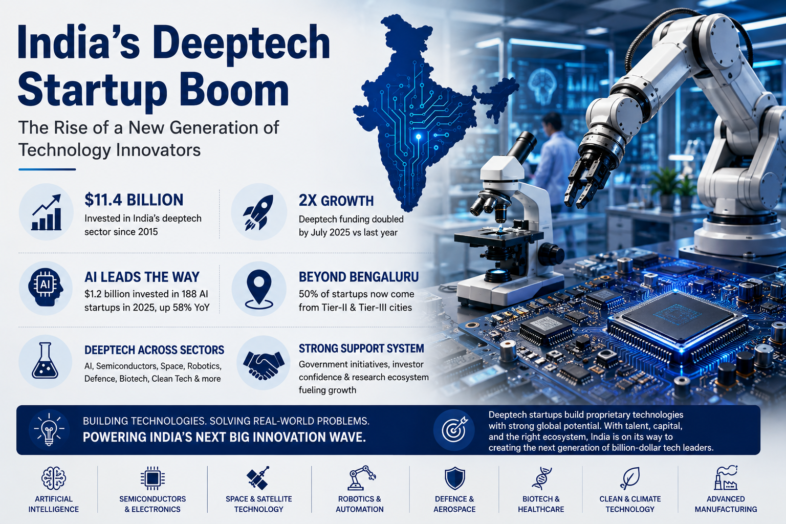
India’s deeptech sector has attracted $11.4 billion in funding since 2015, according to a report by the Indian Venture and Alternate Capital Association (IVCA), reflecting growing investor confidence in startups developing technologies rooted in science, engineering and intellectual property. From artificial intelligence and semiconductors to spacetech, robotics, biotechnology and defence technology, Indian founders are increasingly attempting to solve complex problems with global applications.
The rise of these companies could mark an important shift in India’s startup story—from building digital platforms at scale to creating proprietary technologies that can compete in global markets.
India’s Deeptech Startups Are Entering a New Phase
India’s first major startup wave was driven largely by software, fintech, e-commerce and digital services. Deeptech startups operate differently.
These companies often spend years developing a technology before reaching commercial scale. Their competitive advantage may come from a patented invention, proprietary AI model, semiconductor design, advanced robotics system or scientific breakthrough.
The risks are higher, but so is the potential to create a strong technological moat.
According to data cited by the CFA Institute, Indian deeptech companies raised $1.06 billion across 137 equity funding rounds by July 2025, around twice the funding recorded during the corresponding period a year earlier.
The momentum continued through 2025. Data from the Nasscom-Zinnov Indian Tech Start-up Report, reported by the Economic Times, showed that deeptech funding rose 37% year-on-year to $2.3 billion in 2025.
The numbers indicate that investors are increasingly looking beyond conventional startup models and towards businesses developing difficult-to-replicate technologies.
From Research Labs to Global Markets
One of the most important changes in India’s startup ecosystem is the growing movement of scientists, engineers and researchers into entrepreneurship.
These founders are working on problems across:
- Artificial intelligence and machine learning
- Semiconductors and electronics
- Space and satellite technology
- Robotics and industrial automation
- Defence and aerospace
- Biotechnology and healthcare
- Climate and clean technology
- Advanced manufacturing
The opportunity is significant because a successful deeptech company can potentially sell its technology across multiple markets rather than being restricted to a single geography.
For India, this creates the possibility of moving from being a major technology-services provider to becoming a developer and exporter of intellectual property.
Indian Deeptech Companies Are Already Demonstrating the Opportunity
The country’s deeptech ecosystem is no longer limited to research projects and early-stage prototypes.
Indian startups such as Skyroot Aerospace, Agnikul Cosmos, ideaForge Technology, Agnikul Cosmos, and Qure.ai have demonstrated how Indian technology companies can build businesses around highly specialised technologies spanning space, drones and AI-enabled healthcare.
In the semiconductor ecosystem, companies such as Mindgrove Technologies are also working to build indigenous chip capabilities.
These examples represent different parts of the deeptech landscape, but they have a common feature: their businesses are built around specialised technology rather than conventional digital distribution alone.
The emergence of such companies is important because successful deeptech ecosystems need more than funding. They need founders capable of converting research and engineering expertise into commercially viable products.
AI Is Accelerating India’s Deeptech Opportunity
Artificial intelligence has become one of the strongest growth engines for the sector.
According to Venture Intelligence, Indian AI startups attracted $1.2 billion across 188 investments in 2025, with funding value increasing 58% year-on-year.
AI is also increasingly intersecting with other deeptech industries. Startups are combining machine learning with robotics, healthcare, manufacturing, cybersecurity, defence and space technology.
This convergence could give Indian founders an advantage. The country already has a large technology talent pool, while the growing adoption of AI provides startups with opportunities to develop products for both Indian and international customers.
Beyond Bengaluru: The Deeptech Ecosystem Is Spreading
India’s deeptech story is also becoming geographically broader.
The government said India crossed 2 lakh DPIIT-recognised startups by December 2025, with around half originating from Tier-II and Tier-III cities.
This is particularly relevant for deeptech because universities, engineering institutes and research centres outside major startup hubs can become important sources of scientific talent and innovation.
As these capabilities expand, specialised deeptech clusters could develop around sectors such as manufacturing, agriculture, healthcare, defence, energy and space.
Government Support Could Help Build the Next Startup Giants
Deeptech companies require significant investment in research, infrastructure and product development. Government initiatives can therefore play an important role in helping startups cross the gap between research and commercialisation.
India has been strengthening its focus on semiconductors, artificial intelligence, space technology, research and development and advanced manufacturing.
Nasscom estimates that India has more than 4,200 deeptech startups and has highlighted an ambition to nurture more than 1,000 world-class deeptech startups by 2030.
The combination of government support, private investment, research institutions and corporate partnerships could help create the ecosystem required for deeptech companies to scale.
Why Deeptech Could Produce India’s Next Billion-Dollar Startups
Deeptech startups have one major potential advantage over conventional technology businesses: defensibility.
A consumer application or online platform can potentially be replicated quickly. A semiconductor architecture, advanced robotics system, specialised AI model or biotechnology platform can require years of research and highly specialised expertise.
That creates stronger barriers to entry.
If Indian founders successfully commercialise such technologies, the resulting companies could have applications across multiple countries and industries.
This could make deeptech a particularly important source of India’s next generation of globally competitive startups.
The Biggest Hurdle: Turning Innovation Into Business
The road to deeptech success is far from easy.
A startup can develop a promising prototype and still face years of testing, regulatory approvals, manufacturing challenges and customer acquisition before achieving commercial scale.
Capital is another challenge. Deeptech companies generally require patient capital because development timelines can be significantly longer than those of conventional software startups.
Access to specialised laboratories, testing facilities, computing infrastructure and scientific talent is equally important.
This makes collaboration between startups, universities, research institutions, government agencies and established companies critical to the sector’s long-term success.
India’s Next Startup Story Could Be Built on Science
The $11.4 billion invested in India’s deeptech sector since 2015 is more than a funding milestone. It reflects a changing definition of what an Indian startup can become.
The country has already demonstrated its ability to build large digital businesses. Deeptech offers the opportunity to go a step further by creating companies based on science, engineering, intellectual property and proprietary technology.
The journey will be longer and more capital-intensive, but the potential impact is much larger.
India’s next billion-dollar startup success stories may not come from another app, marketplace or digital platform. They could emerge from research laboratories, engineering teams and university campuses, building technologies for space, healthcare, defence, AI, semiconductors and advanced manufacturing.
If India can successfully turn its growing pool of talent and capital into commercially successful deeptech companies, the country could move from being one of the world’s largest startup markets to becoming a global hub for technology innovation.