


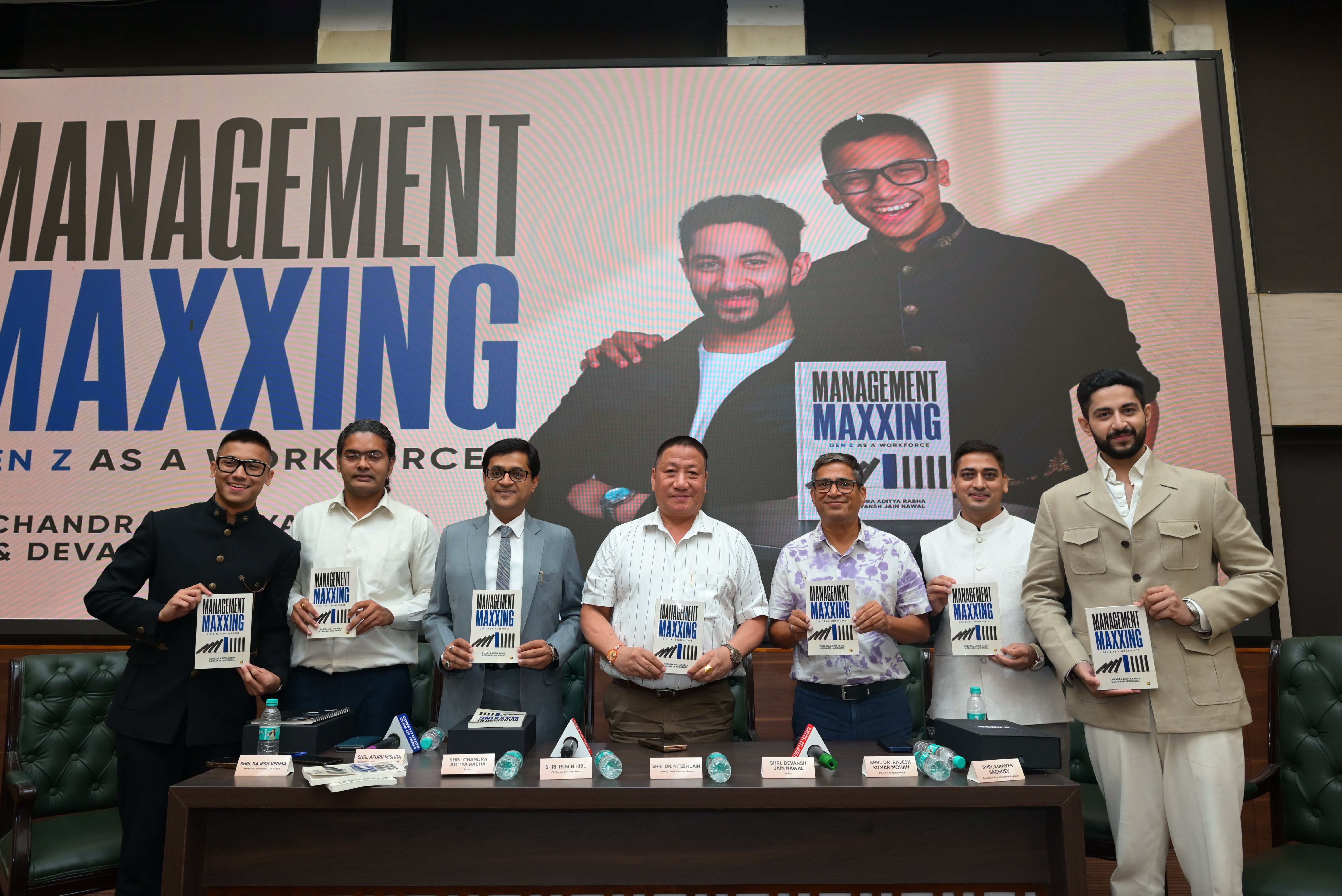
New Delhi, Sep 01: Devansh Jain, Co-Founder and CEO of Culture Circle, today launched his new book, Management Maxxing: Gen Z as a Workforce, at the Constitution Club of India, New Delhi. The book examines the principles of managing a Gen Z workforce through the lens of Devansh’s first–hand experience of managing approximately 150 people at Culture Circle, where the average age of the team is between 22 and 23, with 95% of the workforce under the age of 26.
The book explores the changing relationship between young employees and the workplace, looking at the differences in priorities, motivation, communication, alignment and management styles that organisations are increasingly navigating as Gen Z becomes a larger part of the workforce.
Rather than approaching Gen Z through stereotypes, Management Maxxing seeks to understand the underlying human motivations that influence the way this generation works, communicates, responds to leadership and defines professional growth.
Speaking about the book, Devansh Jain, Co-Founder & CEO, Culture Circle, said,
“I wrote this book because I was living the problem every day. When you are managing 150 people, with an average age of 22 or 23 and 95% of your workforce under 26, you are constantly asking yourself what motivates this generation, how you create alignment, how you give people autonomy without compromising accountability, and how you build a culture that actually works. I didn’t want to write a book telling people how to ‘deal with’ Gen Z. I wanted to understand what is fundamentally different about the way this generation thinks about work, and what that means for us as managers.”
The launch brought together voices from business, government, public policy and institutional leadership, reflecting the wider relevance of the conversation around India’s young workforce and its demographic dividend.
Among the distinguished guests were Hon’ble Shri Pabitra Margherita, Minister of State for External Affairs, Government of India; Shri Nitesh Jain, Partner, Grant Thornton Bharat; Shri Apurv Mishra, Consultant, Economic Advisory Council to the Prime Minister; Sujeet Kumar, Rajya Sabha MP; and Shri Robin Hibu, IPS, Special Commissioner of Police, Delhi Police.
The participation of leaders across these fields underlines the fact that managing Gen Z is no longer simply an HR or corporate question. As India’s young population enters the workforce in increasing numbers, the ability of organisations to attract, develop, align and retain young talent will have implications for productivity, competitiveness and the country’s broader demographic dividend.
At the heart of Management Maxxing is the argument that understanding Gen Z does not mean lowering standards. Instead, organisations need to evolve their management practices while retaining clarity around performance, ownership and accountability.
The book examines questions such as: What actually motivates Gen Z at work? How should managers approach feedback and recognition? How much autonomy should young employees have? How can organisations balance individual expectations with collective goals? And how can leaders build trust with a generation that is increasingly willing to question traditional workplace hierarchies?
For Devansh, the conversation ultimately goes beyond one generation. “Every generation enters the workplace with its own expectations, but I think Gen Z is forcing us to question a lot of assumptions that managers have taken for granted. The answer isn’t to simply give Gen Z what it wants, nor is it to force them into an old model of work. The answer is to understand the human motivations underneath those expectations and build organisations where empathy and accountability can coexist,” he added.
Through the book, Devansh hopes to contribute to a more nuanced conversation between generations at work — one where organisations better understand what young employees expect from them, while young employees also understand the responsibility, resilience and accountability expected of them.