


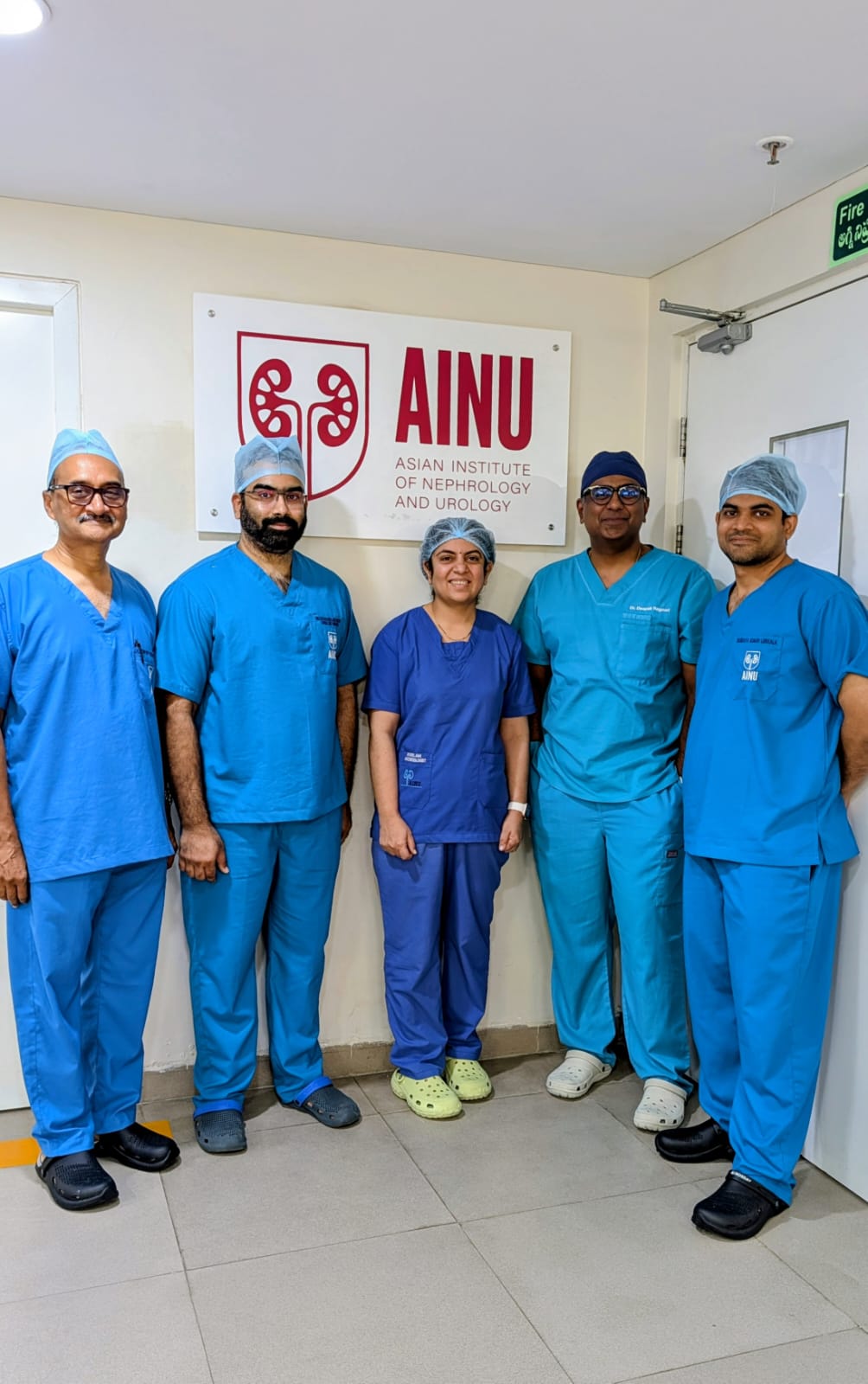
Hyderabad, August 27, 2026: A 27-year-old pregnant woman carrying a large kidney stone measuring nearly 4 cm was successfully treated at the Asian Institute of Nephrology and Urology (AINU) Hospital Hitec City after doctors carefully monitored her condition throughout pregnancy and chose to defer definitive stone treatment until after delivery.
The woman had no significant symptoms during her pregnancy. However, urine examinations during the first trimester repeatedly showed pus cells, proteinuria and microscopic blood, while urine cultures also detected E. coli. An ultrasound performed during the seventh month of pregnancy revealed a large left staghorn kidney stone measuring approximately 35 × 18 mm and occupying more than half of the kidney.
Commenting on the complexity of the condition, Dr. Deepak Ragoori, Senior Consultant Urologist, AINU Hospital Hitec City said, “The presence of a large kidney stone during pregnancy presented a complex clinical decision. While the size and configuration of the stone were concerning, the patient remained clinically stable. Considering her condition and the stage of pregnancy, the AINU team opted for conservative management with close monitoring rather than immediately undertaking definitive stone surgery.”
The pregnancy progressed safely, and the woman subsequently underwent a Caesarean section and delivered a healthy baby. Two weeks after delivery, she returned to the urology team for reassessment. A CT scan performed after delivery showed that the stone measured approximately 4.1 × 2.7 cm. Given its size and configuration, the team planned definitive treatment through percutaneous nephrolithotomy (PCNL), a minimally invasive procedure used to remove large kidney stones.
Six weeks after the Caesarean section, the woman underwent PCNL under general anaesthesia. The procedure was completed uneventfully. The case highlights an important principle in managing kidney stones during pregnancy: definitive treatment does not always have to be performed immediately. The decision depends on several factors, including symptoms, infection, obstruction, stone size and location, kidney function, and the clinical condition of both the mother and fetus.
“When a pregnant woman is clinically stable, and there is no emergency indication for intervention, careful monitoring may allow the pregnancy to progress safely, with definitive treatment undertaken after delivery. However, kidney stones during pregnancy cannot simply be ignored. Pain, fever, urinary infection, obstruction or deterioration in the mother’s condition can change the clinical situation and may require urgent intervention,” added Dr. Deepak Ragoori, Senior Consultant Urologist, AINU.
Dr. Chalapathi Raju, Dr. Vishwajit Reddy, Dr.Neelam and Dr. L. Udaya Kumar participated in the procedure. The AINU Hospital Hitec City team emphasised that close follow-up is essential to identify early signs of infection or other complications and initiate appropriate treatment without delay.
The case reinforces a simple but important message: when treating kidney stones during pregnancy, the safest treatment is not always the earliest treatment. Choosing the right time and the safest approach can help protect both mother and baby while ensuring definitive treatment is not compromised.