


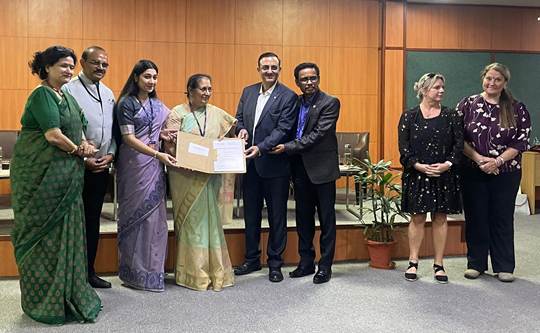
New Delhi, July 28: The Cambridge Certificate Course for Pre–Service Teachers held its graduation ceremony at Amity University today, and its newest graduates share one distinction beyond the certificate: every one of the candidates who enrolled has been placed in leading schools.
The ceremony opened with a welcome from Prof. (Dr.) Alka Muddgal, who traced the programme from inception to this cohort. International trainers Sharon Hennam Dale and Helen Rees Bidder, in conversation with Dr. Lalith Prasad of CUPA, took the audience inside classrooms well beyond India before certificates were presented by representatives of Cambridge and Amity. Dr. Neetu M. Shukla, Programme Director, closed the formal proceedings.
Hon’ble Prof. (Dr.) Balvinder Shukla, Vice Chancellor, Amity University Uttar Pradesh, addressed the graduates on the future of teacher education: “The teacher of tomorrow cannot be prepared with the methods of yesterday. Partnerships like this one with Cambridge ensure our young educators enter the profession globally fluent and locally rooted, ready for a changing world.”
Mr. Ashish Arora, Senior Vice President, Cambridge University Press & Assessment said: As the educational landscape continues to evolve in a rapidly changing world, equipping aspiring teachers with strong pedagogical foundations and future-ready skills has never been more important. The graduates of this programme are skilled teachers of today and the educators who will shape millions of learners tomorrow. At Cambridge, supporting teachers has always been central to our mission, and this programme reflects our continued commitment to preparing educators for the classrooms of tomorrow.”
Developed by Cambridge University Press & Assessment (CUP&A) and delivered by the Amity Institute of Education, the Pre–Service Teacher Programme aligns with India’s evolving education landscape, including the aspirations of NEP 2020, while meeting internationally benchmarked teaching standards. The course also carries academic credit, and a project or internship which on completion turns into a hiring advantage. It blends face-to-face instruction with flexible e-learning modules, covering learner-centred methodology, inclusive education, socio-emotional learning, assessment design and AI-enabled teaching tools. Most new teachers learn the craft on the job, in front of their first students. Candidates work through lesson planning, classroom management, reflective practice and assessment design with international trainers, and learn to integrate technology into the classroom and give feedback that actually changes how students work.
Applications for the next programme cohort are open through the Amity Institute of Education.