


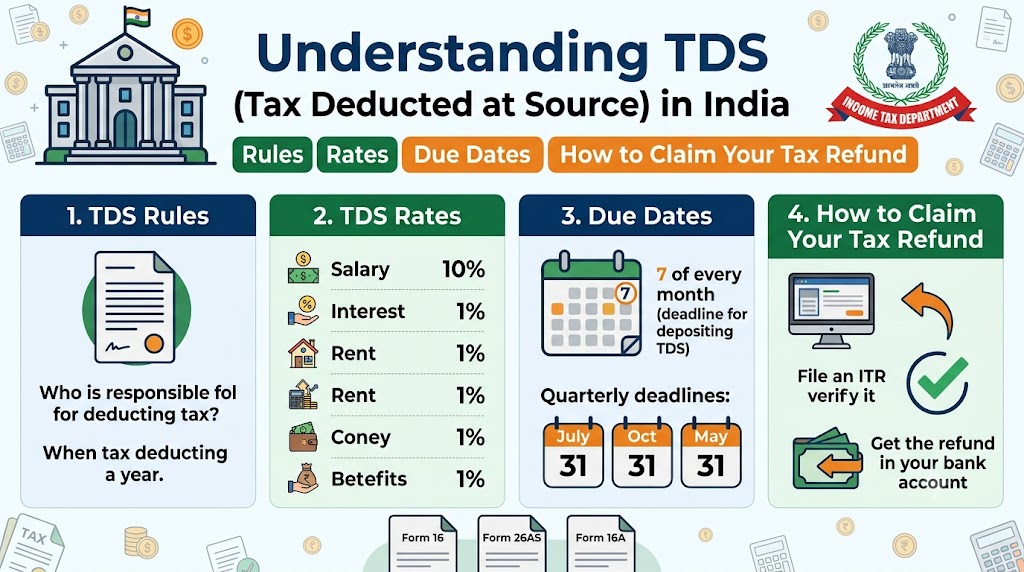
Tax Deducted at Source (TDS) is an important part of India’s tax collection system, affecting salaried employees, investors, landlords, professionals, property buyers and businesses. Although the deduction often happens automatically, understanding how it works can help taxpayers manage their finances, avoid compliance issues and claim the tax credit they are entitled to receive.
For businesses, TDS compliance is equally important. Companies and other eligible deductors must identify payments that attract tax deduction, apply the correct rates, deposit the tax within the prescribed timelines and submit the necessary statements. Errors can lead to interest, penalties and additional administrative work.
The key point is that TDS is generally an advance collection of income tax, not an additional tax over and above the recipient’s final tax liability. The amount deducted is credited against the recipient’s tax liability, subject to the applicable rules.
What Is TDS and Why Is It Important?
TDS is a mechanism through which tax is deducted from specified payments at the time of payment or credit, as prescribed by law. The person or organisation making the payment deducts the applicable amount and deposits it with the government on behalf of the recipient.
The system helps the government collect tax throughout the year instead of waiting until taxpayers file their annual income tax returns. It also creates a record of taxable payments and helps improve tax compliance.
TDS may apply to payments such as salaries, bank interest, rent, professional fees, commissions and certain property transactions. The applicable rate and threshold depend on the nature of the payment, the recipient’s residential status, the relevant legal provision and other prescribed conditions.
For example, if a company pays a consultant ₹1 lakh and the applicable TDS rate is 10%, it would generally deduct ₹10,000 and pay the remaining ₹90,000 to the consultant. The deducted amount would be deposited with the government and credited towards the consultant’s tax records.
The actual treatment depends on the applicable provision, including any exemptions or special conditions.
How Does the TDS Process Work?
The TDS process involves several steps, particularly for businesses and other entities responsible for deducting tax.
1. Obtain the required tax identification. Most deductors must obtain a Tax Deduction and Collection Account Number (TAN). Certain specified transactions have separate compliance procedures and exemptions from the general TAN requirement.
2. Identify the applicable rate and threshold. Before making a payment, the deductor must determine whether TDS applies, when the deduction is required and what rate should be used. The recipient’s PAN and residential status may also affect the deduction.
3. Deduct and deposit the tax. The deductor withholds the prescribed amount and deposits it with the government within the applicable deadline.
4. File the required TDS statement. Eligible deductors must report the deductions and deposits through the prescribed forms or statements. The information generally includes the deductor’s details, recipient information, payment amounts and tax deducted.
5. Issue the relevant certificate. Depending on the type of payment, the recipient receives a TDS certificate, such as Form 16 for salary or Form 16A for many other payments under the applicable framework.
Following these steps helps ensure that tax deductions are properly recorded and recipients can claim the appropriate credit.
TDS on Different Types of Income
TDS rules vary across income categories. Understanding the most common situations can help individuals and businesses identify their responsibilities.
1. TDS on Salary
Employers deduct TDS from salaries based on the employee’s estimated taxable income and the applicable income tax provisions. The calculation takes into account the relevant tax regime, eligible deductions or exemptions, declarations and other required details.
The amount deducted may therefore differ between employees even when their gross salaries are similar.
Employers generally provide Form 16, which summarises salary income and the tax deducted. Employees should compare these details with their salary slips and tax records before filing their income tax returns.
A deduction from salary does not automatically mean that the employee’s final tax liability has been settled correctly. If income from other sources, tax payments or eligible claims affect the final calculation, the taxpayer may need to pay additional tax or may qualify for a refund.
2. TDS on Fixed Deposit and Other Interest Income
Interest earned on fixed deposits and certain other deposits may attract TDS when the relevant conditions and thresholds are met. Banks apply the prescribed rules based on the type of account, the recipient’s status and the applicable tax year.
The deduction is generally made at the prescribed rate. For many resident depositors, the rate under the familiar Section 194A framework has been 10% where the relevant conditions apply. However, the threshold and other provisions should be checked for the particular tax year.
Senior citizens may qualify for a higher interest-income threshold under the applicable rules. Interest from non-bank sources and payments to non-residents can be governed by different provisions.
It is important to remember that TDS and final tax liability are not the same. Even when a bank deducts tax, the interest income may still need to be reported in the income tax return. Conversely, a person whose final tax liability is nil may be eligible to claim a refund or, if the conditions are satisfied, submit the prescribed declaration to avoid TDS on eligible income.
Important for the 2026–27 tax year: The Income Tax Department’s new Form 121 replaces Forms 15G and 15H for eligible declarations under the framework applicable from April 1, 2026. Taxpayers should check the current eligibility requirements before submitting a declaration.
3. TDS on Rental Income
Rent payments may attract TDS depending on the nature of the property, the amount paid, the payer’s status and the applicable provisions.
Under the familiar Section 194-I framework, the commonly applicable rates have been 2% for rent of plant, machinery or equipment and 10% for land, buildings, furniture and fittings, subject to the relevant conditions.
Certain individuals and Hindu Undivided Families (HUFs) that are not otherwise required to deduct TDS under the general rent provision may fall under a separate rule for high-value monthly rent payments.
Landlords should check the tax deducted against the rent received and retain the relevant certificates or payment records. Tenants who are responsible for deducting TDS should ensure that the deduction, deposit and reporting requirements are completed correctly.
Rental TDS thresholds and provisions have changed over time, so older articles and tax calculators should not be relied upon without checking the rules applicable to the relevant tax year.
4. TDS on Professional and Technical Fees
Businesses frequently make payments to consultants, lawyers, accountants, doctors, engineers, advertising agencies and other service providers. Certain professional fees, technical service payments and royalty payments may attract TDS.
Under the familiar Section 194J framework, common rates have included 10% for professional fees and royalty and 2% for specified technical services, subject to the applicable provisions and exceptions. The relevant threshold and classification of a payment must also be checked.
For businesses, incorrect classification can result in under-deduction or excess deduction. Maintaining contracts, invoices, PAN details and payment records helps establish the nature of the service and supports accurate tax reporting.
Professionals should also reconcile TDS credits with their invoices and bank statements. This is particularly useful for consultants and small firms receiving payments from multiple clients, as deductions made by different customers can affect cash flow throughout the year.
5. TDS on Large Cash Withdrawals
Specified cash withdrawals from banks, cooperative banks and post offices may attract TDS under the applicable provisions. The treatment depends on the amount withdrawn, the recipient’s income tax return filing history and other prescribed conditions.
The familiar Section 194N framework has provided for different thresholds and rates depending on whether the recipient has filed income tax returns for the prescribed preceding years. The applicable limits should be checked before making large withdrawals, particularly for businesses that handle substantial cash transactions.
TDS on cash withdrawals is not necessarily the final tax payable on the funds withdrawn. It is a tax deduction governed by specific rules, and the recipient should verify the credit reflected in their tax records.
6. TDS on the Purchase of Immovable Property
Property transactions can involve significant tax and documentation responsibilities. Under the familiar Section 194-IA framework, a buyer purchasing qualifying immovable property from a resident seller is generally required to deduct TDS at 1% when the statutory conditions are met.
The familiar threshold is ₹50 lakh, and the deduction is generally calculated on the sale consideration or stamp-duty value, as prescribed by law. The applicable rules should be checked for the transaction, including the treatment of joint buyers or sellers.
The buyer must deposit the deducted amount and complete the prescribed reporting process. Under the earlier framework, Form 26QB has been used for this purpose, followed by the issue of Form 16B to the seller.
Because property purchases involve substantial amounts, buyers and sellers should confirm the applicable requirements before completing the transaction rather than waiting until after registration or payment.
TDS Deposit and Return Filing Deadlines
Meeting deadlines is one of the most important responsibilities for businesses and other deductors. Under the familiar framework, TDS deducted during most months was generally required to be deposited by the seventh day of the following month, while deductions made in March generally had an April 30 deadline. Certain transactions follow separate timelines.
Quarterly TDS statements under the earlier framework were generally due as follows:
-
April to June: July 31
-
July to September: October 31
-
October to December: January 31
-
January to March: May 31
Specified transactions, including certain property purchases and rent payments, have separate challan-cum-statement requirements and deadlines.
Tax-year transition matters: India’s new Income-tax Act, 2025 and related rules apply from April 1, 2026. As a result, businesses and taxpayers dealing with payments made in the 2026–27 tax year should check the current forms, provisions and deadlines rather than automatically using section numbers and forms from the earlier Income-tax Act, 1961 framework.
Late deposits, incorrect statements or missed filing deadlines may lead to interest, fees or penalties. Businesses should maintain a tax calendar and reconcile their accounting records with tax payments regularly.
How to Check TDS Credit and Claim a Refund
Taxpayers should verify that the TDS deducted from their income appears correctly in their tax records. Under the earlier framework, Form 26AS has been an important source for checking tax credits, while the Annual Information Statement (AIS) provides a broader view of reported financial information.
Taxpayers should compare these records with Form 16, Form 16A, bank interest statements and other relevant documents. If a deduction is missing or incorrect, they may need to contact the deductor to correct the reported information.
A refund may arise when the total tax deducted or paid exceeds the taxpayer’s final tax liability.
For example, suppose Ravi’s final tax liability for the year is ₹50,000, but ₹60,000 has been deducted as TDS. If the tax return and all records support these figures, Ravi may be eligible for a refund of ₹10,000.
The refund is not automatic simply because excess TDS has been deducted. The taxpayer must follow the applicable return-filing process, ensure that the tax credit is correctly reported and meet the relevant eligibility and verification requirements.
Common TDS Mistakes to Avoid
Both individuals and businesses can reduce tax-related complications by paying attention to a few essential details.
-
Ignoring tax credits: Check that the tax deducted by employers, banks or clients is correctly reflected in the tax records.
-
Using outdated rates: Verify the rules and thresholds applicable to the relevant tax year before deducting or calculating TDS.
-
Missing deposit deadlines: Maintain a monthly compliance calendar and assign responsibility for timely payment.
-
Incorrect PAN information: Check recipient details carefully because missing or invalid PAN information can lead to higher deductions under applicable rules.
-
Overlooking income from other sources: Interest, rent and professional receipts may need to be reported even if TDS has already been deducted.
-
Failing to reconcile accounts: Businesses should match their ledgers, invoices, challans and TDS statements to identify discrepancies early.
Professional tax advice may be useful where transactions involve non-residents, multiple property buyers, complex contracts or uncertainty about the applicable provision.
Conclusion
TDS is an essential part of tax compliance in India, helping the government collect tax at the source while creating a record of payments and deductions. For individuals, understanding TDS makes it easier to track income, verify tax credits and claim eligible refunds. For businesses, timely deduction, payment, reporting and documentation help prevent avoidable compliance costs.
The most effective approach is to review deductions regularly, maintain accurate records and confirm the rules applicable to each transaction. With India’s tax framework changing from April 2026, staying updated on the relevant forms, rates and deadlines is especially important.
A clear understanding of TDS can help taxpayers make better financial decisions, while giving businesses greater confidence in managing their tax obligations.