


Aug 27: The night sky is becoming one of the world’s most sought-after travel attractions. As travellers look beyond crowded cities and conventional sightseeing, astrotourism is giving them another reason to travel: the chance to experience some of the darkest and most spectacular skies on Earth.
The trend is gaining momentum. Booking.com’s Travel Predictions 2025 research, based on more than 27,000 travellers across 33 countries and territories, found that 62% of travellers were considering visiting darker-sky destinations. Interest is also growing in experiences such as guided stargazing, starbathing and observing major cosmic events.
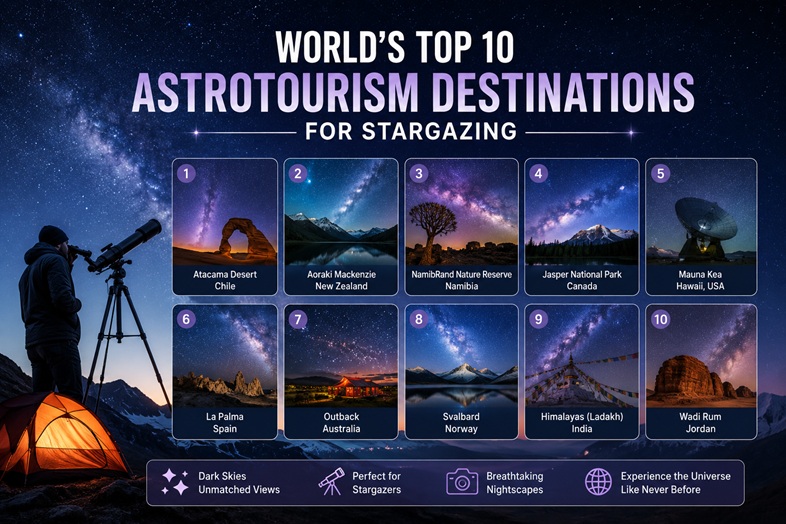
From deserts and mountains to remote islands and protected natural areas, these 10 destinations stand out for their dark-sky conditions, astronomical significance, conservation efforts and ability to offer memorable stargazing experiences.
1. Atacama Desert, Chile
The Atacama Desert is one of the world’s most famous destinations for astronomy. Its extremely dry climate, high elevation and limited artificial light create exceptional conditions for observing the night sky.
Northern Chile is also home to some of the world’s most advanced astronomical observatories. For travellers, the region offers guided night-sky tours where they can observe planets, stars and other celestial objects while surrounded by the dramatic desert landscape.
2. Aoraki Mackenzie, New Zealand
The Aoraki Mackenzie region is home to the Aoraki Mackenzie International Dark Sky Reserve, covering approximately 4,367 square kilometres.
Strict controls on artificial lighting help protect the area’s dark skies. Visitors can join guided astronomy experiences and learn about the southern night sky, while Māori astronomical knowledge adds a cultural dimension to the experience.
3. NamibRand Nature Reserve, Namibia
NamibRand Nature Reserve offers some of the darkest skies accessible to travellers. Located in the remote Namib Desert, the reserve has little artificial light and an expansive landscape that provides an extraordinary setting for stargazing.
Its commitment to conservation has also made protection of the night sky part of its tourism identity. Visitors can combine astronomy with desert landscapes and wildlife experiences.
4. La Palma, Canary Islands, Spain
La Palma has developed a strong international reputation for astronomy. The island’s high-altitude locations, observatories and efforts to control artificial lighting help create favourable conditions for observing the stars.
Visitors can explore dedicated stargazing locations and combine astronomy experiences with the island’s volcanic landscapes and coastal scenery.
5. Natural Bridges National Monument, Utah, USA
Natural Bridges National Monument became the world’s first International Dark Sky Park in 2007. Its remote location and low levels of artificial lighting make it one of the most impressive places in the United States for observing the night sky.
The National Park Service also offers astronomy programmes at the park, giving visitors opportunities to learn about celestial objects and the importance of preserving natural darkness.
6. Hanle, Ladakh, India
High in the Himalayas, Hanle has become one of India’s leading astronomy destinations. Its high altitude, dry conditions and low levels of artificial lighting create favourable conditions for observing the night sky.
The region is home to the Indian Astronomical Observatory, giving Hanle an unusual combination of scientific importance and tourism potential. Its remote Himalayan setting also makes it particularly appealing to travellers seeking a quieter experience.
7. Jasper National Park, Canada
Jasper National Park is home to one of the world’s largest Dark Sky Preserves and has become a major destination for astronomy-focused tourism.
The annual Jasper Dark Sky Festival brings together astronomy, science and outdoor experiences. Visitors can explore the night sky while surrounded by the Canadian Rockies, making the destination attractive to both first-time stargazers and astronomy enthusiasts.
8. Wadi Rum, Jordan
Wadi Rum’s vast desert landscape provides a dramatic setting for stargazing. Away from major urban centres, the desert offers wide horizons and relatively little artificial light.
Overnight desert camps and guided experiences allow visitors to combine Bedouin cultural experiences with night-sky observation. The contrast between the red desert landscape by day and the star-filled sky at night makes Wadi Rum particularly memorable.
9. Uluru and the Australian Outback, Australia
The remote landscapes around Uluru and Australia’s interior offer opportunities to experience the southern night sky away from major population centres.
Astrotourism experiences in the region can combine astronomy with Indigenous cultural knowledge, giving travellers a deeper understanding of both the landscape and the night sky.
10. Kolli Hills, Tamil Nadu, India
Kolli Hills is one of the newest additions to India’s growing astrotourism landscape. Tamil Nadu launched its first Dark Sky Park at the Ariyur Shola Reserve Forest in Kolli Hills in February 2026.
The park features three advanced telescopes and solar-powered infrastructure, with organised stargazing programmes designed to help visitors observe stars, planets, the Moon and the Milky Way. The initiative also connects astronomy with forest conservation, scientific education and eco-tourism.
The launch attracted attention on X, where discussions around the new park highlighted its clear night skies, 1.5-km light-free zone, three telescopes, stargazing sessions and new-moon camps. The development has been noted for its potential to combine astronomy with eco-tourism while encouraging the protection of natural darkness.
Kolli Hills is significant because it shows that India’s astrotourism landscape is expanding beyond established destinations such as Ladakh. It also demonstrates how protecting natural darkness can become part of a destination’s tourism strategy.
Why These Destinations Stand Out
The world’s leading astrotourism destinations share several characteristics: low light pollution, favourable atmospheric conditions, protected landscapes and opportunities for organised astronomy experiences.
Some are formally recognised dark-sky locations, while others benefit from natural remoteness and geography. Together, they demonstrate how the night sky can become a valuable tourism resource without requiring a conventional man-made attraction.
Astrotourism can also create opportunities for local communities. Stargazing tours, accommodation, astronomy guides, photography experiences and night-time activities can generate tourism revenue while encouraging visitors to appreciate and protect natural environments.
Why Dark Skies Matter
Artificial light is making naturally dark skies increasingly difficult to experience, particularly for people living in cities. This scarcity is one reason dark-sky destinations are gaining attention.
For travellers, the appeal is not only seeing more stars. A night beneath a dark sky can provide a slower, quieter experience that contrasts sharply with illuminated urban environments.
This also connects astrotourism with broader trends such as nature travel, wellness tourism, digital detoxes and experience-led holidays.
How to Plan an Astrotourism Trip
Choosing the right destination is only the beginning. Weather, cloud cover, moon phase and local light pollution can significantly influence what travellers see.
A new-moon period is generally preferable for observing faint stars and the Milky Way, while meteor showers and other celestial events require planning around specific dates.
Travellers should also check local access rules, especially when visiting protected areas. Using red-light torches, avoiding unnecessary illumination and respecting wildlife can help preserve the nighttime environment for both nature and future visitors.
The Future of Astrotourism
Astrotourism is becoming part of a wider movement towards experience-led, nature-based and slower travel. Travellers are increasingly seeking experiences that are difficult to replicate in cities, and a genuinely dark sky is becoming one of those rare experiences.
The emergence of new destinations such as Kolli Hills alongside established locations such as Atacama and Aoraki Mackenzie suggests that dark-sky tourism still has significant potential.
For destinations, the opportunity is not simply to attract visitors but to protect the natural resource drawing them there.
For travellers, meanwhile, the next great holiday attraction may not be something built on the ground at all.
It may simply be the spectacular night sky waiting above it.