


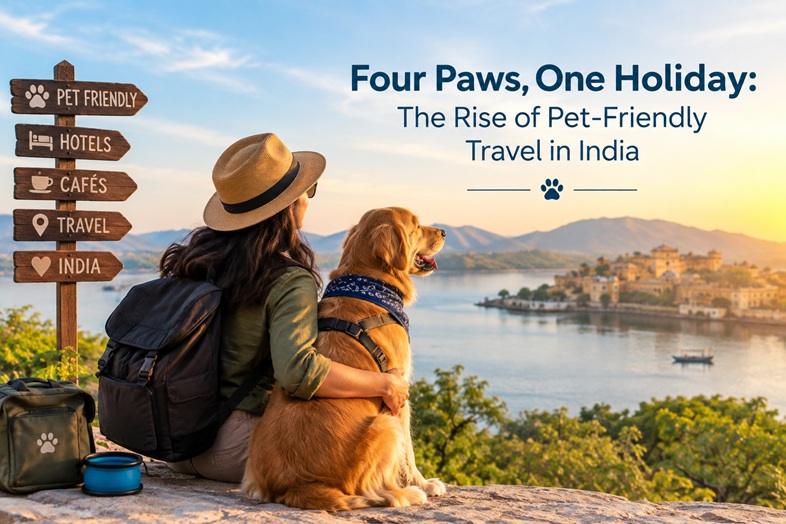
Sept 10:For many Indian travellers, a holiday is no longer complete if a family member has to stay behind. Increasingly, that family member has four legs.
Travelling with pets is moving beyond a niche preference and becoming an emerging opportunity for India’s tourism and hospitality industry. From road trips and boutique stays to resorts, cafés and outdoor experiences, businesses are beginning to adapt to travellers who want their pets to be part of the holiday.
Recent travel research highlights the scale of the shift. Booking.com’s 2026 travel research, based on 29,733 respondents across 33 countries and territories, including 1,007 respondents from India, found that 10% of Indian travellers planned to travel with pets in 2026, compared with 6% in 2025.
The trend is also reflected in the wider pet economy. Euromonitor’s 2026 research describes India’s pet-care sector as experiencing strong expansion, supported by urbanisation, rising disposable incomes and changing attitudes that increasingly position pets as family members. The report also identifies growing demand for premium and health-oriented products and services among urban pet owners.
Together, these trends suggest that India’s tourism industry is facing a new consumer segment: the pet parent who plans the holiday around the needs of the entire family.
The Rise of the Pet-First Traveller
The biggest change is not simply that more people are travelling with pets. It is that pets are increasingly influencing travel decisions.
Destination selection, accommodation, transportation and even daily activities can now depend on whether a place is suitable for animals.
Booking.com research reported in 2026 found that 93% of Indian pet-owning travellers prefer road trips, highlighting the importance of flexibility when travelling with animals. The research also found that pet owners are looking for more than accommodation, with pet-friendly restaurants, towns, nature experiences and beaches influencing their travel choices.
This is turning pet travel into a broader tourism experience rather than a simple accommodation requirement.
For travellers, the question is shifting from “Can I take my pet?” to “What can my pet and I do together?”
Why Road Trips Could Drive India’s Pet-Travel Boom
India’s growing domestic tourism market provides a natural opportunity for pet-inclusive road travel.
Driving gives travellers greater control over rest stops, feeding schedules, exercise and travel duration. It also makes short breaks to nearby hills, beaches, countryside destinations and nature retreats easier to organise.
This could particularly benefit destinations located within a few hours of major cities.
A weekend trip that might otherwise require arranging pet care at home can become a family getaway when accommodation and local experiences are designed to welcome animals.
For tourism operators, this creates an opportunity to target short-break travellers, weekend travellers and experience-seeking pet parents simultaneously.
Hotels Are Rethinking What Pet-Friendly Means
Simply allowing pets on a property may no longer be enough.
Pet parents increasingly expect practical facilities that make the stay comfortable for both themselves and their animals. Open spaces, walking areas, pet-friendly dining, clear policies and access to basic pet services can all influence accommodation decisions.
The growth of India’s wider pet economy strengthens this opportunity. Euromonitor’s 2026 analysis highlights the expansion of premium pet care and changing expectations among urban pet owners, including greater demand for specialised products, health-focused services and convenient purchasing models.
The implication for hospitality businesses is significant.
A hotel or resort that understands the lifestyle of pet parents can differentiate itself without competing solely on room rates or conventional amenities.
The Business Opportunity Beyond Accommodation
Pet-inclusive tourism can create demand across several parts of the travel ecosystem.
Hotels and resorts are only one component. Restaurants, cafés, transportation providers, travel planners, outdoor attractions, pet-care providers and local experience companies can all participate.
A destination could offer pet-friendly walking trails, outdoor dining, nature experiences, dedicated recreation areas or curated weekend itineraries.
This creates a wider pet-travel economy, where spending does not stop once the hotel room is booked.
For smaller destinations, the opportunity may be particularly attractive. They can build differentiated experiences around open spaces, nature and slower travel without having to compete directly with large urban tourism hubs.
Premium Travel Gets a New Dimension
Pet-friendly tourism also connects with the wider premiumisation of India’s travel market.
For many travellers, premium does not necessarily mean the most expensive hotel. It can mean greater privacy, convenience and flexibility.
Private villas, cottages, farm stays and boutique resorts can therefore have an advantage. More space, outdoor areas and fewer restrictions can make these properties particularly attractive to travellers accompanied by pets.
The broader pet-care market is already showing signs of premiumisation. Euromonitor identifies health-focused products, specialised pet services and premium offerings as important elements of India’s evolving pet-care landscape.
Tourism businesses can tap into the same consumer mindset by creating experiences that make travelling with pets easier and more comfortable.
Transparency Will Matter
The growth of pet travel also brings practical challenges.
Travellers need clear information about additional charges, size or breed restrictions, access to common areas, cleaning policies and whether pets can be left unattended.
Unclear rules can quickly turn a holiday into a frustrating experience.
For hospitality businesses, transparency should therefore become part of the product itself. Clearly communicating what is allowed, what facilities are available and what additional services can be arranged can build confidence before the booking is made.
Being genuinely pet-inclusive also requires trained staff and sensible policies that balance the needs of pet owners with those of other guests.
A New Market for India’s Tourism Industry
The rise of pet-friendly travel reflects a broader transformation in Indian consumer behaviour.
Travellers increasingly want holidays that fit their lifestyles rather than forcing their lifestyles to fit traditional tourism formats. Pets are becoming an important part of that equation.
As domestic travel grows and pet ownership and spending evolve, the opportunity extends beyond simply adding a “pets allowed” filter to a hotel booking platform.
The next generation of pet-friendly tourism could connect accommodation, transportation, dining, recreation and specialised pet services into a single travel experience.
For India’s tourism industry, the opportunity is therefore not just to accommodate pets but to design experiences around them.
From road trips to resorts, the pet parent could become one of the next important consumer segments shaping India’s travel economy.