


India, July 22: With mosquito-borne diseases such as dengue and malaria continuing to pose a significant public health challenge in India, Associate Professor Kiran Trivedi from the University of Wollongong India has developed a low-cost artificial intelligence -powered device that can identify disease-carrying mosquito species within seconds by analysing the sound of their wingbeats.
India continues to face a significant burden from mosquito-borne diseases, particularly during the monsoon months when cases of dengue, malaria and chikungunya typically rise across several states. As public health authorities strengthen efforts around outbreak preparedness, the need for timely mosquito surveillance and early identification of disease vectors has become increasingly important. Innovations that enable faster, more accessible and cost-effective monitoring have the potential to complement existing surveillance efforts and support more informed public health interventions.
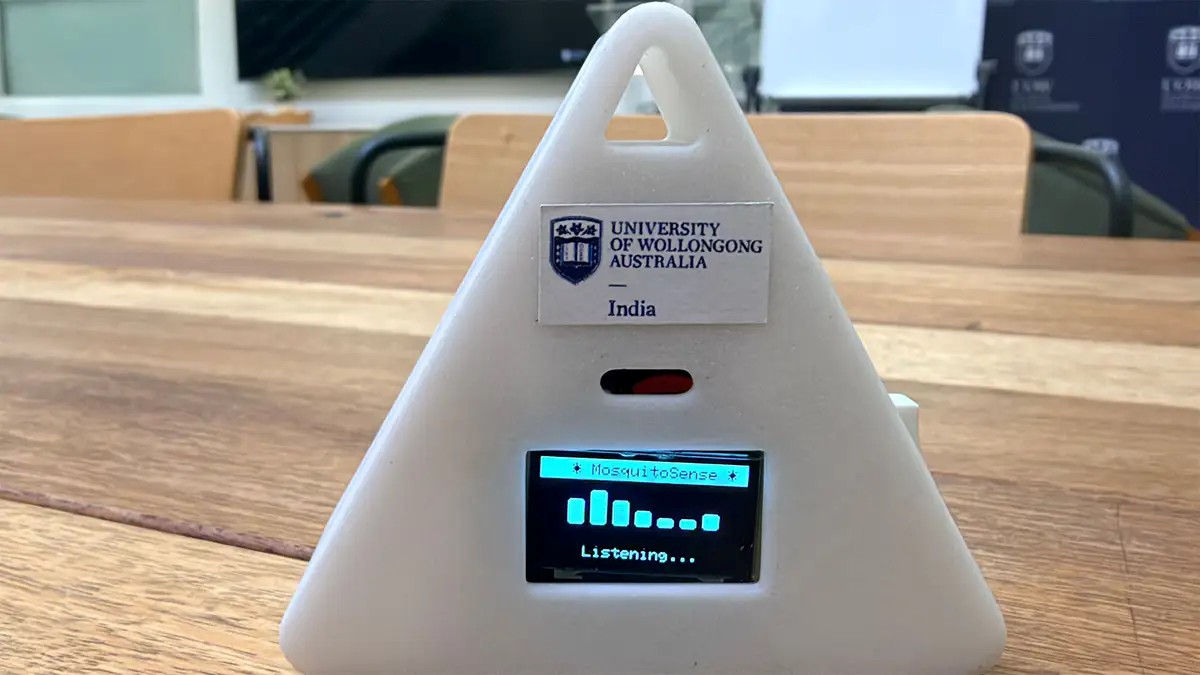
The portable AI device uses Tiny Machine Learning to accurately identify three of the world’s most significant disease-carrying mosquito species – Aedes, Anopheles and Culex – without requiring internet connectivity or cloud-based computing. By enabling rapid, on-site identification of mosquito species, the innovation has the potential to support faster and more efficient mosquito surveillance, particularly in regions where access to laboratory infrastructure may be limited.
AI-powered detector listens for disease-carrying mosquitoes
Unlike conventional surveillance methods, which require mosquito larvae to be collected and analysed in laboratories to determine species, the AI-powered device identifies mosquitoes by their distinct acoustic signatures from wingbeats. Developed in collaboration with Professor Trivedi’s former student Harsh Shroff, the embedded AI model processes sound locally on the device, enabling real-time species identification while operating on minimal power. The model was trained using publicly available mosquito sound recordings and achieved an accuracy of 88.3 per cent. Built on a compact Arduino-based platform with an integrated microphone and display, the device provides a portable and affordable alternative for mosquito monitoring in the field.
The innovation was recently showcased at the United Nations AI for Good Global Summit in Geneva, where Associate Professor Trivedi was invited to demonstrate how low-cost edge AI technologies can be leveraged to address pressing public health challenges through accessible and scalable solutions.
Commenting on the innovation, Associate Professor Kiran Trivedi, University of Wollongong India, said,
“TinyML allows us to bring artificial intelligence directly onto a small, portable device, enabling mosquito species to be identified within seconds without internet connectivity or laboratory infrastructure.
The real potential of this technology lies in its ability to scale. Networks of these devices could continuously monitor mosquito activity and provide real-time insights into emerging disease hotspots, enabling communities and public health agencies to respond proactively rather than waiting for outbreaks to occur. Our objective is to demonstrate how low-cost, accessible AI solutions can be applied to address pressing public health challenges, particularly in regions where traditional surveillance infrastructure may be limited.”
The device also has the potential to be deployed as part of wider surveillance networks, enabling continuous monitoring of mosquito populations and generating real-time data to support public health planning and outbreak preparedness. As artificial intelligence continues to find practical applications across healthcare, the innovation demonstrates how edge AI technologies can support public health and create meaningful real-world impact, highlighting the growing role of low-cost, intelligent solutions in strengthening disease surveillance and supporting more informed public health decision-making.