


Aug 25: For years, businesses have invested in software, apps and digital platforms to make work faster and more efficient. Employees have become accustomed to switching between dashboards, entering information, checking notifications and operating multiple systems throughout the day.
The next shift could be about doing less of that.
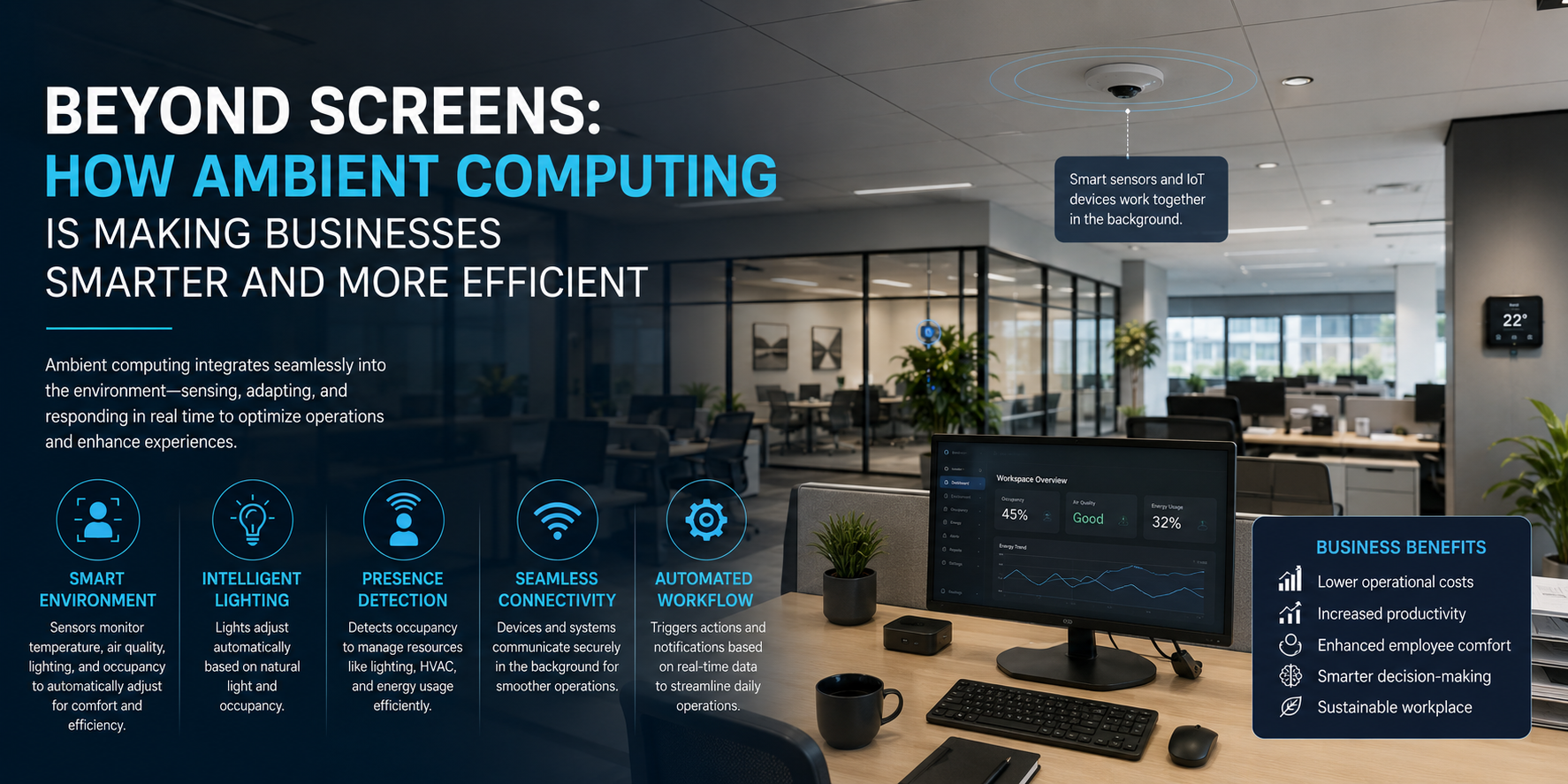
Ambient computing brings together artificial intelligence, sensors, connected devices and software to create environments that can respond to people and situations with minimal manual input. Instead of employees constantly telling technology what to do, technology can increasingly understand context and handle routine tasks in the background.
This is closely aligned with what Deloitte calls the rise of “ubiquitous AI” in its Tech Trends 2025 report. Deloitte argues that AI is becoming increasingly embedded in everyday environments and could eventually become so foundational that people simply experience its benefits without consciously interacting with it.
For businesses, that could mean a shift from technology employees actively operate to technology that quietly supports how work gets done.
A simple example can already be seen in smart offices. An employee could walk into a meeting room and have the system recognise the scheduled meeting, adjust the room settings and make relevant information available. Rather than spending several minutes connecting devices and finding documents, the employee can focus on the meeting itself.
This is where ambient computing could become particularly valuable for businesses.
What Does Ambient Computing Mean for Businesses?
In a business environment, ambient computing refers to connected technologies that can sense their surroundings, process information and trigger appropriate actions without requiring employees to constantly interact with screens.
It can bring together:
- Artificial intelligence
- Internet of Things (IoT) devices
- Sensors
- Cloud computing
- Computer vision
- Voice interfaces
- Wearables
- Location technologies
- Data analytics
The goal is straightforward: create a more responsive business environment.
Instead of employees manually managing every step, systems can increasingly handle routine actions based on context.
From Digital Workplaces to Responsive Workplaces
Most organisations have already digitised their workplaces. Employees use cloud applications, messaging platforms, HR systems, collaboration tools and enterprise software every day.
Ambient computing represents a further evolution.
The workplace itself can become part of the technology ecosystem.
Sensors can identify whether rooms are occupied. Connected systems can manage energy consumption. AI can coordinate routine processes. Digital tools can provide information when it is relevant.
Employees do not necessarily have to operate each system individually.
The shift is from:
“Use the software to complete the task.”
to:
“The environment helps complete the task.”
Deloitte’s India perspective on Tech Trends 2025 similarly points to AI becoming embedded across technologies such as IoT, robotics and spatial computing, while highlighting the potential for more personalised and context-aware business applications.
AI Provides the Intelligence
Sensors can collect information, but AI can help make sense of it.
Consider a conference room. A connected system could know that a meeting is scheduled, recognise that people have entered the room and identify which equipment needs to be activated.
It could potentially prepare the display, adjust lighting and temperature, connect the video-conferencing system and make relevant documents available.
The employee does not need to manually control every part of the room.
The technology becomes a background productivity layer.
Ambient Computing Could Reduce Workplace Friction
Employees lose time on small tasks throughout the working day.
Logging into systems, searching for documents, finding meeting rooms, adjusting equipment and entering repetitive information may each take only a few minutes.
But across hundreds or thousands of employees, those small delays can add up.
Ambient computing aims to remove some of this friction.
An employee entering a workspace, for instance, could automatically receive access to the tools and information relevant to their role, while environmental settings are managed in the background.
The objective is not simply to introduce more technology.
It is to make technology easier to work with.
Manufacturing Could Become More Responsive
Manufacturing is another area where ambient computing could have a significant impact.
Factories already use connected machines and sensors to monitor production. Adding AI can make these systems more responsive.
Equipment can continuously generate data, while AI systems analyse patterns and identify unusual behaviour.
Instead of waiting for a machine to fail, businesses can potentially detect early signs of a problem and schedule maintenance.
This could support:
- Predictive maintenance
- Equipment monitoring
- Quality control
- Worker safety
- Inventory management
- Energy optimisation
Deloitte’s 2025 research also highlights the growing convergence of AI with hardware, IoT and robotics, suggesting that AI is increasingly moving beyond software and into physical environments.
The result is a move towards more proactive operations.
Retail Can Make Physical Stores Smarter
Retailers are also looking for ways to connect physical stores with digital technology.
Sensors, connected shelves and AI systems can help businesses monitor inventory, understand store traffic and improve product availability.
For customers, the experience could become more seamless.
A shopper might receive relevant product information without having to search for it manually, while retailers can use real-time information to improve inventory and store management.
Potential applications include:
- Inventory tracking
- Personalised recommendations
- Customer assistance
- Checkout automation
- Store optimisation
- Loss prevention
The physical store becomes an active part of the digital customer journey.
Hospitality Could Become More Personalised
Hotels and hospitality businesses could use ambient computing to provide more personalised experiences.
A hotel room, for example, could automatically adjust temperature, lighting or entertainment settings based on a guest’s preferences.
Connected systems could also monitor equipment and identify maintenance requirements before they become major problems.
For employees, this could mean spending less time dealing with routine operational tasks and more time focusing on guests.
Healthcare Could Reduce Administrative Work
Healthcare organisations also have opportunities to use ambient technologies.
AI-powered systems can assist with documentation, while connected devices can monitor equipment and environments.
For healthcare professionals, reducing administrative work could be particularly valuable.
Instead of spending as much time entering information manually, employees could use ambient AI tools to assist with documentation while keeping their attention on patients.
The technology does not replace the human interaction. It works in the background to support it.
Logistics and Warehousing Could Become More Intelligent
Warehouses depend on accurate, real-time information.
Ambient computing can combine sensors, cameras, location technology and AI to monitor inventory and movement across facilities.
Workers could receive relevant information based on their location and current task rather than repeatedly checking different systems.
This could help businesses improve:
- Inventory visibility
- Order fulfilment
- Warehouse navigation
- Equipment utilisation
- Worker productivity
- Operational efficiency
The warehouse becomes more responsive because information is available when it is needed.
The Business Case Is About Efficiency
For companies, the attraction of ambient computing is not simply that it represents advanced technology.
Its real value lies in reducing friction and improving efficiency.
Well-designed ambient systems could help organisations:
- Automate repetitive activities
- Reduce manual data entry
- Improve resource utilisation
- Identify operational problems earlier
- Improve employee productivity
- Personalise customer experiences
- Reduce unnecessary technology interactions
This is particularly relevant as businesses move from experimenting with AI towards integrating it into core operations. Deloitte describes AI as increasingly foundational to enterprise technology and says organisations need to align strategy, talent, architecture and data to capture its value.
The objective should be simple: make work easier without making the technology more complicated.
Privacy Cannot Be an Afterthought
There is, however, an important challenge.
The more an environment knows about employees and customers, the more important privacy becomes.
Ambient systems can involve sensors, cameras, microphones, location information and behavioural data.
Businesses therefore need clear answers to basic questions:
- What information is being collected?
- Why is it needed?
- How long will it be retained?
- Who can access it?
- Can employees or customers control how their data is used?
The success of ambient computing will depend partly on whether people trust the environments in which it operates.
Security Becomes Even More Important
More connected devices also mean more potential points of vulnerability.
Businesses adopting ambient computing will need to secure not only laptops and smartphones but also sensors, connected equipment, workplace systems and other devices.
Deloitte’s Tech Trends 2025 places cybersecurity and trust among the foundational forces businesses need to address as emerging technologies become more deeply integrated into enterprise systems.
Strong authentication, access controls, encryption, software updates and continuous monitoring will therefore become increasingly important.
The technology may be invisible to employees, but the security protecting it cannot be overlooked.
The Future of Business Technology Could Be Invisible
Businesses have spent years making employees more digitally connected.
The next stage could involve making those digital systems less noticeable.
Instead of constantly opening applications, entering information and adjusting devices, employees could increasingly work in environments that understand context and handle routine tasks automatically.
This could transform the workplace from a collection of individual software tools into a responsive digital environment.
From Using Technology to Working With It
Ambient computing will not make screens, applications or smartphones disappear.
Instead, they could become one part of a much broader ecosystem.
The office, factory, store, hotel or warehouse itself can become increasingly intelligent.
For businesses, the opportunity is significant, but the approach matters.
Companies that use ambient computing to reduce unnecessary work, improve customer experiences and support employees could gain an advantage over those that simply add more technology to already complicated workplaces.
The future of business computing may therefore be defined by a simple paradox:
The smartest workplace technology may be the technology employees barely notice.