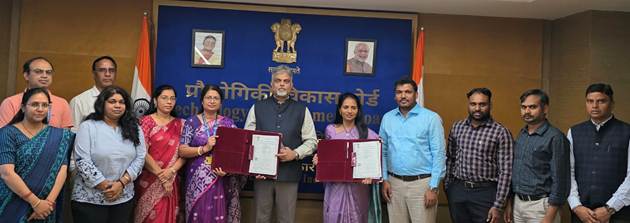

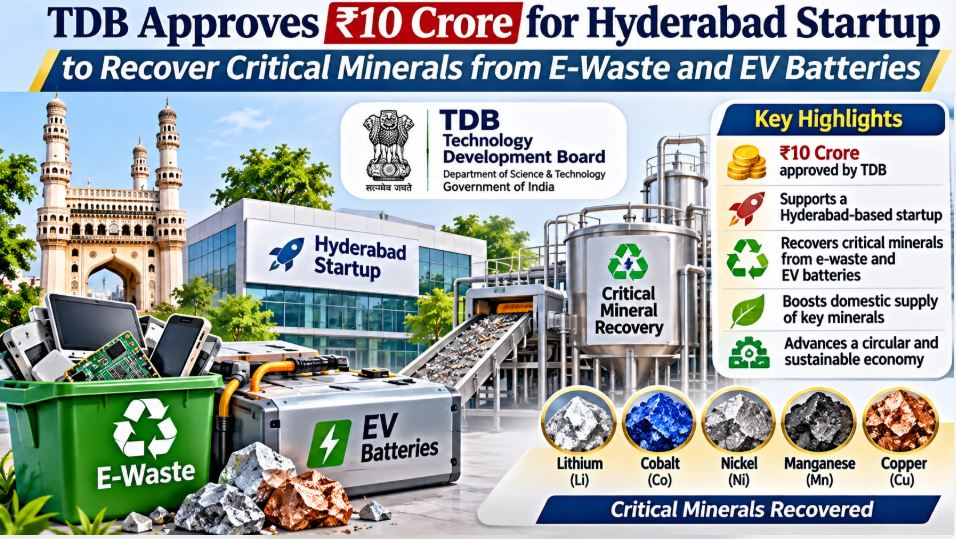
New Delhi, Nov 16: In a significant push towards strengthening India’s self-reliance in critical minerals, the Technology Development Board (TDB) under the Department of Science and Technology (DST) has extended ₹10 crore in financial support to Hyderabad-based Neo Seekermetals Pvt. Ltd. for developing indigenous technology to recover valuable metals from electronic waste and discarded lithium-ion batteries.
Representational Image
The agreement, signed under the government’s Research, Development and Innovation (RDI) Fund, aims to take the company’s patented recycling technology from Technology Readiness Level (TRL)-5 to TRL-9, bringing it closer to full-scale commercial deployment.
The initiative comes at a time when India’s demand for critical minerals is rising rapidly, driven by the expansion of electric vehicles, renewable energy, electronics and advanced manufacturing. Developing domestic capabilities to recover these strategic materials from waste could help reduce dependence on external supply chains while addressing the growing challenge of electronic and battery waste.
₹20 crore project to advance indigenous technology
The project, titled ‘Extraction of Critical Metals by Recycling of E-Waste and Lithium-Ion Battery Waste’, has a total estimated cost of ₹20 crore, of which ₹10 crore has been approved under the RDI Fund.
The financial assistance will be provided through an Optionally Convertible Debt (OCD) mechanism.
Neo Seekermetals is developing an integrated, patented recycling process capable of handling both electronic waste and end-of-life lithium-ion batteries. The technology is designed to extract valuable metals and battery-related materials from complex waste streams and channel them back into productive industrial use.
By advancing the technology towards TRL-9, the project seeks to bridge the gap between laboratory-level innovation and commercial-scale industrial application.
Boost to India’s critical minerals ecosystem
Critical minerals are essential inputs for electric vehicle batteries, renewable energy systems, electronic components and several advanced industrial applications. However, securing reliable supplies of these materials remains a major challenge for countries seeking to accelerate their clean energy and manufacturing transitions.
Recycling offers an additional domestic source of valuable materials by recovering resources from products that have reached the end of their useful life.
The proposed technology could contribute to building a stronger domestic recycling ecosystem, improving resource efficiency and supporting the principles of a circular economy. It also aligns with India’s broader efforts to develop indigenous technologies for strategic sectors and strengthen supply-chain resilience.
TDB highlights strategic importance of resource recovery
Commenting on the agreement, TDB Secretary Rajesh Kumar Pathak said India’s transition towards clean energy and advanced technologies would require secure and sustainable access to critical minerals.
He emphasised that developing indigenous capabilities to recover these resources from electronic waste and discarded batteries is an important part of the country’s long-term strategy.
According to Pathak, support through the RDI Fund is intended to help technologies with strategic relevance move beyond innovation and reach commercial application, while converting waste streams into valuable resources.
A representative of Neo Seekermetals said the financial backing would accelerate the company’s efforts to develop an efficient and sustainable recovery process and take its technology closer to commercial deployment.
Towards a circular and self-reliant economy
The partnership reflects the growing importance of technology-led recycling in India’s efforts to secure critical raw materials for future industries.
As the adoption of electric vehicles, battery storage and electronic products expands, the volume of end-of-life materials is also expected to increase. Efficient recovery and reuse of these materials could create new industrial opportunities while reducing waste and dependence on virgin mineral resources.
With the TDB-backed project targeting commercial readiness, the initiative represents another step towards establishing indigenous capabilities in critical minerals recovery and building a more resilient, resource-efficient manufacturing ecosystem in India.