


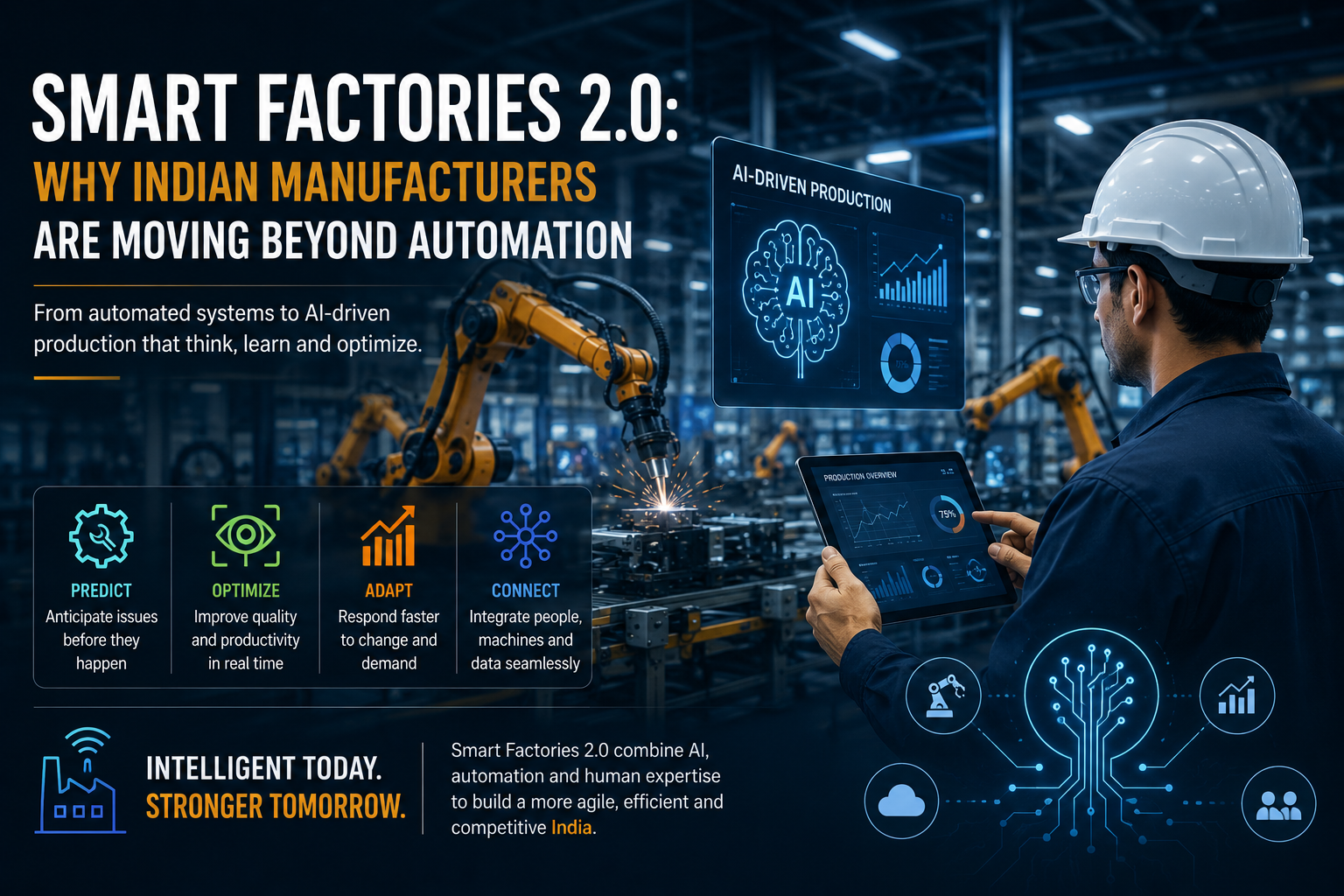
Aug 31: Walk into a modern Indian factory today and you may see robots working alongside people, cameras inspecting products, sensors monitoring machines and digital dashboards tracking production in real time.
But the next big change is not simply about adding more machines.
Indian manufacturing is moving from automation to intelligence.
For years, automation helped factories perform repetitive tasks faster and more consistently. Now, artificial intelligence is beginning to help machines and manufacturing systems understand patterns, predict problems and support decisions.
This is giving rise to what can be called Smart Factories 2.0—factories where AI, robotics, industrial IoT, connected equipment and human expertise work together.
Key Takeaway
India’s manufacturing transformation is moving from simply automating repetitive tasks to using AI to predict problems, optimise production and support faster decisions. The biggest opportunity is not replacing people with machines, but helping people make better decisions with machines and data.
India Is Building the Foundation
India’s manufacturing sector is expanding at a time when global companies are looking for more diversified supply chains.
Manufacturing contributes roughly 16–17% of India’s GDP and employs more than 27 million people. Government initiatives are also encouraging companies to increase domestic production.
Under the Production Linked Incentive schemes covering 14 sectors, cumulative investment had crossed ₹2.16 lakh crore, while production and sales exceeded ₹20.41 lakh crore by December 2025.
As factories become larger and more complex, conventional automation alone may not be enough to manage every moving part.
More machines mean more data. More suppliers mean more variables. More production lines mean more potential bottlenecks.
That is where AI enters the picture.
From Automated Machines to Intelligent Production
Traditional automation is very good at following instructions.
A machine can perform the same task thousands of times with remarkable consistency. But if something unexpected happens, a human generally has to identify the problem and decide what to do next.
AI brings another layer to the process.
A factory can collect information about temperature, vibration, pressure, energy consumption, machine performance and production quality. AI can analyse those signals and identify patterns that may not be immediately obvious.
Instead of asking only, “Is the machine working?”, manufacturers can potentially ask, “Is this machine likely to fail soon?” or “What changes could improve output?”
The distinction is important:
Automation improves execution. AI can add prediction, optimisation and decision support.
AI Is Moving From Experiment to Investment
AI is no longer restricted to technology companies or innovation laboratories. Manufacturers are increasingly treating it as part of their long-term production strategy.
Rockwell Automation’s 2025 State of Smart Manufacturing report, based on more than 1,500 manufacturers across 17 countries, found that 95% of manufacturers globally had already invested in or planned to invest in AI and machine learning over the following five years. In India, the figure was even higher, with 99% of surveyed manufacturers investing in or planning to invest in AI and machine learning.
The finding reflects a wider change in manufacturing thinking. AI is increasingly being considered alongside robotics, automation and connected equipment as part of the factory’s technology infrastructure.
But investment alone does not guarantee success.
Manufacturers still need quality data, skilled employees, secure systems and a clear business case for each AI application.
India’s Robot Revolution Is Already Underway
The move towards AI-driven manufacturing does not mean traditional automation is disappearing.
In fact, India’s industrial robotics market is expanding rapidly.
According to the International Federation of Robotics, Indian factories installed a record 9,120 industrial robots in 2024, putting India sixth globally in annual robot installations.
The automotive industry remains the biggest user, but robotics is spreading across electronics, pharmaceuticals, engineering, food processing and other sectors.
Robots, however, are only one part of the story.
A robot can perform a programmed task.
A connected robot can provide data about its performance.
An AI-enabled production system can potentially use that data to determine whether the process is working efficiently and what might need to change.
That is the real transition from automation to intelligence.
Predictive Maintenance: Fixing Problems Before They Happen
One of the most practical applications of AI in manufacturing is predictive maintenance.
Factories generate enormous amounts of information from sensors monitoring equipment. Changes in vibration, temperature, pressure or energy consumption can sometimes indicate that a machine is developing a problem.
AI can analyse these patterns and provide an early warning.
Instead of waiting for a breakdown—or replacing equipment according to a fixed timetable—manufacturers can potentially intervene when the data indicates that maintenance is actually required.
This can reduce unexpected downtime and help factories make better use of expensive equipment.
The bigger idea is simple:
Don’t wait for the machine to fail. Learn to recognise the warning signs before it does.
Quality Control Is Becoming Smarter
Quality control is another area where AI is making a difference.
Computer-vision systems can inspect products as they move through production lines, identifying scratches, incorrect components, irregular shapes and other defects.
But the real opportunity may lie beyond identifying defective products.
If AI detects that defects repeatedly occur under particular operating conditions, manufacturers can investigate the cause and modify the process.
That turns quality control from a final inspection into a continuous learning system.
For industries such as electronics, automobiles, pharmaceuticals and precision engineering, where small errors can become expensive problems, this could be particularly valuable.
Electronics Shows the Scale of the Opportunity
India’s electronics industry provides a strong example of why smarter manufacturing systems are becoming important.
Electronics production and exports have grown substantially over the past decade, while mobile-phone manufacturing has expanded into a major domestic and export industry.
But rapid growth also creates complexity.
Factories have to manage components, suppliers, production schedules, inventory, quality checks and increasingly sophisticated global supply chains.
AI can potentially help manufacturers forecast demand, optimise production schedules, monitor quality and identify bottlenecks.
As production becomes more complex, the ability to understand what is happening in real time becomes increasingly valuable.
Digital Twins Could Change Factory Planning
Another technology gaining attention is the digital twin.
In simple terms, a digital twin is a virtual representation of a physical machine, production line or facility.
Manufacturers can use it to simulate different scenarios before making changes to the real factory.
What happens if a machine is added? What happens if production is increased? What happens if a particular process is changed?
Instead of discovering the answer through costly trial and error, manufacturers can potentially test different scenarios digitally.
When combined with AI, digital twins could become even more useful by analysing historical and real-time information and helping identify possible outcomes.
The Smart Factory Is Becoming a Smart Supply Chain
A factory does not operate in isolation.
A delayed component can stop production. A sudden change in demand can create excess inventory. A transportation disruption can affect customer deliveries.
AI can potentially analyse information across suppliers, inventory, logistics and orders to identify risks earlier.
This could help manufacturers improve demand forecasting, inventory planning and supplier management.
As Indian companies become more connected to global supply chains, this wider view could become increasingly important.
The factory of the future may therefore not simply be smart inside its four walls.
It may be part of an intelligent manufacturing network.
Energy Efficiency Becomes a Data Game
Energy is another area where AI could deliver practical benefits.
Factories can use sensors to monitor electricity, fuel, cooling systems and other energy-intensive processes.
AI can analyse this information to identify unusual consumption patterns and potential areas of waste.
This allows manufacturers to treat energy efficiency as an ongoing process rather than an occasional exercise.
For companies facing rising cost pressures as well as sustainability expectations, the ability to identify small inefficiencies continuously could make a meaningful difference.
The Human Worker Is Not Disappearing
Smart factories are often discussed as though the future will be dominated by machines operating without people.
The reality is likely to be more nuanced.
Workers will increasingly interact with machines that provide more information.
A maintenance technician may receive a warning that equipment is showing unusual behaviour. A quality inspector may work alongside computer vision. An engineer may use real-time production data to understand why output is slowing.
AI can process enormous amounts of information.
People still need to interpret that information, make judgement calls and take responsibility.
The future factory is therefore more likely to be about human-machine collaboration than simple human replacement.
The Skills Question Could Become More Important Than the Technology
The arrival of intelligent manufacturing creates another challenge.
Factories need people who understand both manufacturing and digital systems.
Mechanical and electrical skills will remain essential, but workers will increasingly need exposure to data analytics, robotics, industrial software, cybersecurity and AI.
A machine can be purchased.
A workforce capable of using it effectively has to be developed.
For India, reskilling could therefore become one of the most important parts of the smart-manufacturing journey.
The Real Question: What Will AI Do for the Bottom Line?
For manufacturers, the excitement around AI ultimately comes down to business results.
Will it reduce downtime?
Will it improve product quality?
Will it reduce energy consumption?
Will it increase production efficiency?
Will it help manufacturers respond faster to changing demand?
These are more important questions than simply asking whether a factory is using AI.
The strongest AI investments are likely to be those that solve specific operational problems and produce measurable results.
A manufacturer does not necessarily need AI everywhere.
It needs AI where AI can create value.
Cybersecurity Becomes a Factory-Level Priority
Greater connectivity also creates greater risk.
When machines, industrial networks, cloud platforms and enterprise systems become connected, a cyberattack can potentially disrupt physical production.
Cybersecurity can therefore no longer be treated as an issue belonging only to the IT department.
Manufacturers will need to protect connected machinery, production data and industrial control systems.
The smarter the factory becomes, the more important it becomes to protect the systems behind that intelligence.
The Legacy-Machine Challenge
Not every Indian manufacturer can afford to replace its entire factory.
Many facilities still depend on machinery that is years or even decades old.
That does not necessarily prevent them from adopting smart manufacturing.
Sensors, connectivity systems and software can potentially be added to existing equipment, allowing manufacturers to collect useful data without replacing every machine.
This creates a more realistic path:
Automate first. Connect next. Add intelligence gradually.
For many manufacturers, especially MSMEs, that may be a more practical strategy than attempting a complete digital transformation overnight.
MSMEs Could Be the Real Test
Large corporations have greater resources to invest in sophisticated AI systems.
India’s MSMEs may have to take a different approach.
A smaller manufacturer might begin with predictive maintenance. Another might use computer vision for quality inspection. A third might use AI to improve inventory planning.
If the technology solves one costly problem, it can then be expanded.
For MSMEs, smart manufacturing does not necessarily mean transforming everything at once.
It could mean using technology to solve one expensive problem at a time.
From Automation to Autonomy
The longer-term direction could be increasingly autonomous manufacturing. Imagine a factory that continuously monitors its equipment, identifies inefficiencies, predicts potential failures and recommends adjustments with minimal human intervention.
That future is still developing, and Indian manufacturers are at very different stages of the journey.
Some are still building their automation capabilities. Others are experimenting with industrial IoT, robotics, computer vision, digital twins and AI.
The transition will not happen at the same speed everywhere.
But the direction is becoming increasingly clear.
India’s Next Manufacturing Advantage
India wants to increase manufacturing capacity, attract global supply chains, improve exports and compete more effectively in international markets.
Technology will play an important role in achieving those goals.
But smart manufacturing is not simply a race to acquire the latest machines.
It is about creating factories that can learn from their operations, recognise problems earlier, adapt to changing conditions and help people make better decisions.
Automation made factories faster.
Connectivity made them more visible.
AI could make them more predictive.
That may be the defining shift behind Smart Factories 2.0.
The factories that succeed in the coming years may not necessarily be those with the most robots or the most sophisticated software.
They may be the ones that understand how to combine machines, data and human judgement most effectively.
India’s next manufacturing advantage may therefore not simply come from building more factories. It could come from building factories that can think, learn and continuously improve.