


Chennai , June 9 : Indian Institute of Technology Madras will showcase cutting-edge innovations, deep-tech startups and strategic research initiatives at ‘Bharat Innovates 2026’, an international technology showcase being held in Nice, France, from 14-16 June 2026 by Ministry of Education, Government of India.
It is a national initiative aimed at identifying, mentoring and showcasing India’s most promising technology ventures emerging from higher education Institutions and Centrally-Funded Technical Institutes. The event will connect Indian innovators with a global audience comprising investors, policymakers, industry leaders, research institutions and technology partners.
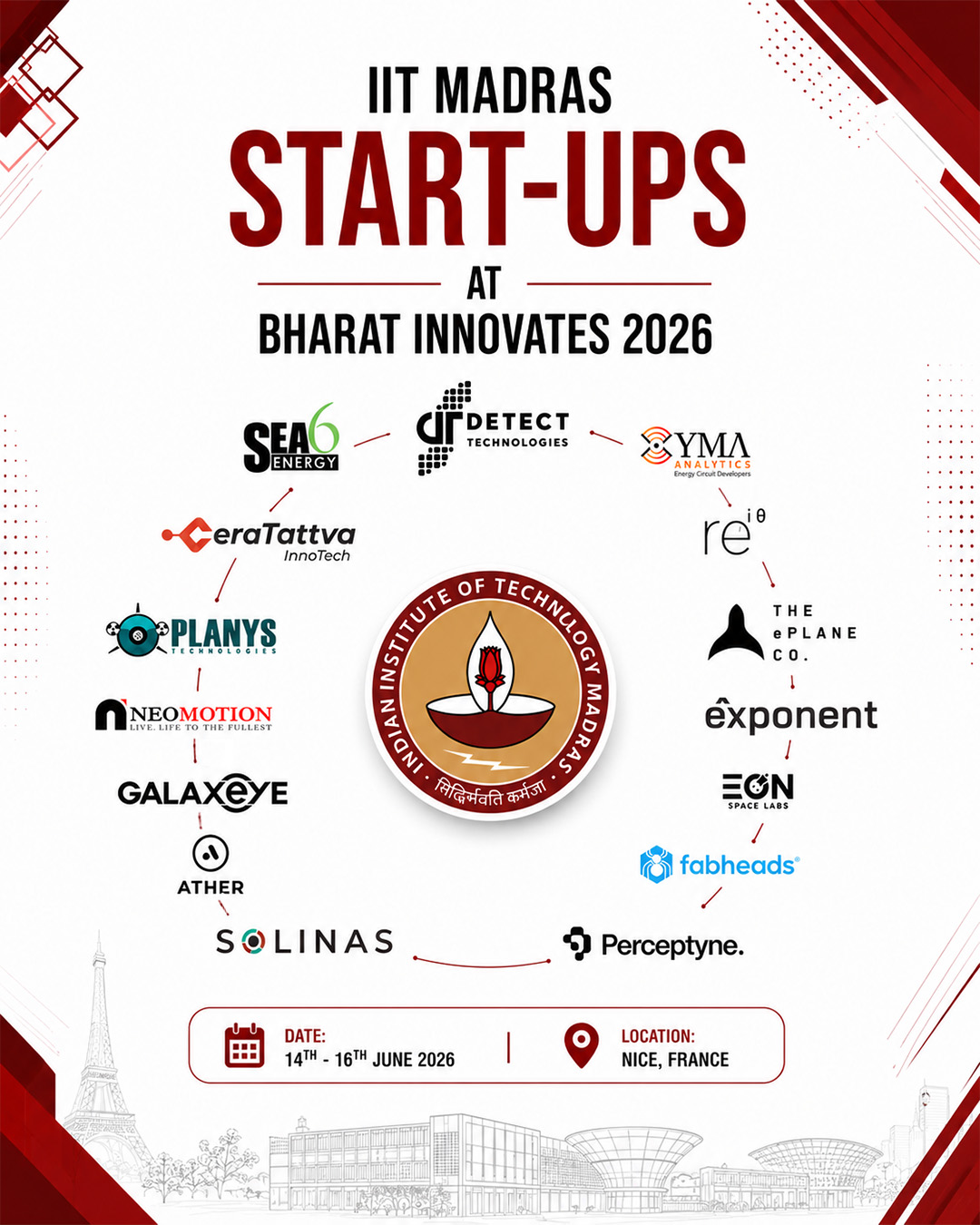
IIT Madras will drive two of the overall 13 thematic areas of Bharat Innovates. The event will showcase 15 IITM-incubated startups, among others.
The Institute’s stall will feature five research projects that highlight India’s growing capabilities in deep-tech innovation and indigenous technology development – Hyperloop Technology, marking technology-lab-grown diamonds, 5G and 6G technologies, Port Automation and domain specific low-compute indigenous AI ecosystem.
Highlighting the importance of this global exposure for IIT Madras technologies, Prof. V. Kamakoti, Director, IIT Madras, said,
“The India–France Year of Innovation 2026 and Bharat Innovates 2026 are expected to open new opportunities for collaboration between IIT Madras and French universities, research labs, startups and industries. The Institute is excited to take part in the event, which opens up opportunities for joint research in 6G technologies, shared testbeds, standards development, startup partnerships, technology transfer and talent exchange programmes.”
Speaking about the event, Prof. Manu Santhanam, Dean (Industrial Consultancy and Sponsored Research), IIT Madras, said,
“Through its participation at Bharat Innovates 2026, IIT Madras aims to demonstrate India’s growing leadership in deep-tech innovation, strategic technologies and globally relevant research-driven entrepreneurship. This platform will provide great exposure for our start-ups and create greater opportunities for university collaborations with leading French institutions.”
The two thematic areas being showcased are led by Prof. K. Murali, Faculty, Department of Ocean Engineering and Head, National Technology Centre for Ports, Waterways and Coast , IIT Madras, and Prof. Radhakrishna Ganti, Faculty, Department of Electrical Engineering, IIT Madras. These themes focus on Blue Economy and Next-Generation Communications technologies.
ADVANCED COMMUNICATIONS TECH
The transition from 5G to 6G is not merely about faster communication. It will enable ultra-low latency systems, intelligent automation, sensing technologies and distributed AI applications that will define the next phase of global digital infrastructure. India’s large domestic market, with its massive and high data consumption, provides a significant advantage as it enables large-scale validation of emerging technologies.
The Next-Generation Communications vertical will feature startups such as REIO Systems, Astrome Technologies and WiSig Networks. These startups are developing indigenous software-defined radio platforms, high-capacity wireless backhaul systems and Open RAN-based 5G solutions, demonstrating India’s ability to build globally competitive telecommunications technologies.
BLUE ECONOMY
India’s Blue Economy must evolve from a sectoral opportunity into a national innovation priority. The country’s long coastline, island territories and strategic maritime position provide enormous opportunities in shipping, logistics, offshore energy, marine biotechnology and sustainable ocean technologies. The challenge is to align economic growth with ecological sustainability.
Start-ups and deep-tech firms are playing a major role in solving complex maritime challenges through advanced robotics and AI-driven technologies.
IIT Madras-incubated startup Planys Technologies uses remotely operated vehicles, autonomous systems and AI-led diagnostics to inspect underwater infrastructure, helping improve asset life, reduce environmental risks and enhance worker safety in sectors such as offshore energy and maritime infrastructure.
Another start-up in the Blue Economy Sector that would be showcased is Zerocircle, a deep-tech startup developing seaweed-derived natural polymer materials as an alternative to synthetic plastics used in everyday packaging. The startup’s PFAs-free and microplastic-free materials are designed to work seamlessly on existing manufacturing lines, enabling easier industrial adoption without major infrastructure changes.
STRATEGIC TECHNOLOGIES
Among the major thematic areas being showcased by IIT Madras is Hyperloop Technology. IIT Madras has been designated as the Centre of Excellence for Hyperloop Technology by the Ministry of Railways, identified by NITI Aayog as the nodal ministry for Hyperloop development in India. IIT Madras-incubated startup TuTr Hyperloop has developed and demonstrated key Hyperloop technologies, including Linear Induction Motor propulsion, Electromagnetic Levitation and vacuum tube operations at the IIT Madras Discovery Campus. The institute is also advancing practical applications of Hyperloop-related technologies for metro rail systems and cargo movement at ports.
Another highlight will be the work of the Indian Centre for Lab Grown Diamonds , IIT Madras. Researchers have developed advanced laser-based technologies capable of embedding invisible QR codes, logos and customised markings inside diamond seeds and gems without affecting clarity or structural integrity.
The technology opens new possibilities for authentication, anti-counterfeiting and traceability in the diamond industry. Beyond jewellery applications, IIT Madras researchers are also developing advanced diamond-based semiconductor technologies, radiation detectors and quantum technology applications using engineered graphitic structures and defect engineering techniques.
IIT Madras will also present its extensive work in 5G and 6G technologies, where the institute along with few other institutions has built end-to-end indigenous capabilities spanning telecommunications hardware, software, standards and testbeds with support from the Department of Telecommunications and Ministry of Electronics and IT.
The Port Automation Unit at NTCPWC, IIT Madras, will also showcase its work in developing smart automation technologies for India’s maritime infrastructure. The unit is building indigenous solutions for intelligent cargo handling, predictive maintenance, IoT-enabled monitoring systems and digital twin technologies aimed at modernising Indian ports under Maritime India Vision 2030 and Amrit Kaal Vision 2047.
IIT Madras Pravartak Technologies Foundation, established under the National Mission on Interdisciplinary Cyber-Physical Systems , will also showcase its work on building a domain-specific, low-compute indigenous AI ecosystem. IITM Pravartak is developing Small Language Models designed to address India-scale challenges through low-cost, scalable and energy-efficient AI applications. The work also aligns with growing global interest, particularly in Europe, around sovereign AI ecosystems, sustainable computing and domain-specific AI solutions.