


Aug 24: For a generation that has never known life without the internet, being constantly connected is beginning to feel less like a privilege and more like a burden.
Deloitte’s 2025 Digital Media Trends found that Gen Z spends 54% more time than the average consumer on social platforms and user-generated content, while 56% say social-media content is more relevant to them than traditional entertainment such as television and movies. At the same time, Deloitte’s 2025 Gen Z and Millennial Survey found that 40% of Gen Z respondents feel stressed or anxious all or most of the time.
These figures do not prove that smartphones or social media cause mental-health problems. But they provide an important backdrop to a cultural shift now emerging among young consumers: the return to analog experiences.
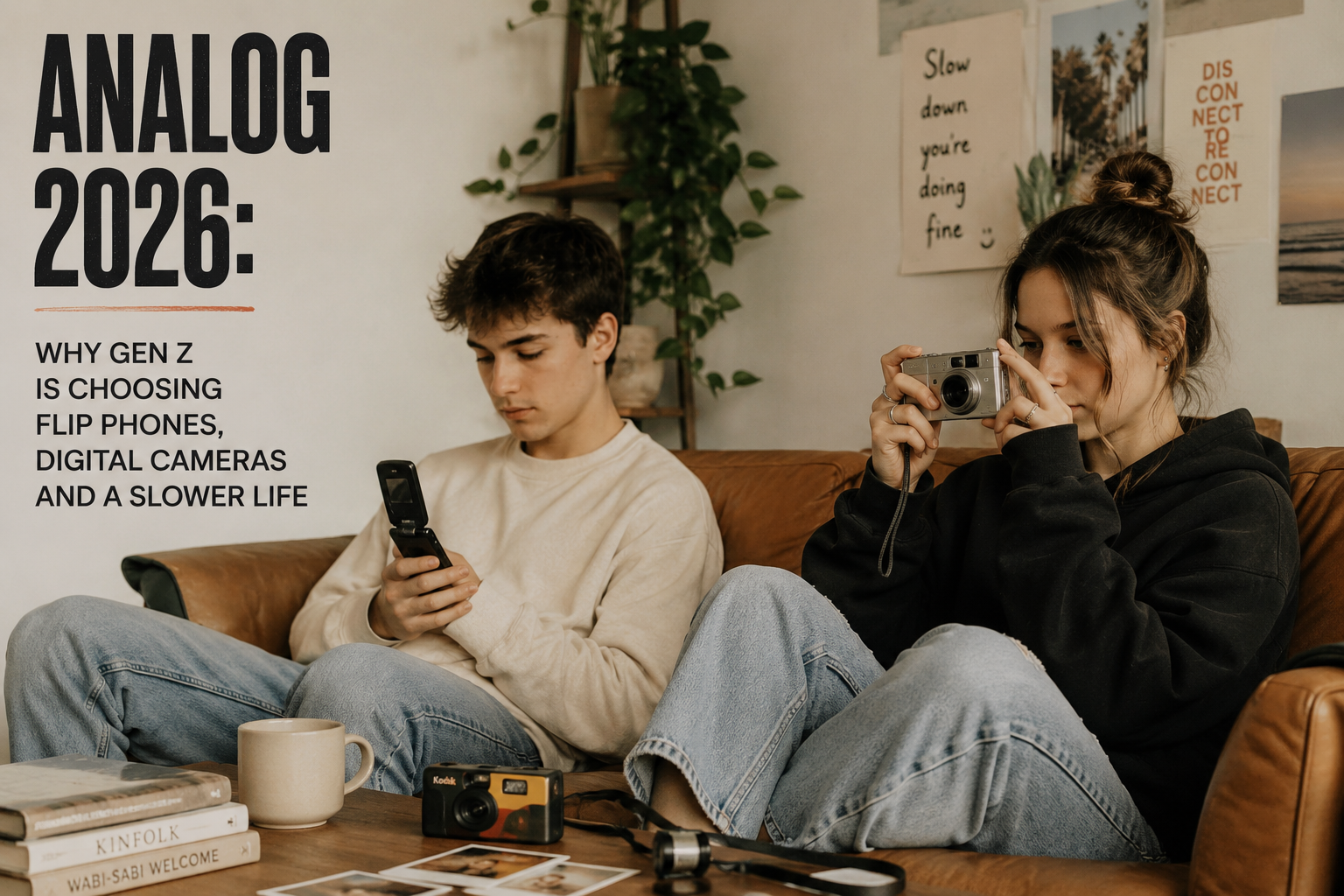
From flip phones and compact digital cameras to CDs, wired earphones, printed photographs and Y2K aesthetics, Gen Z is rediscovering products that were once considered outdated.
This is the idea behind Analog 2026—not a rejection of technology, but a desire to have more control over it.
What Is Analog 2026?
Analog 2026 is best understood as a cultural trend centred on less-connected, more intentional experiences.
It includes the renewed interest in:
- Flip phones and basic mobile phones
- Compact and disposable digital cameras
- CDs, cassettes and vinyl records
- MP3 players and older iPods
- Wired headphones
- Printed photographs
- Notebooks and handwritten journals
- Physical books and magazines
- Y2K fashion and early-2000s aesthetics
- Phone-free experiences and digital detoxes
The common thread is limitation.
A flip phone cannot endlessly scroll through a social-media feed. A CD cannot send a push notification. A notebook cannot vibrate. A disposable camera cannot immediately upload a photograph.
What these products lack is becoming part of their appeal.
Why Flip Phones Are Back
The flip phone has become one of the clearest symbols of the analog revival.
For years, phones evolved by adding more features. Today, the basic phone is gaining attention precisely because it has fewer of them.
For some Gen Z consumers, a flip phone provides communication without the constant temptation of social media, streaming and other attention-consuming applications.
Importantly, this does not mean everyone is abandoning smartphones.
A growing appeal lies in the two-device approach: using a smartphone for work, navigation, payments and essential applications, while using a basic phone during weekends, holidays or periods when the user wants to disconnect.
The flip phone is therefore becoming less of a retro novelty and more of an attention-management device.
Notification Fatigue Is Driving the Search for Simplicity
Modern smartphones have turned almost every part of daily life into a potential notification.
Messages, emails, social-media interactions, shopping offers, news updates, banking alerts and entertainment recommendations compete for attention.
The result is a lifestyle in which people can feel permanently available.
This is particularly relevant for Gen Z because social platforms are already deeply embedded in the generation’s daily routines. Deloitte’s 2025 Digital Media Trends found that Gen Z spends significantly more time with social platforms and user-generated content than the average consumer.
The response is not necessarily to abandon digital life altogether.
Instead, young consumers are beginning to ask a different question:
What if every device didn’t need to demand my attention?
That question sits at the centre of Analog 2026.
The Early-2000s Aesthetic Is Back
The trend extends far beyond mobile phones.
Y2K fashion, old digital cameras, wired headphones, CDs, chunky electronics and low-resolution photographs have all become part of a renewed fascination with the early 2000s.
For Gen Z, however, this nostalgia is unusual.
Much of the generation was too young to have experienced the early 2000s in the same way millennials did. Instead, the era has been reconstructed through family photographs, television, movies, older siblings and social media.
It is therefore borrowed nostalgia—a recreated memory of a period that many never fully experienced.
And the imperfections of that era are part of its appeal.
Why Imperfect Digital Cameras Feel More Authentic
Smartphone cameras have become extraordinarily sophisticated.
They automatically adjust exposure, improve images, remove unwanted elements and make it possible to publish a photograph seconds after taking it.
Compact digital cameras offer something completely different.
The images can be grainy. Flash can dominate the frame. Colours can look slightly strange. The composition may not be perfect.
But that imperfection can make the photograph feel personal.
The camera is not necessarily being chosen because it produces a technically superior image.
It is being chosen because it produces a different experience.
For consumers surrounded by highly edited digital content, imperfect photographs can feel more spontaneous and authentic.
The Return of CDs and Physical Music
Music is experiencing a similar shift.
Streaming has made virtually every song available instantly. Yet unlimited choice can also make listening feel passive.
Physical formats create a different relationship with music.
You choose an album. You play it. You listen to the sequence selected by the artist. You can hold the artwork and keep the physical object.
For younger consumers, this can turn music from background content into a more deliberate experience.
The CD may not be more convenient than streaming.
That is precisely the point.
In an environment built around instant access, friction can create value.
Is Analog Living About Mental Health?
The connection between Analog 2026 and mental health requires some nuance.
Using a flip phone does not automatically improve mental health, and returning to older technology should not be presented as a treatment for anxiety, stress or other mental-health conditions.
However, the desire to create healthier boundaries around digital life is becoming increasingly understandable.
Deloitte’s 2025 Gen Z and Millennial Survey, which included 23,482 respondents across 44 countries, found that 40% of Gen Z respondents feel stressed or anxious all or most of the time.
The statistic does not establish that digital technology is responsible for that stress.
Instead, it helps explain why activities that reduce digital stimulation may feel appealing to some young consumers.
Analog products provide something smartphones often struggle to provide:
a natural stopping point.
Gen Z Isn’t Going Offline
The idea that Gen Z is abandoning technology completely misses the bigger picture.
This remains a highly digital generation.
Young consumers continue to use smartphones, social media, streaming platforms, AI tools and online communities extensively.
What is changing is how technology is being used.
A person can use AI for work and write personal thoughts in a notebook.
Someone can spend time on Instagram but take holiday photographs with a digital camera.
A music fan can use streaming every day and still collect CDs.
A smartphone owner can switch to a basic phone for a weekend away.
This makes Analog 2026 less about digital rejection and more about digital choice.
Why the Trend Matters to Indian Consumers
India offers an especially interesting environment for the analog revival.
The country has one of the world’s largest young, digitally connected populations. Smartphones have become central to communication, entertainment, payments, shopping and work.
That makes the desire for occasional disconnection particularly relevant.
At the same time, India’s youth culture has embraced Y2K fashion, retro music, vintage-inspired photography and nostalgia-driven aesthetics through social platforms.
This creates opportunities for Indian brands to combine old and new.
A hospitality brand could offer digital-detox stays. A café could experiment with phone-free hours. Fashion brands can incorporate Y2K-inspired collections. Retailers can market compact cameras, physical stationery and retro accessories as lifestyle products rather than simply nostalgic objects.
The opportunity is not to convince consumers to abandon technology.
It is to give them moments when they don’t need it.
The Analog Trend Is Also a Business Opportunity
The revival is creating opportunities across multiple consumer categories.
Consumer electronics: Minimalist phones, dedicated music players and compact cameras can appeal to people seeking fewer digital distractions.
Travel: Digital-detox holidays and phone-free experiences can become part of the wellness-travel market.
Hospitality: Hotels and resorts can position limited-connectivity stays as premium experiences.
Fashion: Y2K and early-2000s aesthetics can continue influencing clothing, accessories and lifestyle products.
Retail: Physical music, stationery, cameras and printed photographs can be repositioned around experience and authenticity.
The key is understanding that consumers may not necessarily want less technology.
They may want technology that demands less from them.
The Irony of the Analog Generation
There is an obvious contradiction at the heart of Analog 2026.
Gen Z often discovers analog products through TikTok, Instagram, Pinterest and other digital platforms.
A viral video about a flip phone can make someone want to buy one.
A social-media post featuring a compact camera can revive interest in the device.
An online Y2K trend can send consumers searching for products associated with the early 2000s.
The digital world is therefore helping create demand for experiences that partially escape the digital world.
But perhaps this is not a contradiction at all.
Social media is the discovery mechanism.
Analog is the experience.
The New Luxury May Be Disconnection
For years, technology competed to make life faster.
Faster communication. Faster payments. Faster entertainment. Faster information.
Analog 2026 points in another direction.
A photograph that isn’t immediately uploaded.
An album that requires a deliberate choice.
A phone that cannot run every application.
A conversation without screens.
A weekend without constant notifications.
When digital access becomes unlimited, limited access can become valuable.
That could be the deeper reason behind Gen Z’s fascination with seemingly outdated technology.
What Analog 2026 Really Means
The return of flip phones, CDs, digital cameras and early-2000s aesthetics may initially look like another nostalgia cycle.
But underneath the trend is a broader shift in consumer behaviour.
Gen Z has grown up in a world where being connected is almost unavoidable. The next stage may be learning how to disconnect deliberately.
Analog 2026 isn’t about going backward.
It is about choosing what deserves attention.
The flip phone, CD, digital camera and notebook are simply tools. Their real appeal lies in what they remove: endless feeds, constant alerts, algorithmic recommendations and the expectation of always being available.
Gen Z may not want a world without technology. It may simply want a world in which technology knows when to leave them alone.