


Sep 22: The University of Toronto India Foundation and Villgro Innovations Foundation have signed an MoU to introduce TN-CIRCLE, an 18-month programme that will work with six waste and used-water ventures to support their transition from validated solutions and pilots towards adoption within municipal systems across Tamil Nadu.
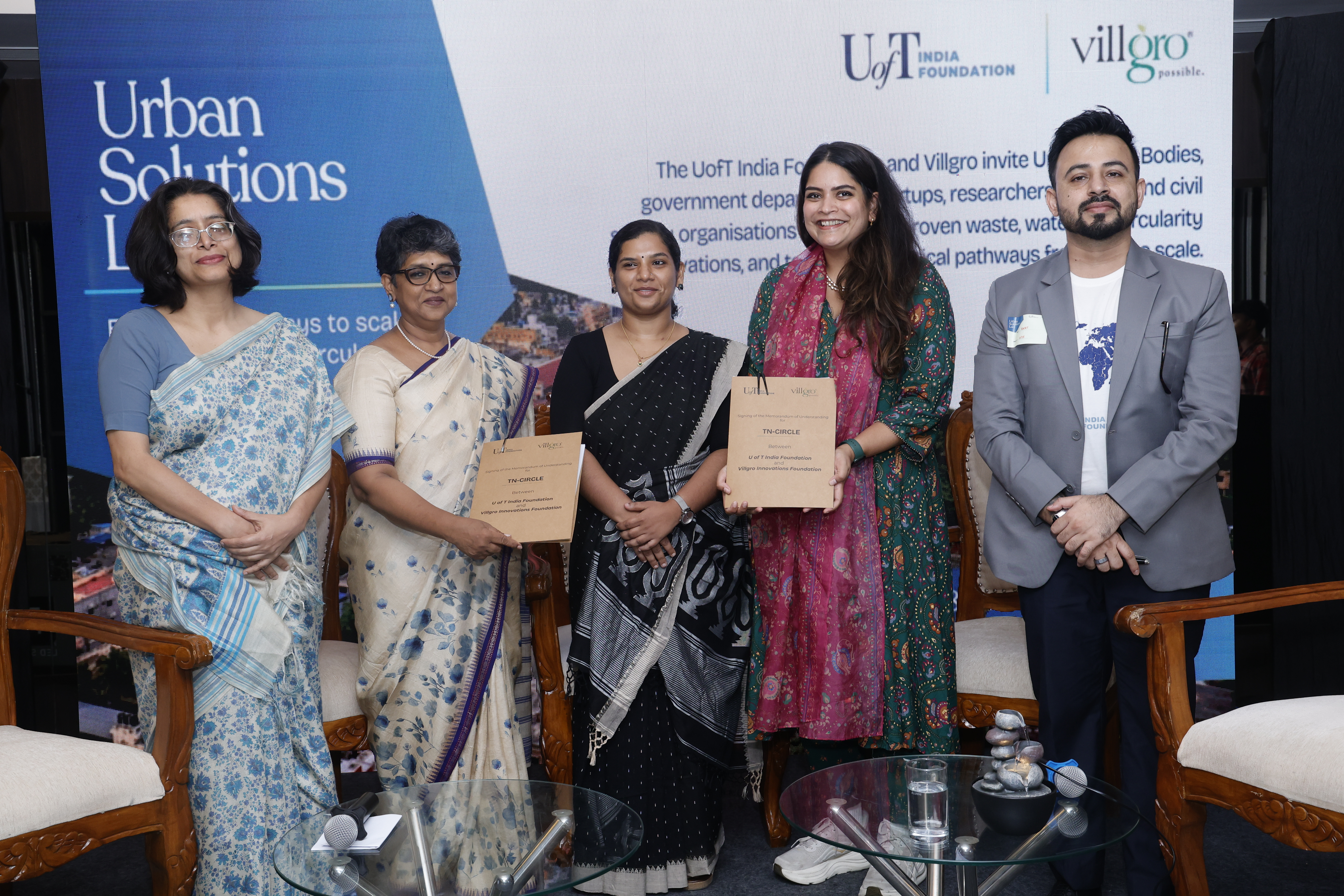
The initiative aims to help reduce or reuse around 1,000 metric tonnes of waste, save or reuse nearly 15 million litres of water, and benefit more than one lakh people.
TN-CIRCLE was introduced during an event named “Urban Solutions Lab” held at IIT Madras Research Park, Chennai, bringing together stakeholders from across the Tamil Nadu’s urban innovation ecosystem. The programme is built on the concept of creating a Collaborative Cluster for Urban Climate Solutions, bringing together cities, ventures, researchers, industry and civil society to exchange evidence, test assumptions and work transparently around municipal needs.
The programme will begin in Chennai and Trichy, with the potential to extend to other urban locations in the state. TN-CIRCLE will focus on helping solutions that have demonstrated potential move towards implementation within municipal systems, with work spanning wastewater treatment and reuse, municipal solid-waste recovery, technology-enabled waste planning and collection, reduction of water losses, and restoration of urban waterbodies and stormwater systems.
This initiative has come at a time when cities are facing increasing pressure on water resources and waste-management systems. The need for stronger urban waste and wastewater management is also highlighted inNITI Aayog’s 2026 Scenarios Towards Viksit Bharat and Net Zero– Sectoral Insights: Waste. The report highlights the need to strengthen wastewater treatment, reuse and resource recovery as India works towards more circular waste-management systems. It also points to the potential of treated wastewater reuse across sectors such as agriculture, construction and horticulture, reinforcing the need for solutions that can help cities reduce freshwater demand while improving resource efficiency.
Under TN-CIRCLE, the programme partners will first work with Urban Local Bodies to identify specific operational challenges and requirements. Relevant ventures will then be assessed against these requirements, followed by technical assessment, diligence, matching with municipal hosts and on-ground deployment. The programme will also monitor deployments and document the lessons that can inform wider adoption.
Gauravi Lobo, Director, University of Toronto India Foundation, said,
“Building companies is the easier half of this problem. The harder half is making sure there is a buyer with a budget line at the end of the pilot. That takes two to three years of staying in one place and deepening the same relationships rather than moving on. Chennai and Trichy are where we are making that commitment.”
UTIF will contribute to programme design, research, technical expertise, selection inputs, institutional relationships and knowledge exchange, while Villgro will lead programme management and on-ground coordination, drawing on its experience of working with enterprises and Urban Local Bodies. Together, the organisations will work with cities, innovators, researchers, industry, investors and civil-society organisations to identify, assess and adapt promising solutions to local requirements and municipal operating conditions.
Rini Dutta, Chief Growth Officer, Villgro Innovations Foundation said,
“The hardest journey for an innovation is often not from idea to product, but from a successful pilot to sustained adoption within municipal systems. Villgro works with urban local bodies to close this gap, helping promising solutions become technically validated, operationally ready and aligned with real city needs. SAAF Cities TN CIRCLE is designed to move validated solutions beyond pilots and embed them within municipal corporations for lasting impact.”
Through TN-CIRCLE, UTIF and Villgro aim to demonstrate how validated waste and used-water solutions can move beyond isolated pilots and become part of everyday urban systems. By working directly with municipal bodies and documenting what enables or limits adoption, the programme will generate practical insights that can help cities, innovators and ecosystem partners replicate successful solutions across Tamil Nadu and potentially other urban Municipal systems.