


Mumbai, June 5: A ceremony marking the start of construction of the first power unit of an integrated nuclear power plant (NPP) took place at the construction site in Farish District of Uzbekistan’s Jizzakh Region. The ceremony marked the pouring of the first concrete into the foundation slab of the future small modular unit within the integrated nuclear power plant project.
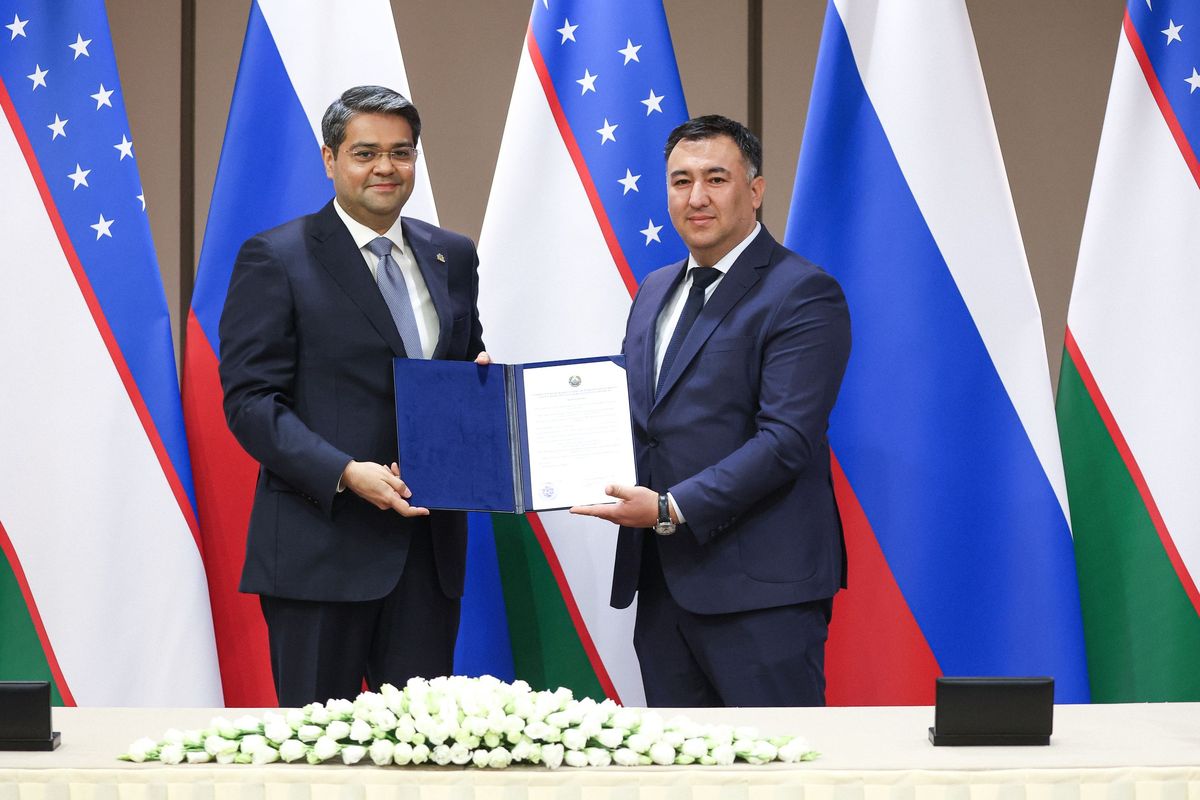
The ceremony was held via a live video link between the NPP construction site in Uzbekistan and St. Petersburg, where the President of the Russian Federation, Vladimir Putin, and the President of the Republic of Uzbekistan, Shavkat Mirziyoyev, authorized the commencement of construction of the integrated NPP’s first power unit. Rafael Grossi, Director General of the International Atomic Energy Agency (IAEA), delivered a welcome address to participants at the site. Progress on the project was reported by Andrey Petrov, First Deputy Director General for Nuclear Energy of Rosatom and President of JSC Atomstroyexport, and Azim Akhmedkhadzhaev, Director of the Atomic Energy Agency under the Cabinet of Ministers of the Republic of Uzbekistan (Uzatom).
Following the presentations, First Deputy Director General for Nuclear Energy of Rosatom and President of JSC Atomstroyexport Andrey Petrov, Director of Uzatom Azim Akhmedkhadzhaev, IAEA Director General Rafael Grossi and students of the Tashkent branch of MEPhI National Research Nuclear University, Sevinch Yarkulova and Dmitry Eskin, pressed a symbolic button to officially launch construction of the first power unit of the integrated NPP in Uzbekistan.
“Uzbekistan is embarking on a path of accelerated high-tech development, and it is a great honor for Rosatom to be part of this historic process. Together with our partners, we are only at the beginning of the project’s implementation, yet its significance is already evident. Once commissioned, the NPP will be capable of supplying up to 14% of the country’s electricity demand. This will provide a powerful boost to industrial, technological, and economic development. Moreover, the atomic city project that we have proposed to Uzbekistan will create an entirely new community. What grows around the NPP will be much more than a satellite town — it will be a genuine science city showcasing advanced nuclear and related technologies,” emphasized Andrey Petrov, First Deputy Director General for Nuclear Energy at Rosatom.
The “first concrete” pouring for the reactor building’s foundation marks the transition of the facility into a status of under construction in accordance with the IAEA standards. This milestone marks the beginning of a key stage in implementing Uzbekistan’s integrated NPP project and represents a logical continuation of the long-standing cooperation between Russia and Uzbekistan in nuclear technologies. As part of the ‘first-concrete’ stage, specialists will pour 133 cubic meters of concrete mix, while the total volume of concrete required for the project will amount to 10,000 cubic meters.
On June 4, the Committee for Industrial, Radiation and Nuclear Safety under the Cabinet of Ministers of the Republic of Uzbekistan issued a license to the State Institution “Directorate for the Construction of the Nuclear Power Plant” for the construction of an NPP power unit featuring the RITM-200N reactor.
The decision was made at a meeting of the Committee’s Kengash (Council) after the design documentation, technical solutions, and safety justification materials had undergone a full comprehensive review at the Scientific and Technical Center for Radiation and Nuclear Safety. The review was conducted in accordance with national legislation, the IAEA’s international requirements, and with the involvement of foreign experts, including leading specialists from a relevant Russian specialized center. Earlier, on March 23, a permit had already been issued for the use of the site designated for the placement of nuclear installations. The Committee will maintain continuous state oversight to ensure compliance with all license conditions and nuclear and radiation safety requirements throughout the entire construction period.