


From Berhampur’s daylight violence to Balianta’s mob lynching, a string of high-profile crimes has intensified questions around policing, deterrence and public safety in Odisha. But do the numbers support the fear—or is perception moving faster than reality?
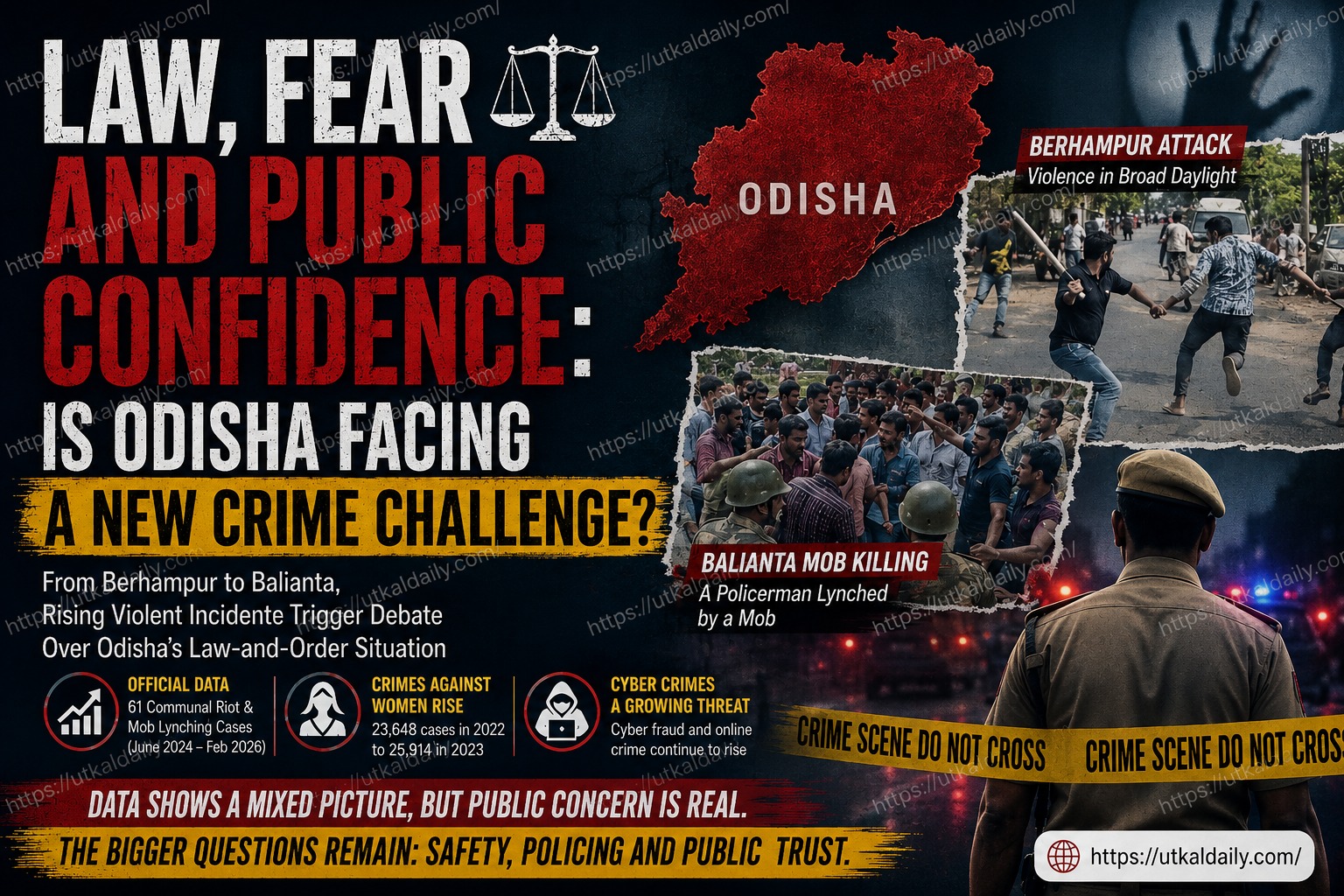
Bhubaneswar, May 29 (BNP): A daylight attack in Berhampur captured on video. A police constable lynched by a mob in Balianta. Violent incidents spreading rapidly across social media, fuelling outrage, anxiety and political debate within hours.
As Odisha witnesses a succession of disturbing and highly visible crimes, questions surrounding law and order have moved beyond isolated incidents into a broader public conversation: Is the state witnessing a deeper crime challenge, or are viral visibility and public perception amplifying fears faster than facts?
The answer, analysts say, may lie somewhere in between.
In recent months, several violent incidents across Odisha have triggered concern over public safety, police preparedness and criminal deterrence. While the state government maintains that law and order remains firmly under control, critics argue that recurring acts of violence — especially those unfolding in public spaces — are raising uncomfortable questions about policing efficiency, response systems and public confidence.
When Violence Turns Public
Among the most widely discussed recent incidents was the Berhampur attack, where a youth was allegedly chased and assaulted with sharp weapons in broad daylight. Videos of the attack circulated rapidly online, sparking outrage and renewed concerns about how such violence could occur openly in a populated area.
The incident took another dramatic turn when police later launched an operation to apprehend suspects, culminating in a reported encounter in which one accused sustained injuries after allegedly attempting to escape and hurl explosives at officers. Authorities described the action as necessary and proportionate, while the sequence of events reignited public debate over criminal audacity and preventive policing.
Equally alarming was the Balianta mob violence case, in which a Government Railway Police (GRP) constable was allegedly lynched by a crowd, sending shockwaves through the state and prompting serious questions over crowd control, intelligence gathering and police preparedness.
The aftermath triggered an intensified institutional response. The Crime Branch stepped in, multiple arrests followed, disciplinary action was initiated against certain police personnel, and Odisha Police moved toward strengthening anti-mob response capabilities, including plans for specialised tactical intervention in sensitive situations.
For many citizens, however, the issue is no longer limited to individual incidents. Reports of assaults, gang rivalries, extortion-related violence, crimes against women and repeat offenders emerging from different districts have contributed to a growing perception that violent crime is becoming increasingly visible and, in some cases, more brazen.
Crime Rising — Or Fear Becoming More Visible?
One of the central questions shaping Odisha’s law-and-order debate is whether crime itself is rising or whether public exposure to crime has changed dramatically.
Security experts argue that the digital ecosystem has fundamentally altered how people experience public safety.
A decade ago, many violent incidents remained localised, reported through newspapers or brief television segments. Today, crimes are frequently captured through CCTV footage, smartphones and social media videos, spreading instantly through messaging groups, short-video platforms and digital news portals.
A violent assault in a neighbourhood can now become a statewide conversation within minutes.
This increased visibility matters because perception often shapes public confidence as strongly as statistics.
Even when crime trends remain stable or fluctuate marginally, repeated exposure to violent visuals may reinforce a sense of insecurity. Citizens do not necessarily judge safety only through crime data; they judge it through what they see, hear and repeatedly encounter online.
In that sense, Odisha’s present debate is not simply about crime — it is also about fear, visibility and trust.
Has Fear of the Law Reduced?
Another difficult question increasingly entering public discussion concerns criminal confidence.
Public attacks in crowded places, repeated violent incidents and alleged repeat offenders have prompted debate over whether fear of immediate consequences is weakening in some pockets.
Critics argue that when individuals appear willing to commit assaults in broad daylight or in front of cameras, it reflects deeper concerns around deterrence.
This has led to uncomfortable but necessary questions: Are investigations moving fast enough? Are delayed trials, bail provisions or judicial backlogs weakening deterrence? Are local policing systems sufficiently preventive rather than reactive?
Law-enforcement officials caution against sweeping conclusions, noting that sensational crimes do not automatically indicate systemic collapse. Yet experts acknowledge that perception matters. Even a handful of brutal incidents can significantly affect how citizens view state authority and public safety.
Policing Under Pressure?
Retired police officials and security observers point to another dimension: pressure on policing systems.
Rapid urban expansion in cities such as Bhubaneswar, Cuttack and Berhampur has increased demands on law enforcement, while crime itself has evolved. Police today are expected to tackle not only violent offences but also cybercrime, financial fraud, digital misinformation, crowd violence and organised local disputes.
Challenges frequently cited include manpower shortages, intelligence limitations, increasing technological complexity and rising public expectations for instant police response.
At the same time, high-profile incidents place enormous pressure on policing agencies to demonstrate visible action.
In both Berhampur and Balianta, police moved swiftly through arrests, investigations and operational responses. Yet analysts note that effective policing is ultimately judged not only by reaction after crime but also by the ability to prevent violence before it unfolds.
That distinction — response versus prevention — increasingly lies at the centre of Odisha’s law-and-order debate.

What Do the Numbers Say?
According to National Crime Records Bureau (NCRB) records, Odisha reported 1,379 murder cases in 2022 and 1,362 in 2023, suggesting relative stability rather than a dramatic spike in homicide. However, experts argue murder data alone does not capture the full picture of public insecurity.
Crimes against women remain an area of concern. NCRB data showed such cases rising from 23,648 in 2022 to 25,914 in 2023, reinforcing calls for closer examination of district-level trends, conviction rates and police responsiveness.
Cybercrime is another growing dimension of law and order that often receives less public attention despite its rapid rise. Financial scams, digital extortion and online fraud increasingly affect ordinary households and businesses, expanding the definition of crime beyond physical violence.
Analysts stress that any serious assessment of Odisha’s law-and-order situation must compare district-wise trends, conviction timelines, repeat offender data and police staffing patterns across multiple years — particularly before and after recent political transition — rather than relying on short-term perception alone.
Politics, Policing and Public Trust
Predictably, crime has also become a political battleground.
Opposition parties have cited recent incidents to argue that public insecurity is growing and criminal confidence appears to be increasing. Viral videos of violence, they argue, are feeding anxiety and exposing weaknesses in deterrence and preventive policing.
The ruling establishment rejects suggestions of a broader breakdown.
Government representatives and police officials maintain that Odisha remains under effective administrative control, pointing to swift arrests, Crime Branch probes, police action and institutional responses as evidence that law enforcement mechanisms remain functional and responsive.
Officials argue that isolated but sensational crimes should not define the overall law-and-order narrative in a state as large and socially diverse as Odisha.
The truth, observers say, likely lies in measurable outcomes rather than rhetoric.
Public confidence depends not on competing political claims but on whether citizens feel safe walking streets, whether investigations conclude quickly, whether convictions follow and whether visible policing reassures rather than reacts.
The Larger Question
Whether Odisha is witnessing a measurable rise in violent crime or a heightened sense of insecurity amplified through viral visibility, recent incidents have undeniably deepened public concern.
The challenge before the government extends beyond arrests and official assurances.
For citizens, confidence in law and order is shaped not merely by statements but by lived experience — how safe streets feel, how quickly police respond and whether justice appears visible and credible.
Ultimately, Odisha’s challenge may not only be controlling crime, but also restoring trust: convincing citizens that institutions remain strong, deterrence still matters and the rule of law remains capable of staying one step ahead of fear.