


Pic Credit:Pexel
Every spring, India bursts into a dazzling spectacle of colour, music, and celebration. Streets fill with clouds of pink, yellow, green, and red as laughter echoes through bustling cities, quiet villages, and ancient temple towns. This is Holi — the Festival of Colours — one of India’s most vibrant and cherished cultural traditions.
Celebrated annually in March, Holi marks the arrival of spring and the departure of winter. Yet the festival is far more than a seasonal celebration. It is a centuries-old expression of renewal, joy, faith, and togetherness that continues to unite millions of people across India and beyond.
For two unforgettable days, social barriers soften, communities come together, and public spaces transform into arenas of celebration where colour becomes a language of happiness.
Ancient Roots of a Timeless Festival
Holi is among the oldest surviving festivals in the world, with origins reaching deep into ancient Indian history. References to the festival appear in early Sanskrit texts, including the Jaimini Purva Mimamsa Sutras and various Puranic writings, suggesting that Holi existed centuries before the Common Era.
Historians believe the festival originally emerged from agricultural traditions celebrating the end of winter and the arrival of a new harvest season. Over time, mythology and spiritual symbolism became woven into its rituals, allowing Holi to evolve into a festival celebrated across regions, communities, and generations.
Its enduring appeal lies in its universality. Holi belongs not to one region or social group, but to the collective cultural spirit of India itself.
The Legend of Prahlad and Holika
At the spiritual heart of Holi lies the legendary story of Prahlad and Holika — a tale symbolizing the triumph of faith and goodness over evil.
According to Hindu mythology, Prahlad was a young prince devoted to Lord Vishnu despite the opposition of his father, the powerful demon king Hiranyakashipu. Determined to destroy his son’s faith, the king enlisted the help of his sister Holika, who possessed a magical protection against fire.
Holika sat with Prahlad inside a blazing pyre, believing the flames would consume him. Instead, the protection failed, Holika perished, and Prahlad survived through his unwavering devotion.
This event is commemorated during Holika Dahan, the ceremonial bonfire lit on the evening before Holi. Across India, families gather around large fires to pray, celebrate, and symbolically burn away negativity, pride, and misfortune.
Radha and Krishna: The Spirit of Playful Love
Holi’s joyful tradition of colours is closely linked to the legends of Krishna and Radha.
According to folklore, Krishna once worried about the contrast between his dark complexion and Radha’s fair skin. His mother playfully suggested that he colour Radha’s face however he wished. Krishna did exactly that, and the playful gesture became a beloved part of Holi celebrations.
Today, the festival continues to reflect the spirit of affection, joy, and playful togetherness associated with Radha and Krishna’s divine love story.
The Day India Turns Colourful
The most iconic part of Holi takes place on the day after Holika Dahan, known as Rangwali Holi.
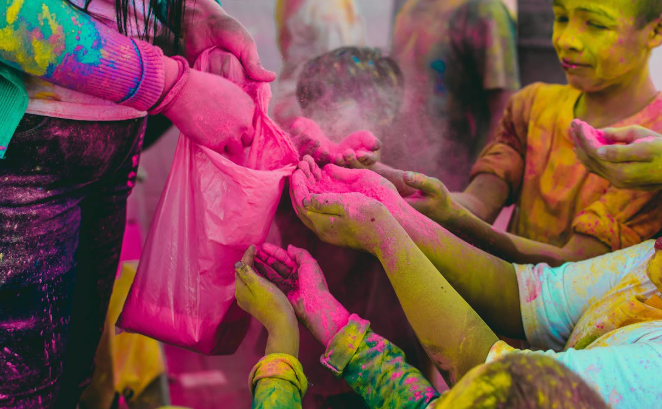
From early morning, people gather in streets, parks, and courtyards armed with coloured powders called gulal, water balloons, and water guns. Friends chase one another through clouds of colour while music, drumming, and dancing fill the atmosphere.
Children laugh as they splash water across crowded lanes, while families exchange sweets and festive greetings. Strangers often become part of the celebration, reflecting Holi’s remarkable spirit of openness and equality.
For a brief moment, distinctions of age, class, and status seem to disappear beneath layers of vibrant colour.
The Meaning Behind the Colours
The colours of Holi are not merely decorative — each shade carries symbolic significance rooted in Indian tradition.
- Red symbolizes love, strength, and fertility
- Blue represents Lord Krishna and divine energy
- Green signifies renewal, harmony, and new beginnings
- Yellow reflects happiness, knowledge, and prosperity
Together, these colours mirror the vitality of spring and the emotional energy of the festival itself.
Food, Music, and Festive Traditions
Like every great Indian celebration, Holi is deeply connected to food and hospitality. Homes prepare traditional delicacies shared with family, friends, and guests throughout the festivities.
Popular Holi dishes include:
- Gujiya — sweet pastries filled with khoya and nuts
- Malpua — syrup-soaked festive pancakes
- Dahi Bhalla — lentil dumplings served with yogurt and chutneys
- Thandai — a chilled milk-based drink flavored with saffron, almonds, and spices
Music also plays a central role. Folk songs, drumming, and energetic dancing continue throughout the day, creating an atmosphere of celebration that feels both chaotic and deeply joyful.
Holi Across India
One of Holi’s most fascinating qualities is the way different regions celebrate it in unique forms.
In Barsana and Nandgaon, the famous Lathmar Holi recreates playful legends of Radha and Krishna through mock stick battles. West Bengal celebrates Dol Jatra with devotional processions and music, while Punjab’s Hola Mohalla features martial arts displays and community gatherings.
In Rajasthan, royal palaces host grand Holi events filled with traditional performances and cultural pageantry.
These regional variations reflect India’s extraordinary diversity while preserving the festival’s universal themes of joy, renewal, and unity.
A Festival Celebrated Around the World
Today, Holi has become a global cultural phenomenon. Indian communities across Europe, North America, Australia, Africa, and Southeast Asia organize colourful celebrations that attract people from many cultures and backgrounds.
Universities, cultural festivals, and public events inspired by Holi now celebrate the festival’s message of inclusiveness, joy, and human connection.
Despite its international popularity, Holi remains deeply rooted in its ancient traditions and spiritual meaning.
The Enduring Spirit of Holi
More than just a festival, Holi is an experience — one that celebrates life in its most vibrant form.
It reminds people to forgive, reconnect, and embrace the changing seasons with hope and positivity. It celebrates the victory of light over darkness, joy over fear, and love over division.
For a few extraordinary days every year, India becomes a living canvas of colour and celebration. And in every burst of gulal drifting through the air, Holi carries a timeless message: life is brighter when shared together.