


The decline in marriage and fertility rates has emerged as a prominent demographic trend in recent decades, with women’s education being identified as a critical factor. In an insightful study, researchers investigated the causal relationship between women’s education and family formation in Japan and found that education only modestly delays family formation. These findings suggest that other institutional factors deserve greater attention in understanding the demographic trends in East Asia.
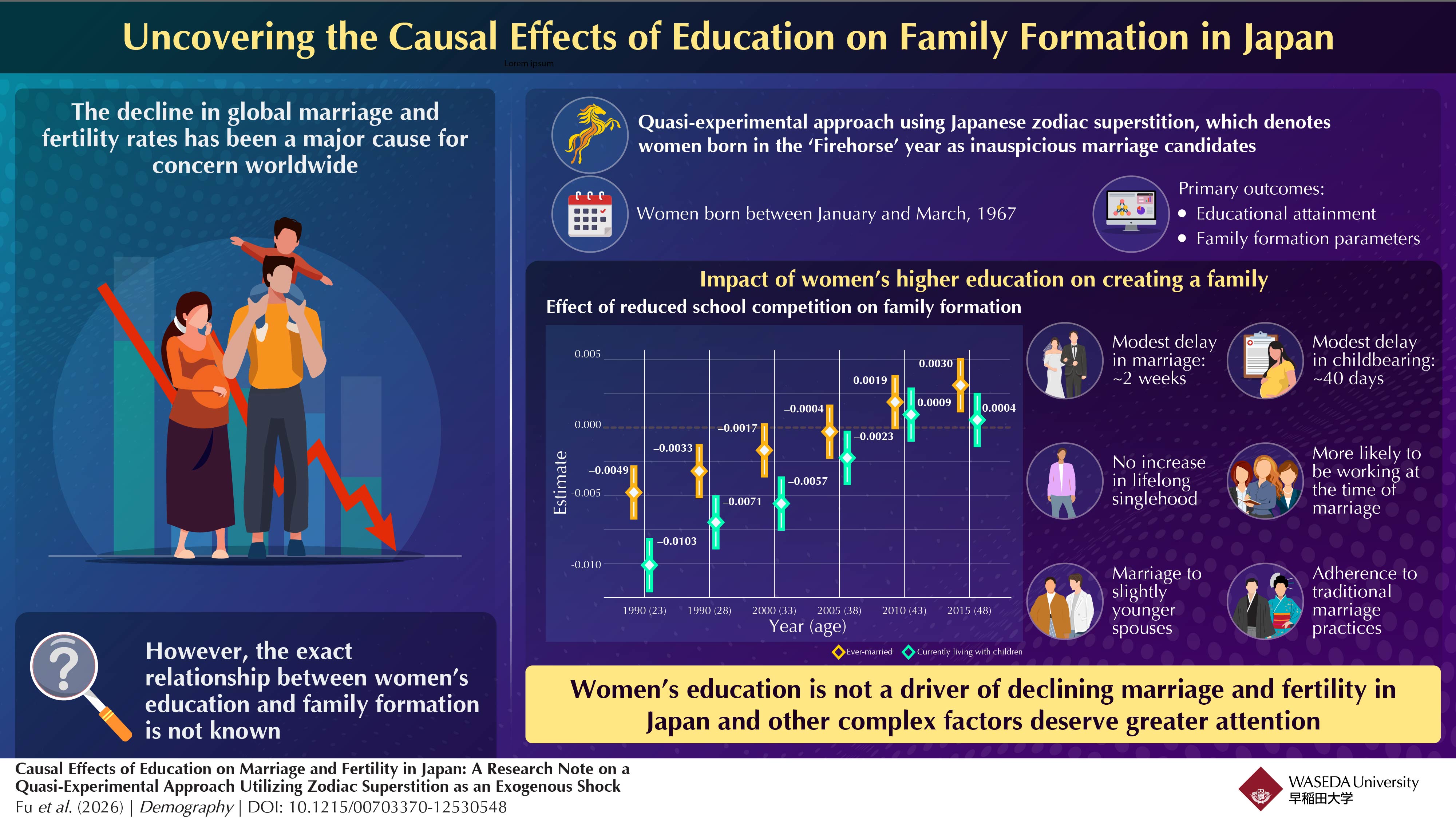
The rapidly declining marriage and fertility rates across developed East Asian societies strain pension and healthcare systems, threaten economic growth, and reshape entire societies. To tackle this issue, governments in Japan and across East Asia have invested heavily in pronatalist measures, but often with limited success. For instance, Japan’s government has repeatedly expanded childcare subsidies and parental leave provisions, yet the total fertility rate hit a record low of 1.20 in 2024. A common narrative in media commentary, policy circles, and even within families is that women are “too educated” or “too career-focused” to marry and have children. However, the exact causal relationship between women’s education level and family formation is not well understood.
To fill this knowledge gap, a team of researchers from Japan and Singapore, led by Associate Professor Rong Fu from the Faculty of Commerce, Waseda University, Japan, and Visiting Scholar at the Columbia Population Research Center, Columbia University, USA, used a novel quasi-experimental approach to understand the relationship between education, fertility, and marriage in Japan. Joining her in this collaboration were Assistant Professor Senhu Wang from the National University of Singapore, Singapore; Assistant Professor Yichen Shen from Kanagawa University of Human Services, Japan; and Professor Haruko Noguchi from Waseda University. Their findings were published online in the journal Demography on April 01, 2026.
For this study, the researchers leveraged the Japanese zodiac concept of the “Year of the Firehorse.” Women who are born during this particular zodiac year are believed to be particularly inauspicious for marriage, with the superstition suggesting that these women possess fierce temperaments that could lead to marital discord. Explaining the motivation behind their study Dr. Fu says, “As the Year of the Firehorse returns in 2026 for the first time in 60 years, our study uses the previous Firehorse year of 1966, which caused a dramatic baby bust driven by zodiac superstition, as a natural experiment to answer a question at the heart of East Asia’s demographic crisis: Is women’s education really to blame for declining marriage and fertility?”
In the Firehorse year of 1966, many prospective parents sought to avoid having children born under this supposedly inauspicious zodiac sign. This avoidance behavior resulted in a smaller cohort of women, born between January and March 1967, who faced reduced competition for educational resources in later years. Since the academic year in Japan begins in April, these individuals born in early 1967 were grouped with the previous year’s cohort for educational purposes. This mismatch was leveraged to identify a group of women born between January and March of 1967 who benefited from reduced school competition, yet were not subject to Firehorse-related discrimination.
The researchers report that women of the mismatch cohort, who gained greater access to education, delayed marriage by only about 2 weeks and first childbirth by about 40 days. These delays were temporary: by their mid-40s, more-educated women were just as likely to be married and to have children as their peers. Education shifted the timing of family planning and expansion, but it did not lead to women preventing or avoiding the same. In other words, education itself has only a minimal direct effect on whether and when women form families.
The present research suggests that such efforts may be targeting the wrong lever. If education is not the root cause of delayed family formation, then the focus should shift toward removing the structural barriers that educated women actually face: workplaces that penalize mothers, a persistent expectation that women bear the overwhelming share of childcare and housework, and a lack of flexible career re-entry paths after bearing a child or children.
Another finding in this work is that women are adapting economically but are still constrained by unchanged social structures. According to the authors, more educated women entered marriage with greater labor force participation, yet adhered to traditional marriage practices. Real-world progress in family formation likely requires institutional reforms that catch up with women’s educational and economic advancement, such as genuine enforcement of paternity leave, flexible work arrangements that do not carry career penalties, and affordable, high-quality childcare to support women and empower them in building careers as well as families.
“The timing of our publication in a new Firehorse year also offers a real-world application of a different kind. If superstitious birth avoidance recurs in 2026, it would create another natural experiment, allowing researchers and policymakers to examine whether the same dynamics play out under today’s very different gender norms and economic conditions,” concludes Dr. Fu.
