


New Delhi, Aug 6: India’s fintech ecosystem needs to go beyond digital payments to create employment, spur innovation and promote Viksit Bharat @2047 at a time when the country is set to witness Viksit Bharat @2047. This was stated by Shri Anup Sanjay Dhotre, Member of Parliament & Member, Parliamentary Standing Committee on Communications & Information Technology whilst addressing the opening session of the 3rd India International FinTech Festival 2026.
Calling upon the need for collective effort on the part of industry, startups, and policymakers, Shri Dhotre observed that India’s digital narrative has created a “wonderland” of opportunities.
“We need to move towards Viksit Bharat @2047 through technology-led job creation and financial empowerment with enhanced security against cyber frauds and financial scams. The focus areas must include promoting fintech innovations in sectors like agriculture and building scalable infrastructure and solutions through an industry-fintech-policy convergence,” he said, adding, “India has entered the league of nations offering world-class digital financial services.”
The 3rd India International FinTech Festival 2026 commenced at Hotel Ashoka, New Delhi, today with Shri Anup Sanjay Dhotre, Hon’ble MP, Lok Sabha, member, Parliamentary Standing Committee on Communications & Information Technology inaugurating the event.
Welcoming policymakers, regulators, financial institutions, fintech innovators, and technology leaders, Mr. Amitabh Chaudhry, Senior Vice President, ASSOCHAM and MD & CEO, Axis Bank observed that India has emerged as a global fintech innovation hub with one of the world’s most comprehensive Digital Public Infrastructure ecosystems.
“UPI processes over 22 billion transactions every month with more than 558 million Jan Dhan accounts and 1.4 billion Aadhaar registrations fueling India’s digital revolution.” Initiatives like Jan Dhan, Aadhaar, UPI, Digi Locker, FASTag, Account Aggregator, ONDC, and Digital Rupee have enabled financial and digital transactions of unprecedented scale and convenience,” he said.
“India is home to one of the largest and most vibrant fintech ecosystems globally, and the future of financial services will be shaped by the convergence of banks, fintechs, and technology partners. Artificial Intelligence, Digital Public Infrastructure, embedded finance, cybersecurity, and responsible innovation will drive the next wave of transformation. India’s journey toward Viksit Bharat @2047 will be powered by the collaborative strength of fintechs, banks, and technology firms,” he added.
Speaking on the occasion, Mr. Gautam Aggarwal, Division President for South Asia and Country Corporate Officer, India, Mastercard said;
“India’s fintech narrative is witnessing a paradigm shift as the focus transitions from ‘access to value. We have been able to demonstrate inclusion, innovation, and scale. The next big challenge is to create a profitable ecosystem. It is not merely about how many people are digitally empowered but how many people can participate in the digital economy in a sustainable manner. The entire industry needs to think strategically beyond incrementalism and leverage emerging technologies such as Artificial Intelligence for exponential growth and build end-to-end trusted solutions where security, transparency, and customer protection are embedded in every process,” he said.
“There is a huge opportunity to extend India’s Digital Public Infrastructure narrative to Tier-II, Tier-III and rural India through trustworthy AI-led financial services,” he added.
Speaking as the representative of India’s fintech industry, Mr. Madhur Deora, President & Group CFO, Paytm said
“India’s fintech journey has become the talk of the town as the country joins the league of nations in terms of digital financial services. We process almost 24 billion transactions worth around ₹300 lakh crore every month,” he said, adding, “Our focus areas are on sustainability, scalability, and trust.”
“The first-order question for fintech companies must be, am I providing transformative value to my customers? If we are able to deliver convenience, transparency, financial inclusion, and security, it will lead to sustainable business models,” he said.
Further, speaking about innovation and trust, Mr. Deora said companies should think beyond incrementalism and leverage the power of Artificial Intelligence to create smart ecosystems and products and embed trust as the critical fifth pillar.
“Compliance is the minimum standard; we need to build products and processes by design with enhanced security and transparency to build customer confidence and add long-term value. Security, transparency, and customer protection need to be frontburner priorities,” he observed.
Speaking on the panel on AI and Trust, Mr. Hemant Jhajhria, Head of Consulting, KPMG in India shared his views on AI and Trust and said India has entered the age of AI and the next wave of value creation will come from ‘decision intelligence’
“The next wave of innovation and value creation will come from the ‘intelligence layer’ that drives decision-making, autonomous processes, and extremely contextual financial services. The key takeaway from this research is that India has the ability to replicate its successful DPI story in the world of AI,” he said.
“As India builds its capabilities in AI talent, models, and language models and its data infrastructure matures, there is every reason to believe that India can lead the world in leveraging AI for financial services and create significant value. However, it is important to note that AI is not just about deploying an algorithm; it is about embedding it across enterprise functions to unlock transformative value,” he added.
Commenting on the transformative power of AI, Mr. Kunal Guha, Managing Director, Commerce, Shopping & Payments, Asia Pacific, Google said;
“Artificial Intelligence is the ultimate equalizer. It is enabling even small-time kiranas to optimize their inventory, pricing, and customer engagement to compete on a digital level with larger players. The true game-changer will be realized when someone in a small town wakes up one day and has an idea and the tools to bring that idea to life through the financial and digital infrastructure and intelligence provided by AI,” he said.
India’s fintech future must be driven by open protocol, digital interoperability, biometric authentication and trust-driven AI, he said, adding, “Collaboration between government, regulators, and industry has been the backbone of India’s digital finance journey and will be critical for the next phase of innovation.”
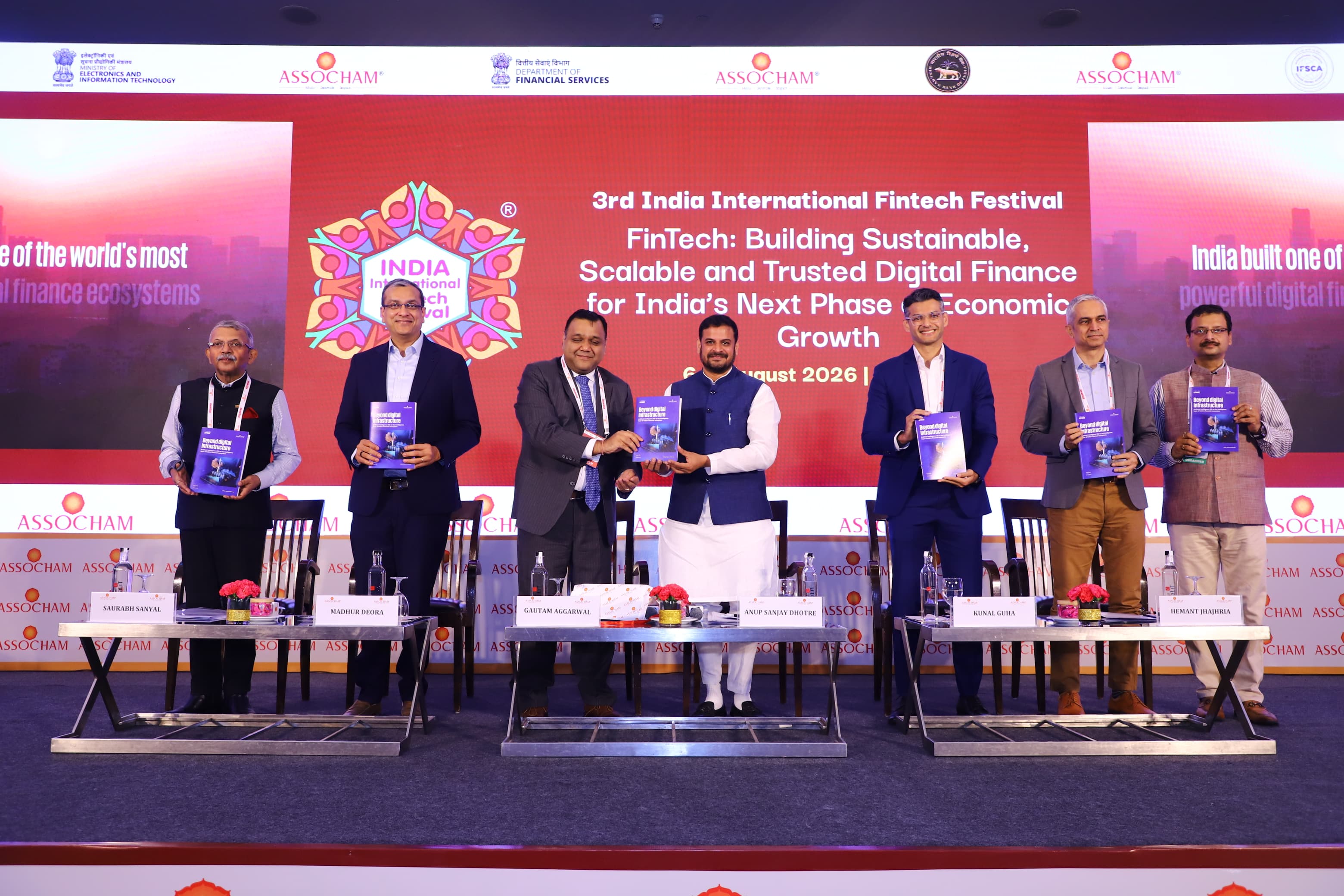
The opening session of the 3rd India International FinTech Festival 2026 saw the release of the ASSOCHAM-KPMG Knowledge Report on India’s fintech landscape, emerging technologies, AI adoption, and regulatory outlook.
Day one of the India International FinTech Festival witnessed deep-dive discussions on Digital Lending 2.0, cybersecurity and fraud management solutions, merchant enablement, cross-border payments, Artificial Intelligence, Digital Public Infrastructure, and sustainable finance, with policymakers, regulators, banks, fintech companies, and technology firms coming together to strategize the path forward for India’s digital financial services ecosystem.