


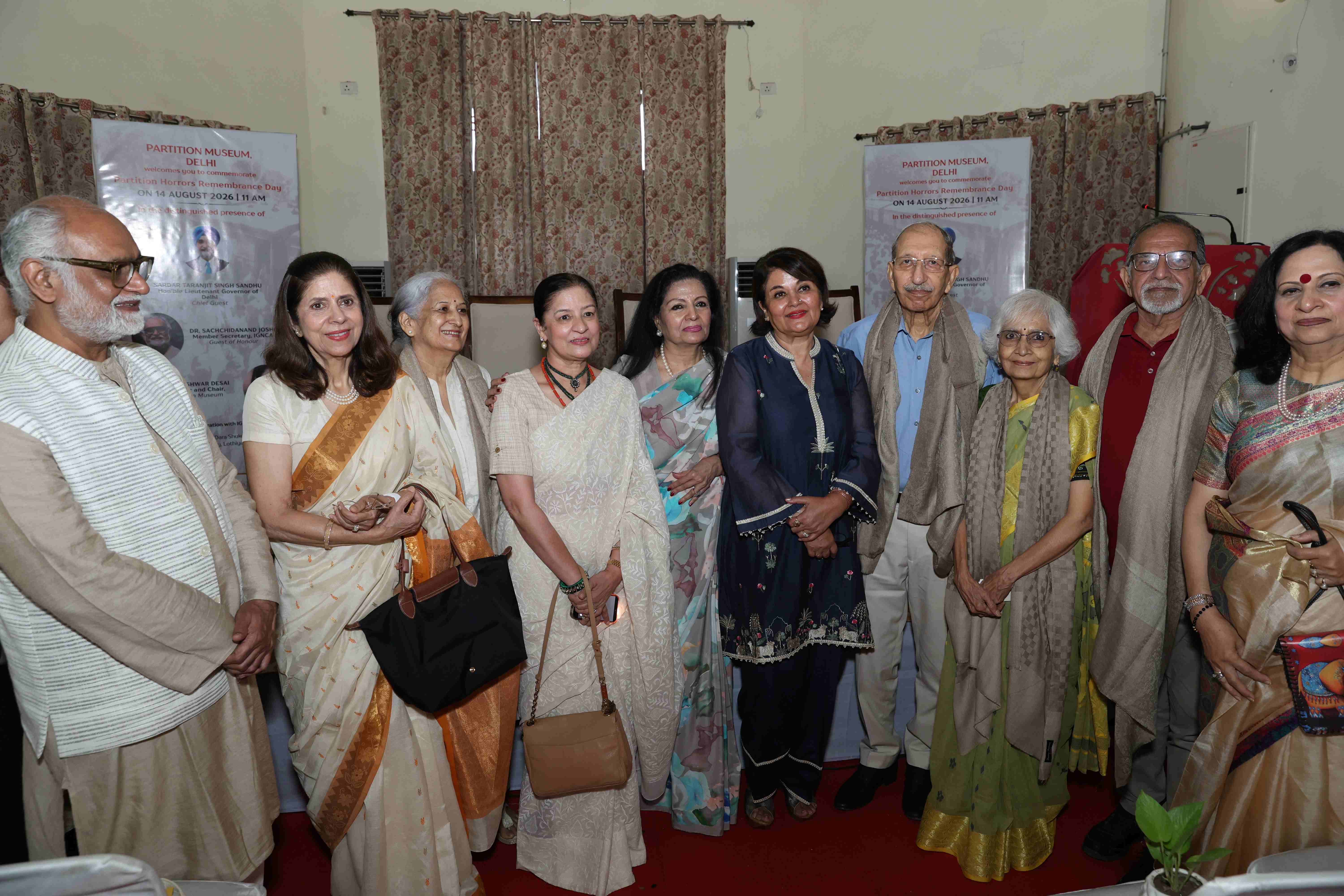
Aug 15: The Partition Museum, Delhi, in collaboration with the Indira Gandhi National Centre for the Arts (IGNCA), commemorated the 79th year of India’s Partition on Friday, August 14th, 2026, at 11 A.M. at the Partition Museum and Cultural Hub, Dara Shukoh Library Building, inside Dr. B.R. Ambedkar University Campus, Lothian Road, Delhi.
The memorial ceremony was held in the distinguished presence of Dr. Sachchidanand Joshi, Member Secretary, IGNCA, as the Guest of Honour, Lady Kishwar Desai, Founder and Chair, Partition Museum, Ms Lakshmi Puri (Former Assistant Secretary General, United Nations), Shri K. Mahesh (MD, DKVIB and Secretary ACL Department under the Government of NCT of Delhi).
Though unable to be present in person, Hon’ble Lieutenant Governor of Delhi, Sardar Taranjit Singh Sandhu, shared his thoughts as, “Partition was not merely the drawing of a border; it was the uprooting of millions from their homes, communities and memories. Delhi bears the imprint of that history in neighbourhoods such as Lajpat Nagar, Punjabi Bagh, Model Town and Khan Market, shaped by the rehabilitation of displaced families who arrived with little, yet rebuilt their lives and contributed to the making of a new nation.
It is this lived history that Hon’ble Prime Minister Shri Narendra Modi sought to preserve by designating 14 August as Partition Horrors Remembrance Day—a day to remember the pain, honour the resilience of survivors and reaffirm our commitment to unity and harmony.
For me, this resilience has a deeply personal resonance. My grandfather, Sardar Teja Singh Samundri, dedicated his life to courage, non-violence and service, and chose principle over personal liberty, attaining martyrdom in Lahore Central Jail in 1926. His life reminds us that true resilience lies not merely in enduring adversity, but in standing by one’s values and serving a larger cause.
As we remember Partition, let us preserve these stories as legacies of courage, rebuilding and nation-building.”
Dr. Sachchidanand Joshi, Member Secretary, IGNCA and Guest of Honour, shared his views as, “The preservation of memory is an essential part of preserving culture. It is also essential to remember the agony of the Partition to keep our Country united and strong. The stories of Partition live not only in history books, but in oral histories, family photographs, documents and personal belongings passed down through generations. It is also to tell the world about this tragedy, which is one of the biggest human displacements of all time.
IGNCA values its association with the Partition Museum in bringing these lived histories into a larger cultural conversation, so that they may continue to be documented, studied and understood by generations to come.”
The programme brought together Partition survivors and families of eyewitnesses to remember the millions uprooted in 1947, evoking applause and teary eyes. The occasion also marked Partition Horrors Remembrance Day, designated by Prime Minister Narendra Modi, and was followed by a museum tour offering a glimpse into the personal histories, objects, photographs and documents that keep Partition’s memories alive.
Lady Kishwar Desai, Founder and Chair, Partition Museum, whose vision has been central to creating the Partition Museums, emoted, “The Partition Museum was created to ensure that the voices of ordinary people are not lost to the passage of time. The objects they carried, the photographs they preserved, the documents they saved and, most importantly, the stories they shared, tell us what Partition meant at a deeply personal level. On Partition Horrors Remembrance Day, we remember not statistics or borders, but people, their homes, their losses, their journeys and their extraordinary resilience. This commemoration is also an invitation to younger generations to listen to those memories and understand why they must never be forgotten.“
Lady Kishwar Desai furthered announced that as a special initiative for the 80th year of India’s Independence and Partition, The Partition Museum will undertake a project along with city governments and several young artists to create and place sculptures across the cities of New Delhi, Amritsar and Mumbai to honor the resilience and perseverance of the refugees who began a new life post partition. These sculptures would be of men, women and children, placed at key locations like Lajpat Nagar, Friend’s Colony, Khan Market and Kingsway Camp in New Delhi to mark the pain of those uprooted overnight. In Amritsar and Wagah Border as well there will be sights from the Partition of 1947. This project attempts at bringing the glimpse of personal tragedies of victims of partition out of the closed doors of museums and brings people together from all walks of life to identify with their profound pain.
The Partition Museum in Amritsar, established to mark the 70th anniversary of India’s Partition, was the first museum in the world to collect and publicly display oral histories, documents, photographs and objects carried across the border by refugees of 1947. It was established by The Arts and Cultural Heritage Trust (TAACHT) under the chairmanship of Lady Kishwar Desai, with Mallika Ahluwalia as its first curator. The museum has received more than seven national and international awards.
The Partition Museum, Delhi, is the second Partition Museum in the world. Both museums were conceived as people’s museums, centred on the lived experiences of those affected by Partition, and are run entirely through donations.
Their collections and exhibitions encompass the Punjab and Bengal Partitions, as well as the Lost Homeland of Sindh, bringing together personal narratives and material histories from communities whose lives were transformed in 1947. The museums also feature art installations and artworks by well-known artists who have themselves been impacted by Partition.
Today, the museums welcome national and international visitors, school and college students from India and abroad, and have been written about by international historians and featured in films and documentaries.
The August 14 ceremony at the Delhi museum will bring these strands together—memory, history, culture and lived experience—in an effort to ensure that the human stories behind Partition remain alive for generations that did not witness it.