


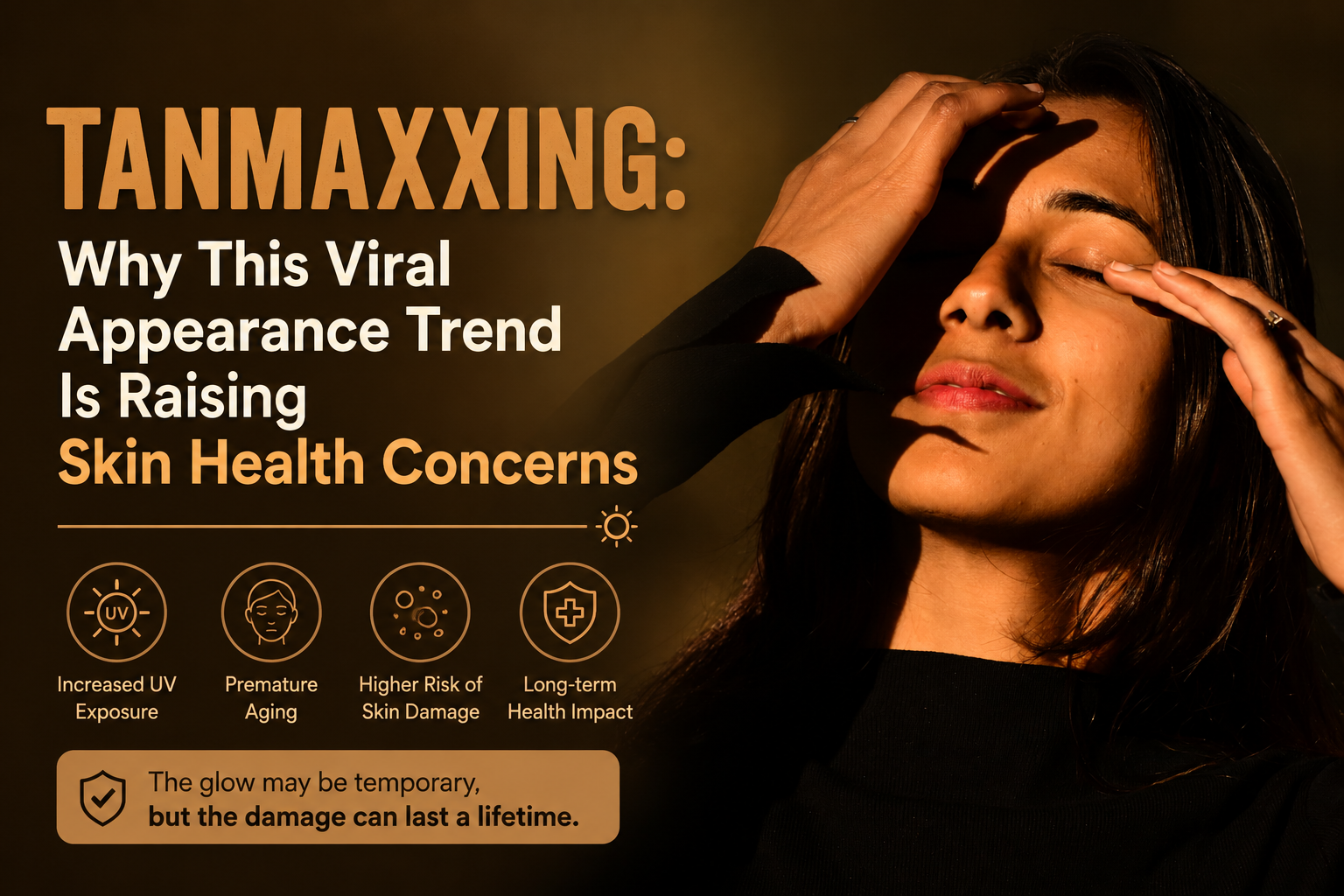
Aug 22: Social media has a new appearance trend in the spotlight, and this time the focus is on getting as tan as possible. Tanmaxxing is gaining attention as users share tanning routines and ways to achieve a darker, more noticeable complexion.
The trend is part of the wider “maxxing” culture, in which people attempt to optimize different aspects of their appearance or lifestyle. But tanmaxxing has attracted particular concern because some versions of the trend encourage prolonged or intense exposure to ultraviolet (UV) radiation.
Recent coverage has described users deliberately seeking periods of strong sunlight, sometimes tracking the UV index or reducing sun protection in an attempt to deepen their tan. Dermatologists have warned that this approach can expose the skin to unnecessary UV damage.
What Is Tanmaxxing?
Tanmaxxing is an informal internet term for deliberately trying to maximize or deepen a tan.
It follows the same naming pattern as other online “maxxing” trends. The broader idea is to identify a particular aspect of appearance and continually try to improve or optimize it.
With tanmaxxing, the desired result is generally a darker, deeper or more noticeable tan. Social media makes the trend particularly easy to promote because tanning transformations can be displayed through photographs, videos and before-and-after posts.
Why Is Tanmaxxing Going Viral?
The appeal of tanmaxxing is partly visual. A change in skin tone is immediately noticeable on camera, making it suitable for short-form videos and transformation content.
Tanned skin has also been associated with holidays, beaches, outdoor lifestyles and leisure in some cultures. Social media influencers can reinforce these associations by presenting a bronzed complexion as part of a desirable lifestyle.
The wider popularity of appearance-focused “maxxing” trends has created an environment where even individual beauty preferences can become named online movements.
However, tanmaxxing is different from many harmless grooming trends because achieving a darker tan through UV exposure involves a known health risk.
Tanmaxxing Sparks Social Media Debate
The trend has generated discussion across social media, including X, where users and commentators have questioned whether the pursuit of a darker tan is worth the potential health consequences.
The debate reflects a larger concern surrounding appearance trends online: when a particular look becomes fashionable, users may feel pressure to reproduce it without fully considering how the look is achieved.
Recent coverage has also highlighted the connection between tanmaxxing and the broader “maxxing” culture, in which social media can amplify niche appearance habits and turn them into mainstream trends.
For tanmaxxing, that amplification can be particularly concerning when posts encourage people to spend more time under intense sunlight or treat sunburn as part of the desired aesthetic.
What Does Science Say About Tanning?
A tan is the skin’s response to exposure to UV radiation. The World Health Organization (WHO) identifies UV radiation as a primary cause of skin cancer.
WHO reports that more than 1.5 million cases of skin cancer were diagnosed globally in 2020, along with more than 120,000 associated deaths. The organization recommends sun protection when the UV Index reaches 3 or above.
That makes the idea of deliberately increasing UV exposure to achieve a darker tan particularly concerning.
A tan may be viewed as a cosmetic result, but the biological process involves the skin responding to UV exposure.
What the WHO Report Says About Tanning
The WHO report “Artificial tanning devices: public health interventions to manage sunbeds” provides particularly strong evidence about the risks of deliberate artificial tanning.
According to WHO, artificial tanning exposes people to UV radiation for cosmetic purposes and is associated with increased skin-cancer risk. The report also notes that the International Agency for Research on Cancer (IARC) classified UV-emitting tanning devices as carcinogenic to humans.
WHO’s guidance further states that UV radiation from artificial tanning can contribute to DNA damage and that skin-cancer risk increases with exposure.
While tanmaxxing generally refers to tanning as an appearance goal rather than specifically using sunbeds, the same concern applies when the trend encourages unnecessary UV exposure.
Why Chasing a Darker Tan Can Be Risky
The concern is not simply that people like the appearance of tanned skin. The problem begins when achieving that appearance encourages excessive UV exposure.
UV radiation can contribute to premature skin ageing as well as skin cancer. WHO also warns that excessive exposure can damage the eyes and affect the immune system.
Some recent reporting on tanmaxxing has also raised concerns about people deliberately seeking peak UV periods or using tanning oils in an attempt to accelerate the process.
The result can be a beauty routine that prioritizes a short-term appearance over long-term skin health.
Tanning Beds Are Not a Safer Shortcut
Some people may turn to tanning beds or other artificial tanning devices to achieve a darker complexion more quickly.
Health authorities, however, do not consider artificial tanning a safe cosmetic shortcut.
WHO says sunbeds pose a skin-cancer risk and recommends avoiding artificial tanning devices. Its report notes that artificial tanning has been associated with hundreds of thousands of non-melanoma skin cancer cases and more than 10,000 melanoma cases annually across the United States, Europe and Australia combined.
IARC’s classification of UV-emitting tanning devices as carcinogenic to humans further underlines the concern.
Can You Get a Tanned Look Without UV Exposure?
People who like a bronzed appearance do not necessarily have to expose their skin to UV radiation.
Sunless tanning products, including self-tanning lotions, creams and spray tans, can create a darker appearance without deliberately increasing UV exposure.
However, a cosmetic tan should not be mistaken for sun protection. People spending time outdoors should still take appropriate precautions.
WHO recommends seeking shade, wearing protective clothing and using sunscreen on exposed skin. It also advises avoiding artificial tanning devices.
Tanmaxxing and the Bigger Beauty Trend
Tanmaxxing highlights how quickly social media can transform an ordinary beauty preference into a viral appearance goal.
The wider “maxxing” culture encourages people to think about their appearance as something that can always be optimized. That can sometimes encourage healthy habits, but it can also create pressure to pursue increasingly extreme results.
The problem becomes more serious when the desired appearance requires behaviour that carries established health risks.
In the case of tanmaxxing, the conversation is therefore not just about whether bronzed skin is fashionable. It is also about how social media can influence beauty standards and encourage people to take risks to achieve them.
The Bottom Line
Tanmaxxing may be the latest viral appearance trend, but the health warnings surrounding excessive UV exposure should not be ignored.
The WHO and IARC have established the risks associated with UV radiation and artificial tanning. WHO specifically recommends avoiding artificial tanning devices, while sun protection is advised when UV levels are high.
For people who want a bronzed appearance, sunless tanning products can offer an alternative without deliberately increasing UV exposure.
Ultimately, tanmaxxing is another example of how quickly social media can turn a beauty preference into an optimization challenge. Trends may change quickly, but protecting long-term skin health remains more important than achieving a temporary online aesthetic.