


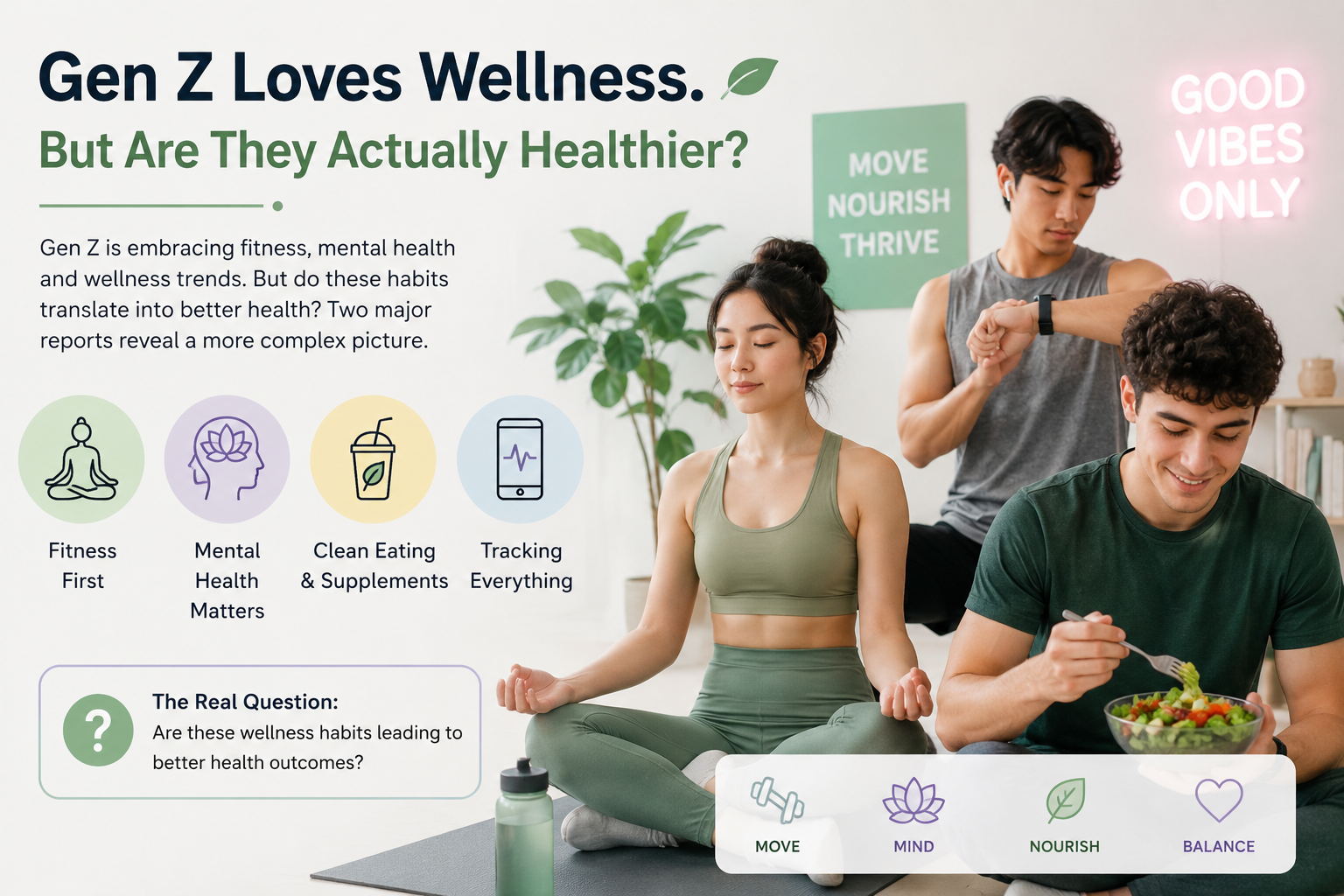
Aug 08: Gen Z has made wellness part of everyday culture. From Pilates and running clubs to meditation, fitness trackers, healthier food choices and open conversations about mental health, young people are arguably more comfortable talking about well-being than previous generations.
But there is a gap between being interested in wellness and actually being healthy.
Recent data suggests that Gen Z is highly conscious of mental and physical health, yet many young people continue to experience significant stress and face challenges around physical activity.
Gen Z Wellness: Key Numbers
The latest reports provide some striking figures:
- 52% of Gen Z respondents in Deloitte’s 2025 survey rated their mental well-being as good or very good.
- 40% said they feel stressed or anxious all or most of the time.
- Deloitte surveyed 14,751 Gen Z respondents and 8,731 millennials across 44 countries.
- In India, 33% of Gen Z respondents said they feel stressed or anxious all or most of the time.
- 36% of Indian Gen Z respondents said their job contributes significantly to their anxiety or stress.
- 55% of Gen Z respondents in India said they struggle to stretch their income until the next payday.
- WHO estimates that 31% of adults globally, around 1.8 billion people, did not meet recommended physical-activity levels in 2022.
- WHO also estimates that 81% of adolescents aged 11–17 do not get enough physical activity.
These numbers show why the Gen Z wellness conversation needs to go beyond fitness trends and social-media aesthetics.
Mental Health Is at the Centre of Gen Z Wellness
One of the biggest changes Gen Z has brought to wellness is the normalization of mental-health conversations.
Therapy, mindfulness, burnout, anxiety, journaling and emotional well-being are increasingly discussed openly. Mental health is no longer treated simply as a private issue.
But awareness has not removed the underlying pressures.
According to Deloitte’s 2025 survey, only 52% of Gen Z respondents rated their mental well-being as good or very good, while 40% reported feeling stressed or anxious all or most of the time. Deloitte also found that longer-term financial concerns were a significant contributor to stress for many Gen Z respondents.
This creates an important distinction: Gen Z may be better at talking about mental health without necessarily experiencing better mental health.
That is not a failure of the wellness movement. Rather, it shows that awareness is only the first step.
India’s Gen Z Wellness Story Has Its Own Challenges
The Indian data adds another layer to the discussion.
Deloitte’s India findings show that one in three Gen Z respondents in India experiences stress or anxiety all or most of the time. Work is also a significant factor, with 36% saying their job contributes significantly to their stress or anxiety.
Financial pressure is another concern. Deloitte reported that 55% of Indian Gen Z respondents struggle to stretch their income until the next payday.
This matters because wellness does not happen in isolation.
Financial uncertainty can affect sleep, eating habits, exercise, relationships and mental health. A person may follow wellness content online and still struggle to maintain healthy routines because of work pressure or economic stress.
Gen Z Fitness Trends Do Not Automatically Mean More Exercise
Fitness has become highly visible among Gen Z.
Running groups, strength training, yoga, Pilates, walking challenges and wearable devices have turned exercise into a lifestyle and social activity.
Yet the popularity of fitness content does not necessarily mean people are moving enough.
The WHO’s physical-activity data offers an important reality check. Its 2024 analysis found that 31% of adults worldwide—approximately 1.8 billion people—were insufficiently active in 2022. WHO also says that inactivity among adults increased by around five percentage points between 2010 and 2022.
For adolescents, the situation is even more concerning, with 81% not meeting recommended activity levels.
The takeaway is simple: following fitness culture is not the same as getting enough physical activity.
Social Media Is Both a Wellness Tool and a Pressure Point
Social media has played a major role in making Gen Z wellness trends mainstream.
A workout, recipe or mindfulness technique can reach millions of people within hours. Online communities can encourage healthier habits and make conversations about mental health less intimidating.
But social media can also create unrealistic expectations.
Perfect morning routines, highly edited bodies, restrictive diets and constant self-optimization can make wellness appear like a full-time job.
The pressure to eat perfectly, exercise every day, sleep optimally and always be productive can ironically become another source of stress.
For Gen Z, therefore, the challenge may be learning to use wellness content without allowing it to define what a “perfect” healthy life should look like.
Gen Z Wellness Is Moving Towards Holistic Health
Another important shift is the changing definition of wellness.
For many young people, being healthy is no longer simply about weight or appearance. Gen Z wellness increasingly includes:
- Physical fitness
- Mental health
- Sleep
- Nutrition
- Stress management
- Social relationships
- Work-life balance
- Preventive healthcare
- Digital well-being
This broader approach is encouraging because physical and mental health are closely connected.
WHO notes that regular physical activity provides significant physical and mental-health benefits and recommends adults undertake at least 150 minutes of moderate-intensity activity a week, or an equivalent amount of vigorous activity.
The Wellness Industry Can Make Health Look Complicated
The growing interest in wellness has also created a huge consumer market.
Fitness subscriptions, smartwatches, supplements, functional foods, boutique fitness studios and wellness retreats can all be useful for some people.
But buying wellness products is not the same as improving health.
A fitness tracker cannot replace exercise. A supplement cannot compensate for a poor diet. A meditation app cannot resolve every source of chronic stress.
Some of the most effective health habits remain remarkably simple: move regularly, eat a balanced diet, sleep adequately, manage stress and seek appropriate professional support when necessary.
Are Gen Z Actually Healthier?
The evidence does not support a simple yes or no.
Gen Z is clearly more wellness-aware. But that does not necessarily mean the generation is healthier across every measure.
The Deloitte survey shows a generation that is highly conscious of mental well-being while continuing to experience significant stress. The WHO data, meanwhile, shows that physical inactivity remains a major global challenge, including among adolescents.
The two reports therefore point to a gap between wellness awareness and wellness outcomes.
Gen Z may know more about health than ever before. The bigger challenge is turning that knowledge into sustainable behaviour.
From Wellness Trends to Sustainable Health
The next phase of Gen Z wellness may be less about chasing the newest trend and more about making healthy habits realistic.
Instead of asking which supplement, workout or wellness challenge is currently popular, young people could focus on more fundamental questions:
- Am I physically active on a regular basis?
- Am I getting enough sleep?
- Is my diet balanced?
- Am I managing stress in a healthy way?
- Do I have meaningful social connections?
- Am I getting health information from credible sources?
- Do I seek professional help when I need it?
This approach takes the pressure out of wellness and puts the focus back on health.
The Bottom Line
Gen Z has changed the wellness conversation. Mental health is more openly discussed, fitness has become increasingly social and young consumers are paying greater attention to their overall well-being.
But the latest data shows that awareness alone is not enough.
Deloitte’s 2025 survey highlights persistent stress, financial concerns and mental-health challenges among Gen Z. WHO data shows that physical inactivity remains widespread globally.
The opportunity now is to move beyond wellness as a trend and towards wellness as a sustainable way of living.
Gen Z may already love wellness. The real question is whether that enthusiasm can translate into healthier, more balanced lives.