


Chennai, Aug 27: The Faculty of Management, SRM Institute of Science and Technology, organised an international conference on “Human Capital Management: Creating Flourishing, High-Performing and Psychologically Healthy Organisations” in collaboration with the International Institute of Organisational Psychological Medicine, Melbourne, Australia and Melbourne, Florida, USA.
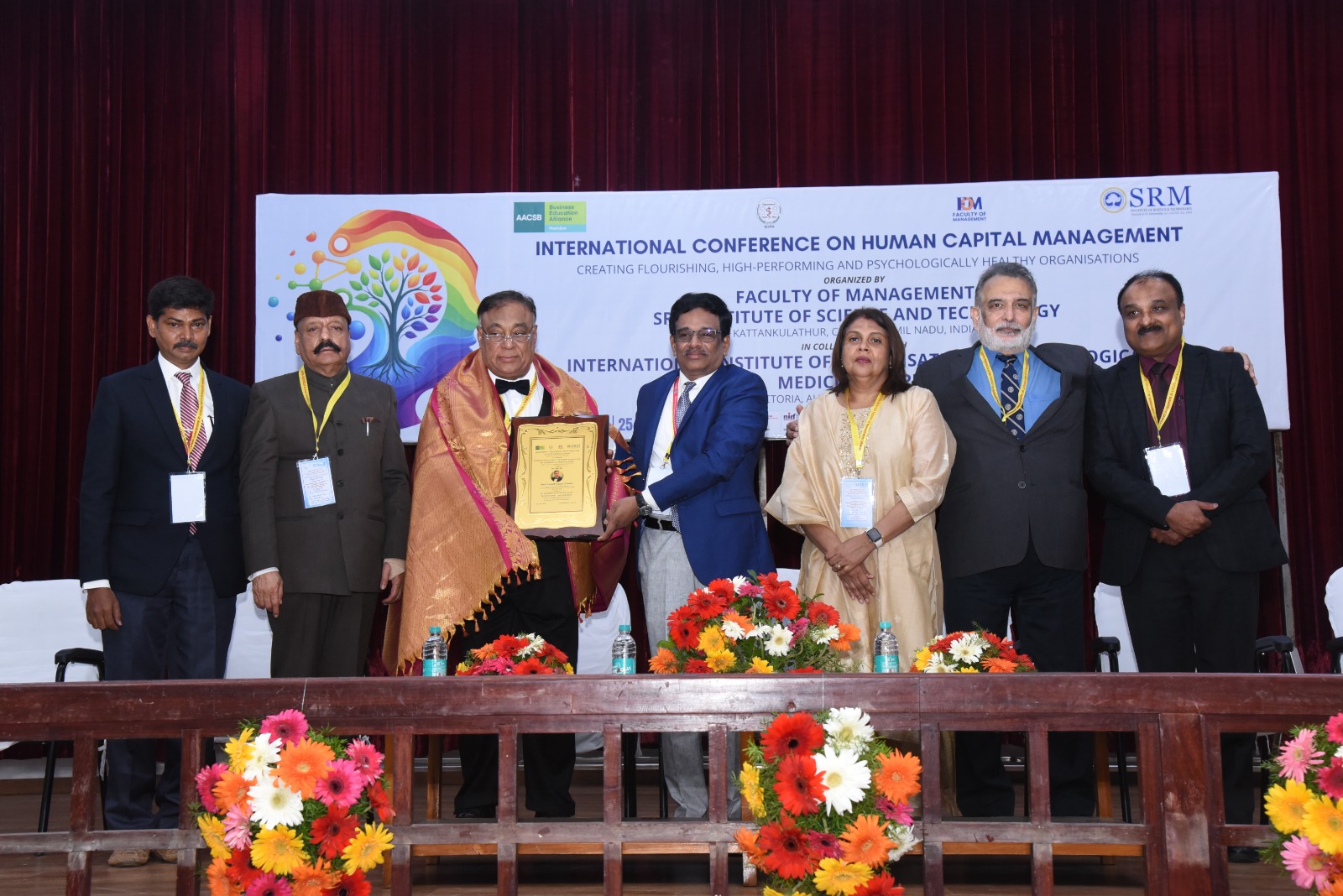
The distinguished guests and speakers included Prof. Russell Franco D’Souza, Dean and Professor of Psychological Medicine, International Institute of Organisational Psychological Medicine, Melbourne, Australia; Dr. Rajiv Tandon, chair IAOPM World, USA; Dr. Shabbir Amanullah, Former Division Head and Clinical Director, Division of Geriatric Psychiatry, Queen’s University, Kingston, Canada; Dr. Vedprakash Mishra, Pro Chancellor, Datta Meghe University, Maharashtra; Dr. Mary Mathew, Vice Chancellor, Karpaga Vinayaga Educational Lore for Learning, Tamil Nadu; and Dr. Ashish Nanda, Roland Christensen Distinguished Professor, Harvard Business School, USA and former Director, IIM Ahmedabad.
In his address, Dr. Shenbagaraman highlighted, “the growing importance of people skills, emotional intelligence, interpersonal skills and creativity in the contemporary workplace. He observed that rapid technological advancement has transformed the nature of work and made effective people management and strong interpersonal relationships increasingly important for organisational success.
He further emphasised that
“organisations must maintain an effective balance between human psychology, people management, technology and artificial intelligence. He stressed that technological integration should take place without compromising employee well-being”.
In his comments Dr. P. Saravanan, Associate Professor and Convener, Faculty of Management, SRM IST said,
“The importance of adopting the term Human Capital Management (HCM) rather than limiting the organisational perspective to Human Resource Management (HRM). He explained that traditional HRM largely focuses on administrative functions, whereas HCM adopts a strategic perspective by treating employees as valuable organisational assets whose economic and professional value can be enhanced through investment, training and development.
He noted the strong international response to the conference, with 196 research papers received from 23 countries, including India, the United Kingdom, the United States, China, Australia, Switzerland and the United Arab Emirates.”
In his comments Prof. Russell Franco D’Souza, Dean and Professor of Psychological Medicine, International Institute of Organisational Psychological Medicine, Melbourne, Australia, said,
“the unprecedented disruptions facing organisations, including the rapid development of artificial intelligence, workforce shortages, growing expectations around employee well-being, workplace safety and ethical leadership. He introduced an emerging framework integrating Human Capital Management with Organisational Psychological Medicine.
He emphasised that organisations that intentionally cultivate flourishing people are more likely to achieve sustainable high performance. He stressed that employee well-being should not be considered separately from organisational success but should instead be viewed as an important predictor of it.”
The expert sessions were followed by a panel discussion on “Launching an Elective on Psychological Medicine and the Workplace,” moderated by Dr. Rajiv Tandon. The panel featured Prof. Russell Franco D’Souza, Dr. Shabbir Amanullah, Dr. Vedprakash Mishra and Dr. Mary Mathew, who brought diverse perspectives to the discussion on psychological medicine and workplace well-being.