


Bhubaneswar, Aug. 14 (UDN): The Odisha Higher Education Department (DHE) has issued detailed operational guidelines for the Gyanodaya Shikshya Ru Samrudhi scheme, bringing clarity to the eligibility criteria and coverage of the state government’s free education initiative.
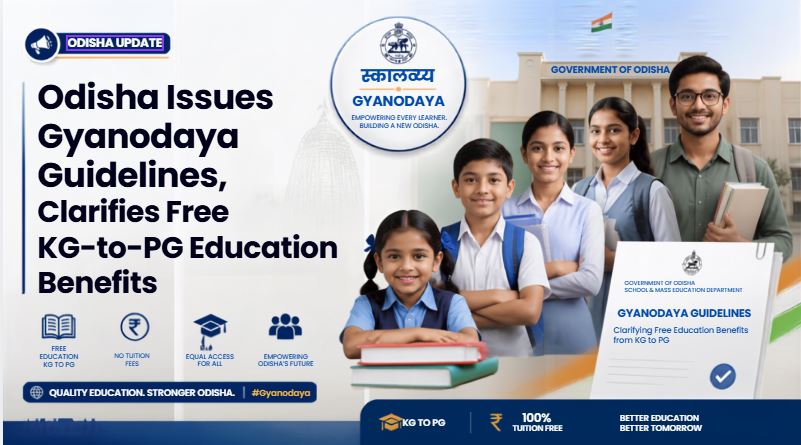
Representational Image
The guidelines, issued on Friday, specify which students and institutions will be covered and lay down rules governing admissions, attendance and fee collection.
Who Will Get the Benefit?
The scheme will cover regular undergraduate (UG) and postgraduate (PG) students enrolled in eligible institutions across Odisha.
These include:
State public universities
Government colleges
Government-aided colleges
Sanskrit colleges
However, several categories have been kept outside the scheme.
Self-financed courses will not be covered. Professional programmes such as B.Ed, B.H.Ed, M.Ed, ITEP, LLB, LLM, BBA, BCA, MBA and MCA are also excluded.
Students enrolled in private unaided colleges, institutions operating under public-private partnership (PPP) arrangements, and those pursuing courses through distance, open or correspondence modes will not be eligible for the benefits.
SAMS Admission Mandatory
The guidelines make admission through the State Admission Management System (SAMS) mandatory for students seeking benefits under the scheme.
Eligible students must take admission or re-admission through SAMS in regular UG or PG courses offered by institutions covered under the programme.
Students are also required to maintain a minimum 75 per cent attendance to continue receiving the benefits.
Colleges Barred From Collecting Covered Fees
The new guidelines also regulate fee collection from eligible students.
Colleges and institutions covered under the scheme cannot collect fees that are included within the benefits provided under Gyanodaya.
However, institutions may collect certain optional charges, including seminar fees, excursion fees, study tour fees and alumni association fees.
Such charges must be linked to specific activities and should have the approval of the competent authority in accordance with government instructions.
Scheme Aims to Expand Access to Higher Education
The operational guidelines are expected to remove ambiguity over the implementation of the Gyanodaya scheme and ensure that eligible students receive the intended benefits without additional financial burden.
By clearly defining eligible courses, institutions, admission procedures and fee rules, the Higher Education Department has sought to bring greater transparency and consistency to the implementation of the state’s free education programme.