


Bengaluru, Aug 26: GITAM, Bengaluru, hosted the three day Indo French Workshop on LIBS and Raman Spectroscopy for Planetary Sciences: Techniques, Challenges and Frontiers from August 19 to 21. The event was entirely funded by the Centre Franco Indien Pour la Promotion de la Recherche Avancée , an international centre jointly supported by the Indian Government’s Department of Science & Technology and the French Government’s Ministry for Europe & Foreign Affairs. The workshop brought together leading scientists and researchers from India and France. Dr. Shubhadip Chakraborty from Department of Chemistry, GITAM Bengaluru was the principal organizer of the event from India and Dr. Jérémie Lasue from the Institut de Recherche en Astrophysique et Planétologie, Toulouse was the co-organizer from France. The major goal of this workshop was to discuss the emerging technologies for planetary exploration and opportunities for future collaboration in the domain of space science.
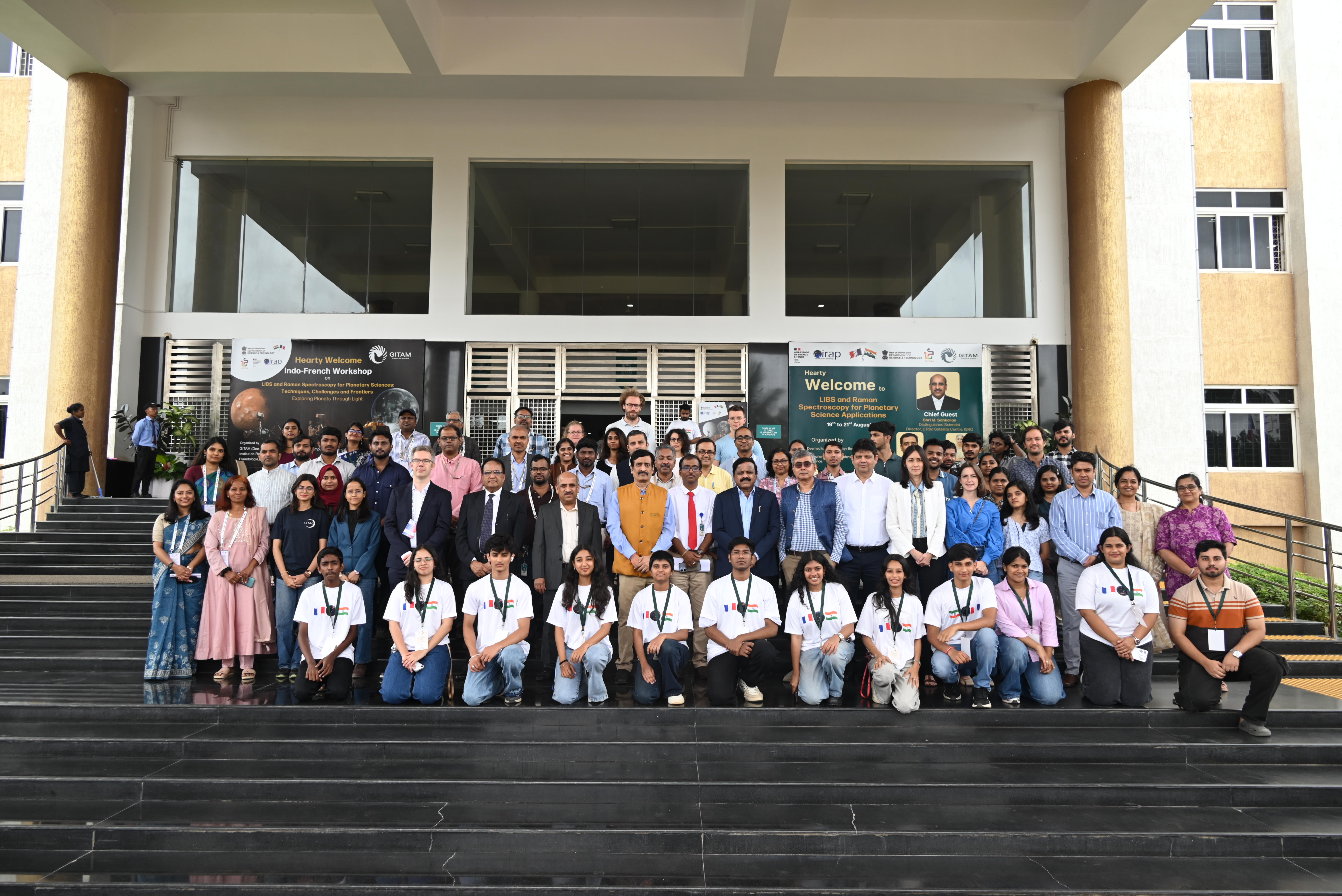
The workshop was inaugurated on August 19 in the presence of Shri M. Shankaran, Director, U. R. Rao Satellite Centre, ISRO.It brought together distinguished guests including Professor Nitin Seth Director, CEFIPRA, Professor Dibyendu Nandi, Senior Professor of Raman Research Institute; Professor Annapurni Subramaniam, Director, Indian Institute of Astrophysics and Dr. Antoine Guillemet, Attaché for Academic and Scientific Cooperation, Consulate General of France in Bengaluru; along with scientists and researchers from Indian Space Research Organization, Indian Institute of Space Science and Technology, Physical Research Laboratory, Manipal Academy of Higher Education, Cochin University of Science and Technology and the French National Centre for Space Studies.
A key focus of the workshop was the use of Laser-Induced Breakdown Spectroscopy and Raman spectroscopy for analysing the elemental and molecular composition of planetary surfaces. Through plenary lectures, technical presentations and brainstorming sessions, scientists discussed how these techniques can support in-situ exploration of the Moon, Mars and other planetary bodies.
Shri M. Shankaran, Director, U. R. Rao Satellite Centre (URSC), ISRO, said,
“LIBS and Raman spectroscopy are simple techniques that have demonstrated very high potential for both elemental and molecular analysis, and both have already been used in planetary rovers and sample analysis. This workshop brings together two complementary areas with plenty of scope for further work, particularly in instrumentation and data analysis. I am happy that a workshop of this nature is being held, and I hope it motivates young researchers to take up work in these domains. There is going to be plenty of work to be done for several lifetimes in this field, and it can be very valuable to science at large and definitely for our country.”
The sessions also examined the challenges of adapting spectroscopic instruments for space missions, including improving sensitivity and reliability, interpreting complex planetary materials and developing robust instrumentation capable of operating in harsh planetary environments.
The scientific programme featured sessions by Professor Agnès Cousin on investigations by Mars rovers including Curiosity and Perseverance, and by Professor Anil Bhardwaj, Director, Physical Research Laboratory, on India’s space exploration programme and its future scientific priorities. Together, the sessions explored how advances in spectroscopy can deepen our understanding of planetary surfaces, while also examining the opportunities and technological challenges shaping India’s expanding lunar and planetary exploration efforts.
The workshop also explored avenues for deeper Indo-French collaboration, including joint research projects, researcher and student exchanges, development of advanced LIBS and Raman instruments, collaborative mission science and participation in future planetary exploration programmes.
The discussions come at a time when India’s planetary science ecosystem is expanding rapidly following the success of Chandrayaan-3 and a growing focus on lunar and planetary missions. Participants noted that this presents significant opportunities for Indian researchers to collaborate with leading international institutions and contribute to future space exploration programmes.
Building on the long-standing scientific relationship between India and France in space research, the workshop provided a platform to create new institutional connections and strengthen existing research networks. It also gave young researchers and students an opportunity to interact with leading scientists working across planetary science, spectroscopy, instrumentation and mission research.