


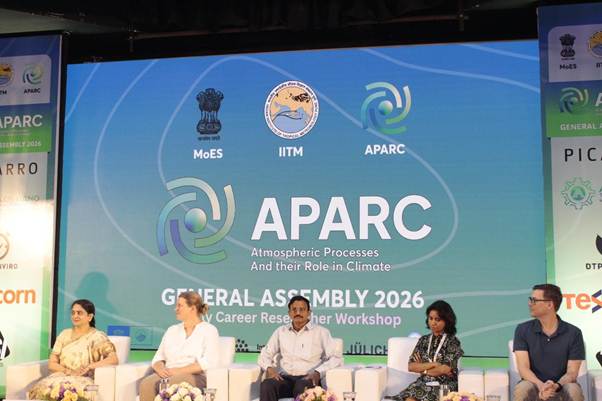
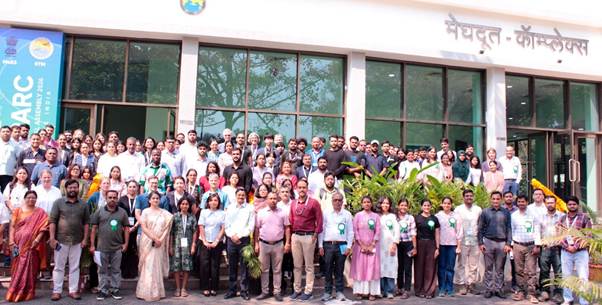
Pune, October 12: The Indian Institute of Tropical Meteorology (IITM), Pune, hosted the APARC Early Career Researcher (ECR) Workshop, titled “The ECR Nexus: Connecting Voices, Tools, and Science to Society,” at Meghdoot Hall, bringing together emerging researchers and international experts to discuss scientific collaboration, career development and the role of research in addressing societal challenges.
The workshop also served as a curtain-raiser for the upcoming Emerging Science, Technology and Innovation Conclave (ESTIC), highlighting the importance of connecting scientific research, technological advancement and policymaking to support India’s development priorities.
Dr. T. Srinivasa Kumar, Secretary of the Ministry of Earth Sciences, delivered the keynote address outlining ESTIC’s vision and strategic objectives. He highlighted the importance of strengthening collaboration across science, technology and policy, while encouraging the development of an innovation ecosystem capable of addressing emerging national and global challenges.
The address also highlighted the need for collaborative platforms that bring together researchers, policymakers and industry representatives to translate scientific advances into practical applications and support sustainable development.
The inaugural session featured a welcome address by IITM Director Dr. Suryachandra A. Rao. Additional addresses were delivered by Scientific Organizing Committee representatives Dr. Ines Tritscher, Director of the APARC Office in Jülich, Germany; Dr. Jonathon S. Wright of Tsinghua University, Beijing; and Dr. Hindumathi Palanisamy of the World Climate Research Programme (WCRP), World Meteorological Organization (WMO), Geneva.
Dr. Suvarna Fadnavis, a member of the Scientific Organizing Committee and Project Director of the Centre for Climate Change Research (CCCR) at IITM, delivered the vote of thanks. Workshop session convener Dr. Aditi Modi presented an overview of the programme and its key objectives.
A major highlight was a keynote presentation by Dr. Maria Molina of the University of Maryland on the applications of artificial intelligence (AI) and machine learning in Earth sciences. The session explored the growing relevance of advanced computational techniques in scientific research and their potential to improve the understanding of complex Earth system processes.
An interactive panel discussion brought together experts from NVIDIA, WCRP/WMO, Lawrence Livermore National Laboratory, the University of Tokyo and the Central University of Jammu to examine career pathways for early career researchers.
The discussion explored opportunities within academia and across industry, research laboratories and international scientific organisations. It provided participants with perspectives on professional development and the skills required to navigate an increasingly interdisciplinary research environment.
The workshop included collaborative brainstorming sessions designed to identify key research priorities and encourage cross-disciplinary exchange among participants.
An interactive “Meet the Editors” session featured representatives from Nature Portfolio and Springer Nature, offering early career researchers an opportunity to engage with scientific publishing professionals and gain insights into research communication and publication practices.
Participants also attended a technical tutorial on the Earth System Model Evaluation Tool (ESMValTool), coordinated by Dr. Birgit Hassler. The session focused on technical capabilities relevant to the evaluation and analysis of Earth system models.
The Young Earth System Scientists (YESS) community also presented opportunities for international networking, highlighting avenues for early career researchers to build professional connections and participate in global scientific initiatives.
The workshop sought to strengthen collaboration, technical skills and professional networks among emerging researchers working in atmospheric and Earth sciences. By combining expert presentations, interactive discussions and practical training, the programme provided a platform for participants to exchange ideas and explore emerging research opportunities.
The curtain-raiser also brought attention to ESTIC’s broader focus on advancing science, technology and innovation through collaboration among research institutions, industry and policymakers.
The initiative underscores the importance of supporting early career researchers as contributors to scientific discovery and technological development, particularly in fields such as climate science and Earth system research, where interdisciplinary expertise and international cooperation are increasingly important.