


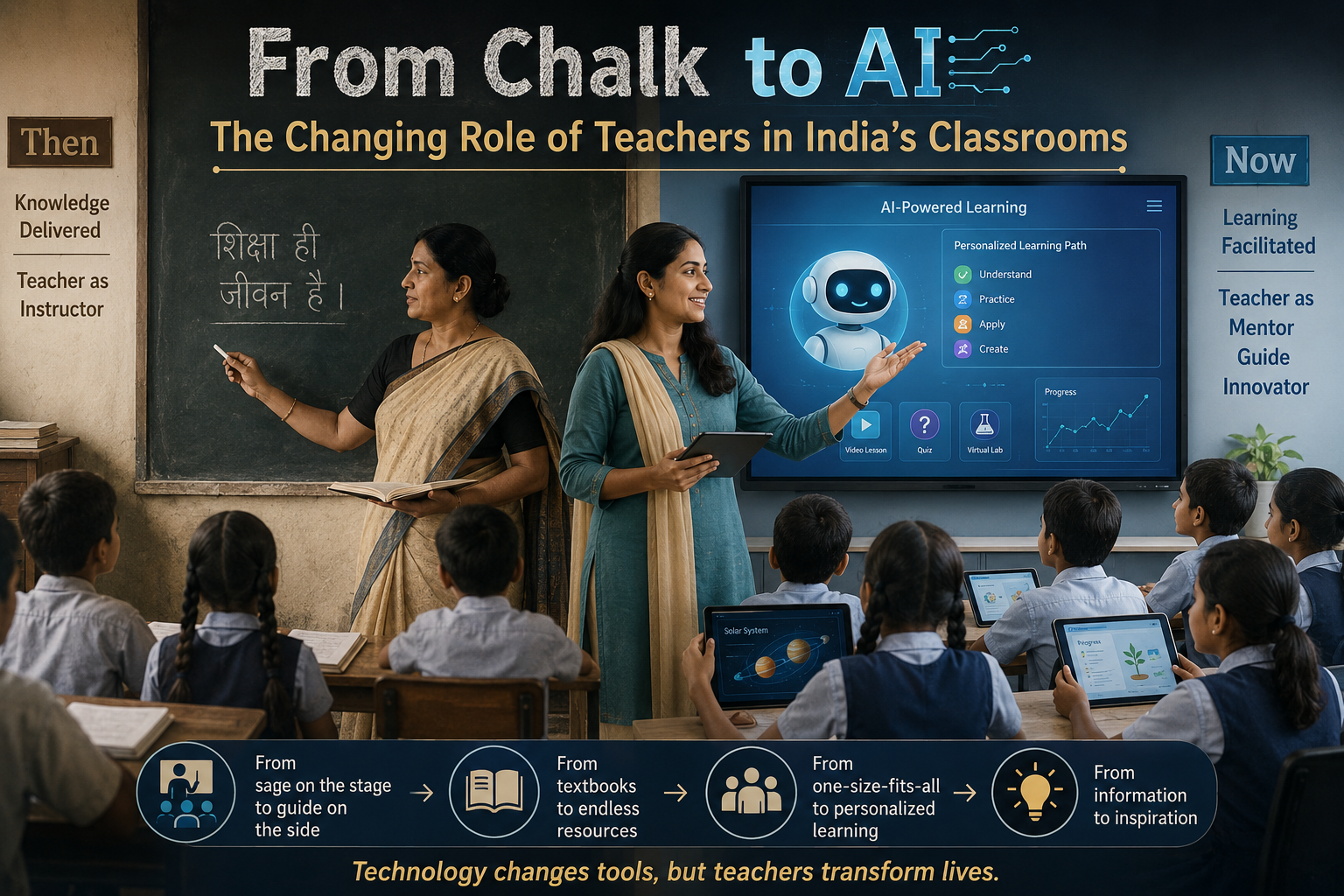
Sept 04: Every year on September 5, India celebrates Teachers’ Day, a day dedicated to recognising the educators who shape young minds, encourage curiosity and leave an enduring influence on their students. The date marks the birth anniversary of Dr. Sarvepalli Radhakrishnan, the country’s second President, renowned philosopher, scholar and educationist. The occasion reflects India’s longstanding respect for teachers and their contribution to society.
Across India, Teachers’ Day is celebrated with a distinctly personal touch. Schools and colleges organise special assemblies, cultural programmes, speeches, games and appreciation activities. In many institutions, students take on the role of teachers for a day, conducting classes and activities while their teachers take a step back. Cards, flowers, handwritten notes and small gestures of appreciation are also common.
The celebration extends to the national level through the National Teachers’ Awards, which recognise educators for their contribution to the quality of education and the lives of their students. In 2024, the President conferred the National Teachers’ Awards on selected educators as part of the Teachers’ Day celebrations.
But Teachers’ Day 2026 comes at a particularly interesting moment for education.
The classroom is changing rapidly. The familiar blackboard now shares space with smart displays, digital learning platforms, online resources and artificial intelligence. At the same time, today’s students are growing up in an environment where information is available almost instantly.
For teachers, this is creating a new challenge — and a new opportunity.
The role is no longer simply about delivering lessons. It is increasingly about helping students understand information, question what they see, use technology responsibly and develop the confidence to think independently.
India’s Classroom Is Changing at Scale
The transformation is taking place across one of the world’s largest education systems.
According to the Ministry of Education’s UDISE+ 2024–25 report, India had more than 14.71 lakh schools, nearly 24.69 crore students and 1,01,22,420 teachers. The number of teachers crossed the one-crore mark for the first time since the beginning of UDISE+, while the pupil-teacher ratio also improved across different stages of school education.
These figures represent a hugely diverse education ecosystem — from technology-rich urban schools to classrooms where access to digital infrastructure remains more limited.
Yet the nature of learning is changing across this landscape.
Students can now find explanations, tutorials, examples and educational resources outside school with just a few taps. Increasingly, they can also turn to AI tools for answers.
That means teachers are no longer competing with a shortage of information.
They are helping students navigate an abundance of it.
The Teacher Is No Longer the Only Source of Information
For generations, the teacher was often the primary source of knowledge in the classroom.
Today, that dynamic has changed.
A student struggling with mathematics can find multiple explanations online. A child curious about space can watch animations and documentaries. A difficult concept can be searched within seconds.
AI has taken this one step further by allowing students to ask questions in conversational language and receive customised explanations.
But finding an answer is not the same as understanding it.
This is where the teacher’s role becomes more valuable.
The modern educator is increasingly a guide who helps students distinguish between information and knowledge, convenience and learning, and an answer and the right answer.
AI Is Entering the Classroom
Artificial intelligence is likely to become one of the most significant technologies influencing education in the coming years.
UNESCO’s AI Competency Framework for Teachers describes a new teacher-AI-student dynamic and identifies 15 competencies across areas including a human-centred mindset, AI ethics, AI foundations and applications, AI pedagogy and AI for professional learning.
The message is significant: teachers themselves need to develop the knowledge and skills required to work effectively with AI.
AI can help create learning materials, offer alternative explanations, support practice and assist with some routine educational tasks.
But technology still needs human judgement.
A teacher must decide whether an AI-generated explanation is accurate, whether it suits the age and ability of students, and whether using the tool actually improves learning.
Gen Alpha Is Changing the Classroom Conversation
Many of today’s younger students belong to Gen Alpha, a generation that has grown up surrounded by smartphones, digital platforms, online videos, interactive games and increasingly AI-powered tools.
For them, technology is not necessarily a new addition to life. It is part of the environment in which they have grown up.
That creates a different learning mindset.
A Gen Alpha student may expect information to be visual, interactive and immediately accessible. They may move between a textbook, video, search engine and AI tool without seeing these as separate learning environments.
Teachers therefore face the challenge of turning digital familiarity into meaningful learning.
The objective is not to make every classroom look like a technology lab.
It is to teach students how to use technology without becoming dependent on it.
The Teacher Becomes the Reality Check
Imagine a student asking an AI tool to explain a historical event.
The response may be detailed and convincing. But is it accurate? Is anything missing? Does another perspective exist?
A teacher can turn those questions into a lesson.
Instead of simply providing the correct answer, the teacher can show students how to verify information, compare sources and recognise limitations.
That is particularly important in an age when AI can produce information in seconds.
The ability to question an answer could become just as important as the ability to find one.
From Passive Learning to Participation
The modern classroom is also becoming more interactive.
A science lesson can combine experiments with digital simulations. A history class can use maps, photographs and primary sources. A language lesson can incorporate storytelling, presentations and multimedia projects.
Technology can make these experiences easier to create, but it does not determine whether they are effective.
The teacher still designs the learning experience.
This shifts the classroom away from a purely one-way model where the teacher speaks and students listen.
Instead, students can investigate, discuss, collaborate, create and present — with the teacher acting as guide and mentor.
Personalised Learning Needs a Human Touch
AI-powered learning platforms can analyse student performance and recommend exercises based on individual needs.
But teachers have been personalising education long before algorithms appeared.
They know which student needs another example. They notice when a normally active student becomes quiet. They understand that two children with the same marks may need very different kinds of support.
A digital system can identify a performance pattern.
A teacher can understand the person behind the pattern.
That distinction is unlikely to disappear, regardless of how advanced educational technology becomes.
Critical Thinking May Become the New Superpower
In a world of instant answers, knowing how to think may become more important than simply knowing what to remember.
Students need to ask:
- Is this information reliable?
- What evidence supports it?
- Could the answer be biased?
- Is there another perspective?
- Can I verify this independently?
These questions are becoming essential learning skills.
Teachers are therefore moving into the role of critical-thinking coaches, helping students become more careful consumers and creators of information.
The aim is not to shield students from technology.
It is to give them the judgement to use it intelligently.
Teachers Are Becoming Learners Too
The technological transformation of education is changing teachers as well.
Educators are increasingly expected to understand digital platforms, online resources, AI tools and new approaches to classroom engagement.
This creates an interesting dynamic.
Sometimes a student may discover a new digital tool before their teacher does.
That does not diminish the teacher’s role.
Instead, it opens the door to collaborative learning.
Teachers do not need to know everything about every emerging technology. They need to understand enough to evaluate it, use it responsibly and help students make informed choices.
UNESCO’s framework reinforces this need for continuous professional development and human-centred AI use in education.
The Human Skills Technology Cannot Replace
There is an interesting paradox at the centre of AI-powered education.
As machines become better at processing information, distinctly human skills may become even more important.
Creativity. Empathy. Communication. Collaboration. Curiosity. Ethical judgement.
AI can generate ideas, but students need to decide which ideas are meaningful.
It can produce an answer, but students need to understand its implications.
It can complete a task, but students still need to know why the task matters.
Teachers are uniquely positioned to develop these qualities through discussion, mentoring, teamwork and real-world experiences.
India’s Digital Divide Still Matters
The future of education cannot be built around the assumption that every Indian student has the same access to technology.
A student in a metropolitan school may have access to high-speed internet, personal devices and AI-powered learning tools. Another student may depend on shared devices or primarily offline resources.
This makes inclusion essential.
Technology should help reduce educational inequalities rather than create another divide.
For teachers, that means adapting technology to the needs and realities of their classrooms instead of allowing technology itself to dictate how teaching should happen.
Preparing Students for a Changing Workplace
Today’s teachers are also preparing students for a future workplace that may look very different from the one previous generations entered.
AI and automation are changing how businesses operate and how tasks are performed.
Students therefore need more than textbook knowledge.
They need adaptability, communication, problem-solving, creativity and the ability to keep learning.
The teacher’s responsibility is gradually expanding from preparing students for the next examination to preparing them for a world where continuous learning may become a lifelong necessity.
The Teacher’s Most Important Role May Still Be Human
There are moments in education that technology cannot easily reproduce.
A teacher notices when a student is unusually quiet.
A teacher recognises potential before the student recognises it themselves.
A teacher encourages a child after failure.
A teacher celebrates a small improvement that might never appear in a performance report.
These moments matter.
For Gen Alpha and future generations alike, teachers may become even more valuable because they offer something technology cannot fully provide: human connection, encouragement and understanding.
Teachers’ Day 2026 Is About More Than a Thank You
Teachers’ Day will always be a day of appreciation.
But in 2026, it is also a reminder of how much the teaching profession is evolving.
Teachers are working with students who have unprecedented access to information. They are adapting to digital classrooms and exploring AI while also teaching children how to question the technology around them.
The President of India’s Teachers’ Day message has similarly highlighted teachers’ role in nurturing future generations, developing critical thinking and using technology appropriately in education.
That makes today’s teacher not simply a subject expert, but also a mentor, facilitator, digital guide and role model.
From Chalk to AI, the Teacher Remains
The tools in the classroom will continue to change.
The blackboard may become a digital display. Textbooks may increasingly sit alongside interactive resources. AI may become part of everyday learning.
But education will never be only about accessing information.
It is about learning how to ask better questions.
It is about understanding other people.
It is about making mistakes and trying again.
It is about developing curiosity when there is no easy answer.
And it is about having someone who believes that you can do more than you currently think possible.
From chalk to AI, India’s classrooms are changing. But at the heart of education, the teacher remains the person who turns information into understanding — and learning into possibility.