


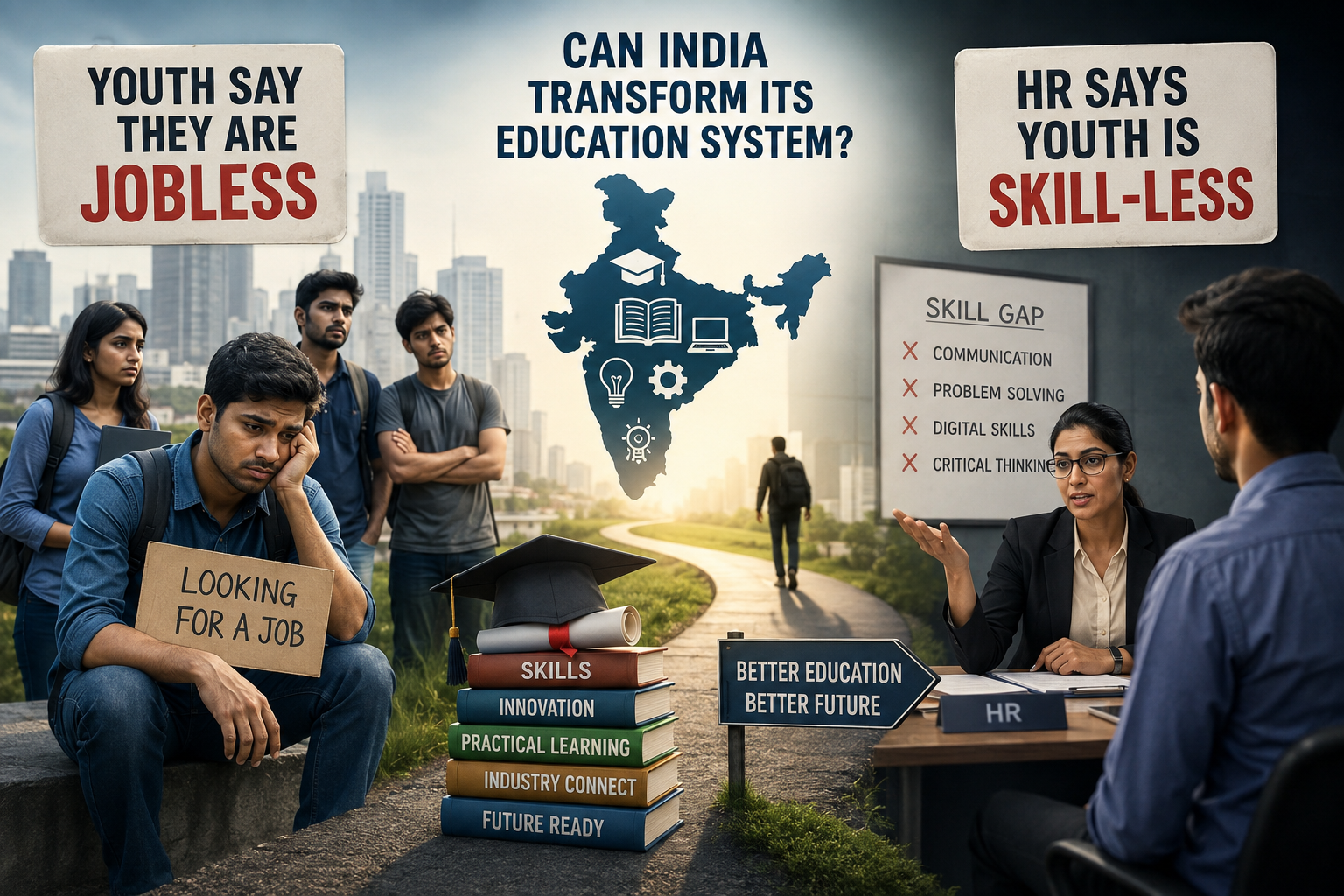
Aug 21: India’s young population is often described as one of its biggest economic strengths. Yet, a growing contradiction is emerging in the employment market.
Young people say they are jobless, while HR professionals say many young candidates are skill-less or not job-ready.
The debate raises an important question: Is India producing enough jobs for its young population, or does the education system need to do more to prepare students for the changing workplace?
The answer may lie somewhere in between. India’s employment challenge is not simply about the number of jobs available. It is also about the growing gap between education, employability and industry requirements.
The Numbers Tell a More Complicated Story
The employment challenge facing India’s youth is significant. According to the Periodic Labour Force Survey (PLFS) Annual Report 2025, the unemployment rate among people aged 15–29 stood at 9.9% in 2025, compared with 3.1% for people aged 15 years and above.
Although youth unemployment has declined, young people entering the labour market continue to face considerably greater employment challenges than the overall working-age population.
At the same time, there is evidence of an employability gap. Mercer | Mettl’s India Graduate Skill Index 2025 found that only 42.6% of Indian graduates assessed were considered overall employable. Employability for AI and machine-learning roles stood at 46.1%.
Together, these figures point to a deeper problem. India needs to create employment opportunities, but it also needs to ensure that young people possess the skills required to take advantage of those opportunities.
Youth Say: “We Have Degrees, But Where Are the Jobs?”
For generations, getting a degree has been considered the traditional route to a secure career.
Students complete school, enter college, earn a degree and expect to find employment.
But the transition from education to employment is not always straightforward.
A graduate may have a degree in engineering, commerce, management, science or the arts but still struggle to find suitable employment. In some cases, there may be intense competition for available positions. In others, jobs may require technical or practical skills that students have not developed during their academic journey.
This understandably creates frustration.
If young people spend years completing their education, they may ask a simple question:
If a degree is not enough to get a job, what skills should education have provided?
HR Says: “A Degree Is No Longer Enough”
Recruiters look at the same situation from another perspective.
A degree demonstrates academic achievement, but employers increasingly want candidates who can apply their knowledge in practical situations.
A digital marketing employer may expect a graduate to understand analytics, social media, content creation and AI tools.
An engineering company may look for candidates familiar with automation, software applications or data analysis.
A finance organisation may expect analytical ability and digital proficiency in addition to academic qualifications.
The workplace is therefore asking a different question from the education system.
It is not just “What did you study?” but “What can you do?”
The Education-to-Employment Gap
This is where India’s education system faces a major challenge.
Traditional education has often placed significant emphasis on examinations, marks and theoretical knowledge. These remain important, but the modern workplace demands more.
Employers increasingly value:
- Problem-solving
- Communication
- Critical thinking
- Digital literacy
- Teamwork
- Adaptability
- Creativity
- Practical experience
- Continuous learning
These capabilities cannot always be developed through classroom teaching alone.
Technology Is Changing the Skills Equation
The challenge is becoming more urgent because technology is transforming jobs at an unprecedented pace.
Artificial intelligence, automation, cloud computing, cybersecurity, robotics and data analytics are changing how businesses operate.
Some jobs are being automated, some are being redesigned and entirely new roles are emerging.
A student beginning a degree today could graduate into a workplace that looks very different from the one that existed when the course started.
This means education must prepare students not only for existing jobs but also for continuous change.
The most valuable skill may ultimately be the ability to learn new skills.
Can India Transform Its Education System?
The answer is yes, but transformation must go beyond updating textbooks.
India needs an education system that brings together knowledge, practical skills and employability.
Practical Learning Must Become More Important
Students need opportunities to experience the workplace before they graduate.
Internships, apprenticeships, live projects and industry assignments can help bridge the gap between classroom learning and employment.
A marketing student could work on an actual campaign. An engineering student could participate in an industrial project. A commerce student could analyse real financial information.
Such experiences teach students how to apply what they have learned.
Stronger Industry-Academia Collaboration
Educational institutions and companies need to work more closely.
Industry knows what skills employers need, while universities and colleges provide academic foundations.
Companies could participate in curriculum development, conduct workshops, provide mentorship and offer internships.
Such partnerships could make education more responsive to changing employment requirements.
AI Literacy Should Become Essential
Artificial intelligence is no longer limited to technology companies.
AI is influencing marketing, finance, healthcare, manufacturing, media, retail and many other industries.
Students therefore need basic AI literacy regardless of their chosen discipline.
They should learn how to use AI tools effectively, understand their limitations and verify AI-generated information.
The goal is not to turn every student into an AI specialist. It is to ensure that graduates are comfortable working in an economy increasingly shaped by AI.
Soft Skills Are Equally Important
The skills gap is not only about technology.
Employers also need people who can communicate clearly, work in teams, solve problems and adapt to new situations.
A technically qualified employee may struggle if they cannot communicate with colleagues or clients.
Similarly, someone with excellent academic knowledge may find it difficult to progress if they cannot adapt to changing workplace requirements.
Education must therefore focus on both technical and human skills.
Communication, leadership, collaboration, creativity and critical thinking should become integral parts of education.
Vocational Education Needs a New Image
India cannot meet its workforce requirements through conventional university degrees alone.
The country needs skilled technicians, healthcare workers, electricians, machine operators, manufacturing specialists, logistics professionals and hospitality workers.
Vocational education should therefore be positioned as a serious career option.
Modern vocational programmes need better infrastructure, industry exposure, updated training and clear career progression.
Most importantly, society needs to recognise that skilled work is valuable work.
Employers Also Have a Role
The responsibility cannot rest entirely with educational institutions.
Employers also need to create pathways through which young people can gain experience.
If every entry-level position requires several years of experience, graduates are effectively being denied the opportunity to acquire that experience.
Companies can help through:
- Graduate trainee programmes
- Internships
- Apprenticeships
- Mentorship
- Entry-level training
- Industry-academia partnerships
Recruiters can also consider potential and willingness to learn instead of focusing entirely on whether a candidate already possesses every required skill.
What Should a Future-Ready Graduate Look Like?
The graduate of tomorrow may not simply be the student with the highest marks.
A future-ready professional will likely need a combination of:
- Academic knowledge
- Practical experience
- Digital literacy
- AI awareness
- Communication skills
- Critical thinking
- Problem-solving
- Adaptability
- Continuous learning
A degree should therefore be viewed as a foundation for a career, not the final measure of employability.
Education Transformation Should Start Before College
Career preparation should not begin after graduation.
Schools can introduce students to technology, entrepreneurship, financial literacy, problem-solving and different career options at an earlier stage.
Young people should be encouraged to understand what they are good at, what interests them and what skills future industries may require.
This could help students make more informed choices about higher education instead of selecting courses solely because they are considered prestigious or popular.
From Getting a Degree to Building a Career
India needs to move from a degree-oriented approach towards a career and skills-oriented education system.
Instead of asking only, “Which degree should I pursue?”, students should also ask:
What skills will I need? What problems can I solve? What kind of career do I want to build?
That shift could make education more meaningful and employment-focused.
A degree provides knowledge. Practical training provides experience. Skills create employability. Continuous learning provides career resilience.
The Jobless vs Skill-Less Debate Needs a New Perspective
The debate between jobless youth and skill-less youth is too simplistic.
Young people cannot be blamed entirely when their education does not provide sufficient exposure to workplace requirements. At the same time, employers cannot ignore the skills necessary to compete in a technology-driven economy.
The real problem lies in the gap between education and employment.
Bridging this gap will require schools, colleges, universities, employers, policymakers and students to share responsibility.
The goal should not simply be to produce more graduates. It should be to create skilled, adaptable and confident professionals who can contribute to India’s changing economy.
The Way Forward
India’s demographic dividend can become one of its greatest economic advantages—but only if young people have the skills and opportunities to participate meaningfully in the workforce.
The answer is not to choose between degrees and skills.
India needs both.
The education system must provide strong academic foundations while giving students practical experience, digital capabilities, AI awareness, communication skills and opportunities for continuous learning.
Youth may say they are jobless. HR may say youth is skill-less.
Perhaps both are describing different sides of the same problem.
The real question is not who is right. It is whether India can transform its education system quickly enough to ensure that a young person leaving college is not merely a graduate, but a job-ready, adaptable and future-ready professional.
Better education should not simply prepare young people to pass examinations. It should prepare them to build careers, solve problems, create opportunities and shape India’s future.