


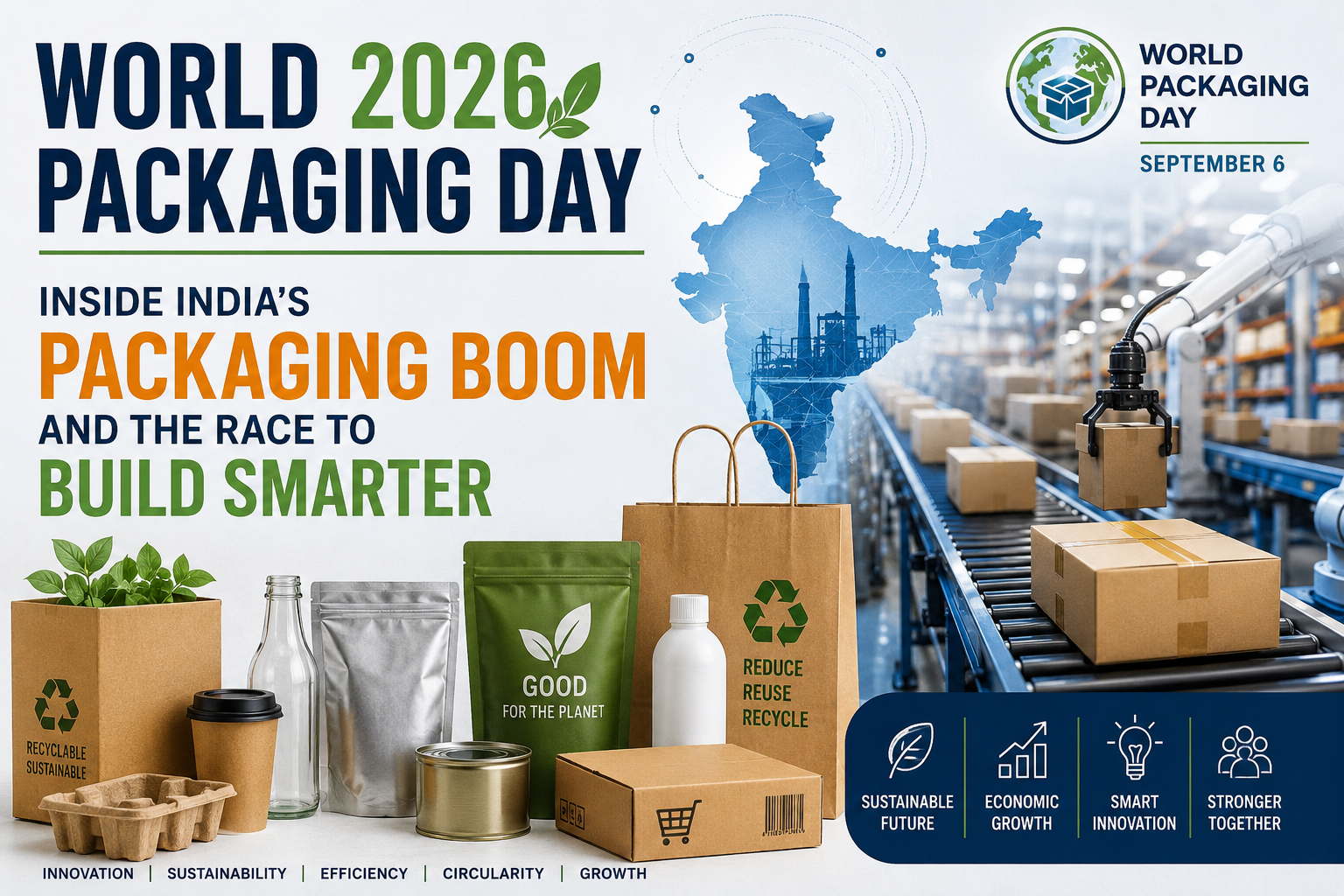
Sept 04: On September 6, 2026, the world will celebrate World Packaging Day for the first time, putting global attention on an industry that is often overlooked despite being essential to almost everything we buy, eat, use and transport.
From the carton protecting an online order to the pouch carrying a packet of spices, packaging has become deeply woven into everyday life. It protects food, medicines and consumer goods, supports transportation and storage, helps reduce product damage and increasingly serves as a communication channel between brands and consumers.
For India, the occasion comes at a significant time. The country’s packaging industry is expanding alongside consumption, organised retail, e-commerce, quick commerce and manufacturing. According to an Avendus Capital report cited by the India Brand Equity Foundation (IBEF), India’s packaging industry could reach approximately ₹8.5 lakh crore (US$92 billion) by FY30, growing at around 9% annually.
That growth is turning packaging from a largely behind-the-scenes business into an increasingly important part of India’s economic story.
From Wrappers to a ₹8.5 Lakh Crore Opportunity
Packaging may not always be the first industry that comes to mind when discussing India’s growth story.
Yet look around and its importance becomes obvious.
Supermarket shelves are filled with packaged products. Medicines require carefully designed containers. E-commerce depends on boxes and protective materials. Restaurants and food-delivery businesses rely on packaging to transport meals safely.
Behind these products is a vast network of manufacturers, printers, converters, suppliers, recyclers and technology providers.
According to IBEF, India has more than 22,000 packaging units, with approximately 85% belonging to the small and medium enterprise segment.
This makes packaging an important part of India’s MSME and manufacturing ecosystem, creating opportunities not only for large corporations but also for specialised smaller businesses.
Food and FMCG Are Driving Demand
India’s changing consumption habits are one of the biggest forces behind packaging growth.
Packaged snacks, beverages, dairy products, spices, ready-to-eat meals, personal-care products and household goods all require packaging that balances protection, convenience, shelf life and cost.
Food processing is particularly important.
According to IBEF data, food processing accounts for around 45% of packaging materials and machinery end-user volume, while pharmaceuticals account for approximately 25%.
The growth of affordable smaller packs is also influencing packaging design. Sachets and pouches allow brands to reach consumers across different income groups, while larger formats cater to families and bulk consumption.
Packaging, in many ways, is evolving alongside India’s consumption patterns.
E-Commerce Has Redrawn the Packaging Map
Then there is online shopping.
A product purchased in seconds on a smartphone may travel through warehouses, sorting facilities, trucks and delivery networks before reaching a customer’s doorstep.
That journey has created enormous demand for corrugated boxes, protective materials, labels, tapes and other packaging solutions.
But e-commerce has also exposed one of the industry’s biggest challenges: waste.
Consumers are increasingly asking why a small product needs several layers of packaging or a box much larger than the item inside.
As India’s e-commerce and quick-commerce markets grow, companies are therefore looking for packaging that protects products without using unnecessary material.
The next packaging innovation may not be about adding more.
It could be about using less, but using it better.
Flexible Packaging Remains a Major Force
Flexible packaging is one of the most visible formats in India’s consumer economy.
Pouches, sachets, films and wrappers are popular because they are lightweight, convenient and cost-effective.
GlobalData data cited by IBEF indicates that flexible packaging represented 52.5% of India’s packaging volumes in 2025, while rigid plastics accounted for another 31.8%.
However, flexible packaging is also at the centre of the sustainability debate.
Manufacturers are exploring lighter structures, recyclable formats and mono-material solutions that can reduce environmental impact while maintaining the barrier properties needed for food and other sensitive products.
The challenge is finding solutions that are environmentally responsible and commercially viable.
Paper Packaging Is Gaining Momentum
Paper and fibre-based packaging are also attracting increasing attention.
India’s paper packaging market reached approximately ₹1.67 lakh crore in August 2025, according to IBEF, with further growth expected through 2030.
Corrugated boxes, cartons and paper bags are already widely used in retail, e-commerce and food businesses.
But sustainability is not simply a matter of replacing plastic with paper.
Every material has different strengths, environmental considerations and applications. Some products require moisture resistance, high durability or longer shelf-life protection.
The more important question is therefore not plastic versus paper.
It is what is the most appropriate material for the job, and how can its environmental footprint be reduced?
Sustainability Is Changing the Industry
For India’s packaging sector, sustainability is moving from a branding conversation to a business requirement.
Companies increasingly have to think about the entire life of a package — from the materials used to make it to what happens after the consumer discards it.
India’s Extended Producer Responsibility (EPR) framework has increased the responsibility of producers, importers and brand owners for managing packaging waste.
For manufacturers, this means sustainability is becoming part of packaging design, sourcing and business strategy rather than something considered after production.
But the transition is not easy.
Recyclable packaging still needs to be collected, sorted and processed. Sustainable alternatives can sometimes be more expensive. Smaller manufacturers may not have the resources to immediately invest in new technologies.
India’s packaging challenge is therefore not simply to create greener materials.
It is to build a complete ecosystem around them.
Smart Packaging Could Be the Next Big Shift
The package itself is also becoming more intelligent.
A QR code can take consumers to product information. RFID can help businesses track goods across supply chains. NFC can support authentication and digital interaction.
IBEF identifies RFID, NFC and QR codes among emerging technologies that can support product authentication and supply-chain efficiency.
For pharmaceuticals, premium consumer products and food businesses, traceability can be particularly valuable.
For brands, meanwhile, packaging is becoming another digital touchpoint.
The box or bottle sitting in a consumer’s hand could soon be doing much more than holding the product.
Packaging Has Become Part of the Brand
Packaging is no longer purely functional.
For D2C and consumer brands, it can be the first physical interaction between the customer and the company.
A premium package can create a sense of luxury. Minimal packaging can communicate simplicity. Recyclable materials can reinforce a sustainability promise.
In a crowded marketplace, packaging can even become part of the brand’s personality.
This is particularly relevant for India’s growing D2C ecosystem, where companies compete not just on price but also on experience and identity.
The package has become part of the product story.
A Manufacturing Opportunity for India
The growth of packaging also fits into India’s wider manufacturing ambitions.
A strong domestic packaging ecosystem can support food processing, pharmaceuticals, electronics, FMCG, agriculture and other industries.
It can also create opportunities for Indian manufacturers to move into higher-value areas such as advanced materials, automated packaging machinery, smart labels and sustainable packaging solutions.
For MSMEs, the opportunity is particularly significant.
Specialisation in areas such as flexible packaging, labels, digital printing, corrugated packaging, machinery and customised solutions could allow smaller businesses to serve increasingly sophisticated domestic and export markets.
Packaging could therefore become more than a supporting industry.
It could become an innovation and manufacturing opportunity in its own right.
The Industry Has to Solve the Growth-Waste Equation
The biggest question facing India’s packaging industry may ultimately be a simple one:
How do you grow without creating more waste?
India’s expanding population, consumption and digital commerce will inevitably create demand for packaging.
The answer cannot simply be to stop using packaging. Packaging protects products, reduces damage and can even prevent food waste.
The answer is smarter design.
That means lighter materials, better formats, improved recycling systems, greater reuse where practical and stronger connections between manufacturers and waste-management networks.
Growth and sustainability will have to move together.
SMEs Could Be at the Centre of the Next Phase
India’s large SME base gives the sector an interesting advantage.
Smaller businesses can often respond quickly to specialised customer requirements and emerging niches.
With access to better technology, financing, skills and recycling infrastructure, these companies could play a major role in developing India’s next generation of packaging solutions.
Automation and digital manufacturing could also improve consistency, productivity and cost efficiency.
The opportunity is particularly strong as Indian brands increasingly seek packaging that is not only affordable but also distinctive, sustainable and technologically enabled.
What World Packaging Day Means for India
The first World Packaging Day arrives at a moment when the definition of packaging is changing.
It is no longer enough to ask:
“How do we package this product?”
The industry is increasingly asking:
“How can we package it better?”
Better could mean lighter. Safer. Smarter. More recyclable. More efficient. Easier to transport. Easier to recover after use.
The World Packaging Organisation’s themes for the initiative include Packaging for Progress, Packaging Against Food Waste, Packaging and Economic Growth, and Packaging and Sustainability — issues that closely connect with India’s own packaging priorities.
The Future Is Not Just About Better Boxes
India’s packaging industry may operate largely behind the scenes, but its impact is visible everywhere.
It supports India’s food economy, protects medicines, enables e-commerce, helps consumer brands build identities and creates opportunities for thousands of manufacturers and MSMEs.
Now the sector is entering another phase — one where sustainability, technology and efficiency are becoming as important as protection and cost.
That makes World Packaging Day 2026 more than a celebration of boxes, bottles, cartons and wrappers.
It is a chance to recognise an industry that sits at the intersection of consumption, manufacturing, logistics, technology and environmental responsibility.
For India, the next packaging boom will not simply be about producing more.
It will be about designing smarter, wasting less and creating packaging that works for both business and the world around it.
And perhaps that is the most interesting thing about packaging: the future of the product may begin with what surrounds it.