


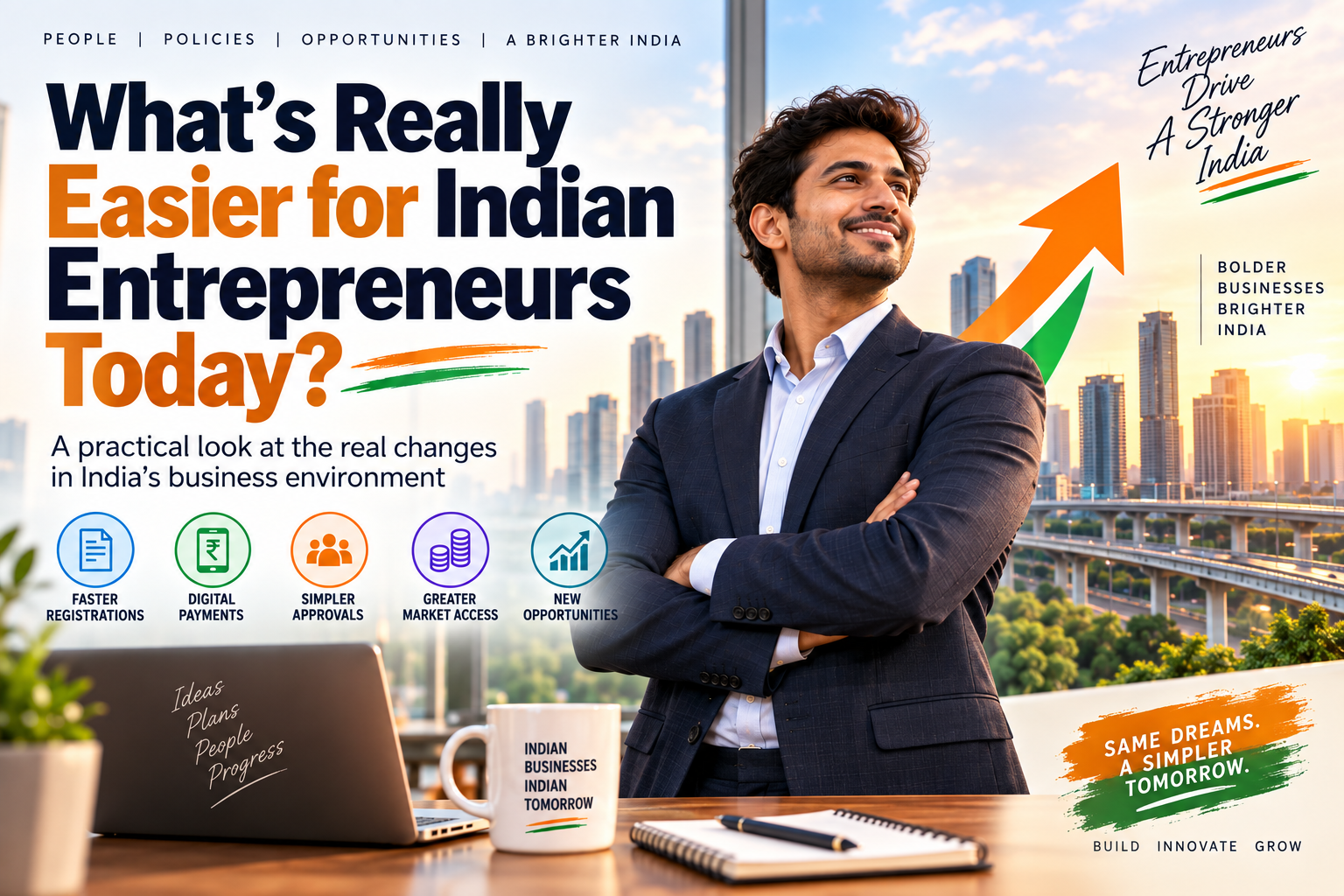
For years, “Ease of Doing Business” (EoDB) in India was largely discussed through rankings, reforms and government announcements. For an entrepreneur, however, the real question is much simpler: Is it actually easier to start, register, finance, operate and expand a business today than it was a decade ago?
The answer is yes—but unevenly.
India has made substantial progress in digitising business-government interactions, simplifying registrations, expanding formalisation, reducing physical interfaces with tax authorities, creating single-window approval systems and widening access to government procurement and digital markets. At the same time, entrepreneurs still encounter significant friction at the state and local levels, particularly around land, construction approvals, labour compliance, inspections, payments and contract enforcement.
It is therefore more useful to examine EoDB not as a ranking, but as the day-to-day experience of an Indian entrepreneur.
1. From Government Promise to Entrepreneurial Reality
“Ease of Doing Business” has become one of the most frequently used phrases in discussions about India’s economic transformation. But for an entrepreneur, the concept has little meaning if it exists only in government reports or international rankings. The real measure is whether a founder can register a company faster, obtain approvals without endless follow-ups, pay taxes more efficiently, access finance, hire workers, sell to customers and resolve disputes without losing months of productive time. Over the past decade, India has made meaningful progress in several of these areas. Yet the experience remains far from uniform, with digital reforms producing impressive gains while ground-level bureaucracy continues to create friction in many sectors.
2. Starting a Business Has Become More Digital
One of the most visible changes is the transformation of business registration and formalisation. Entrepreneurs can now complete many registration processes online rather than physically moving between government offices with files of documents. For small businesses, the Udyam registration system has made formal MSME registration considerably simpler by using a largely digital, self-declaration-based process. Company incorporation and statutory filings have also moved substantially online through the Ministry of Corporate Affairs ecosystem. This matters because the first interaction between an entrepreneur and the regulatory system increasingly happens through a computer or smartphone rather than across a government counter.
3. Less Paperwork Does Not Always Mean Less Compliance
Digitalisation, however, should not be confused with deregulation. An entrepreneur may no longer have to submit stacks of physical documents, but businesses still operate within a complex web of tax, labour, environmental, corporate and sector-specific requirements. In some cases, digital platforms have actually made compliance more systematic because information can be cross-checked automatically. For professional businesses and larger enterprises, this can improve efficiency. For very small entrepreneurs without accountants or compliance specialists, however, the learning curve can remain steep. The improvement, therefore, is often in how compliance is performed, rather than in the complete removal of compliance itself.
4. GST Has Changed the Business Landscape
The Goods and Services Tax has arguably been one of the most consequential changes for businesses operating across India. A common indirect-tax framework has reduced some of the complexity associated with India’s earlier patchwork of state-level taxes. Digital invoicing, online returns and input-tax-credit mechanisms have also encouraged businesses to maintain more organised financial records. At the same time, GST has introduced its own compliance demands, particularly for smaller businesses. The practical lesson is that India’s tax environment has become more integrated and technology-driven, but entrepreneurs still need systems and expertise to navigate it effectively.
5. Government Approvals Are Moving Towards a Single-Window Model
For businesses that require physical infrastructure, obtaining approvals can be far more complicated than registering a company. A factory, warehouse, restaurant, office or logistics facility may require permissions from multiple authorities. India’s National Single Window System attempts to address this problem by providing businesses with a central digital interface through which they can identify and apply for various approvals. The larger significance of such systems is not merely convenience. Entrepreneurs can better understand the regulatory requirements associated with a project before committing significant capital, potentially reducing the risk of expensive delays and unexpected administrative hurdles.
6. Digital Payments Have Reduced Everyday Business Friction
Some of India’s biggest ease-of-doing-business improvements have occurred outside traditional regulatory reform. Digital payments have transformed everyday commercial transactions. UPI, in particular, has enabled even very small businesses to accept electronic payments without investing in complicated payment infrastructure. A street-side merchant, freelancer, retailer or small service provider can receive money almost instantly and maintain a digital transaction trail. For entrepreneurs, this can improve collection cycles, reduce cash-handling risks and create financial records that may eventually support access to formal credit. India’s digital public infrastructure has therefore become an important part of its business environment.
7. Access to Government Customers Has Improved
Another important but sometimes overlooked development is the expansion of digital government procurement. The Government e-Marketplace, or GeM, has created a nationwide online environment where businesses can offer products and services to government buyers. For MSMEs, this potentially opens a market that was historically difficult to access because of information gaps, geography and conventional tendering procedures. A small manufacturer in one part of India can potentially compete for government demand elsewhere without establishing a physical sales network. This does not eliminate competition or procurement requirements, but it can make the government market considerably more accessible to smaller enterprises.
8. Formalisation Is Opening Doors for Smaller Businesses
India’s entrepreneurial economy has traditionally included a huge informal sector. Many micro-enterprises operated without formal registration, making it difficult for them to access institutional credit, government schemes or larger corporate supply chains. The expansion of Udyam registration and related formalisation initiatives is gradually changing that equation. Once a business has a formal identity, its financial and commercial activities can become easier to document. This can help entrepreneurs move from informal survival-oriented operations toward participation in organised supply chains. The real success of formalisation, however, will depend on whether registered enterprises actually experience better access to finance, markets and government support.
9. The State-Level Experience Still Makes a Huge Difference
India’s biggest EoDB challenge is that the entrepreneurial experience can vary dramatically depending on location. A technology startup operating from a shared office may encounter relatively little regulatory friction, while a manufacturing company may have to navigate land acquisition, construction permissions, environmental approvals, electricity connections and local regulations. Much of this activity falls within state and local government jurisdictions. Consequently, national digital platforms cannot by themselves create a uniform business environment. The quality, speed and predictability of local administration remain critical factors determining whether a business can actually translate an investment plan into an operating enterprise.
10. Contract Enforcement Remains an Important Test
There is another dimension of doing business that cannot be solved simply through online registration: what happens when commercial relationships break down. Entrepreneurs need confidence that unpaid invoices, contractual disputes and commercial disagreements can be resolved within a reasonable period. For MSMEs, delayed payments can be particularly damaging because working capital is limited. India’s insolvency reforms and efforts to improve commercial dispute resolution have strengthened the institutional framework, but the broader issue of speedy enforcement remains important. A business environment becomes truly entrepreneur-friendly when companies can not only enter the market easily but also protect their commercial interests when relationships fail.
11. The Biggest Remaining Problem Is Uncertainty
For many entrepreneurs, the cost of bureaucracy is not necessarily the official fee charged by the government. It is the uncertainty surrounding the process. How long will an approval take? Will two officials interpret the same rule differently? Will a local requirement appear after investment has already been made? Will a tax dispute take months or years to resolve? These questions influence investment decisions just as much as taxes and subsidies do. India’s next phase of EoDB reform therefore needs to focus not merely on reducing forms and procedures but on creating predictable timelines, consistent interpretation and transparent decision-making across different levels of government.
12. India’s EoDB Story Is Real—but Still Unfinished
The evidence suggests that doing business in India has genuinely become easier in several practical respects. Registration is increasingly digital, tax administration is more technology-driven, government procurement is more accessible, digital payments have dramatically reduced transaction friction and formalisation is becoming easier for millions of small enterprises. But India’s entrepreneurial environment is still a work in progress. The next generation of reforms must move beyond digital portals and focus on the everyday realities of factories, shops, offices and startups—particularly approvals, local administration, compliance costs, payments and contract enforcement. Ultimately, the success of Ease of Doing Business will not be determined by how impressive a reform looks on paper. It will be determined by whether an entrepreneur can start faster, operate with greater certainty, spend less time navigating bureaucracy and devote more energy to building a successful business.
For Indian entrepreneurs, that distinction is crucial. Ease of Doing Business is not ultimately about a government portal or an international ranking. It is about whether a founder can spend more time building a business and less time navigating the system around it.
India has moved meaningfully in that direction. The next phase of reform will determine how far that progress reaches the entrepreneur’s actual desk, factory floor, shop counter and balance sheet.