


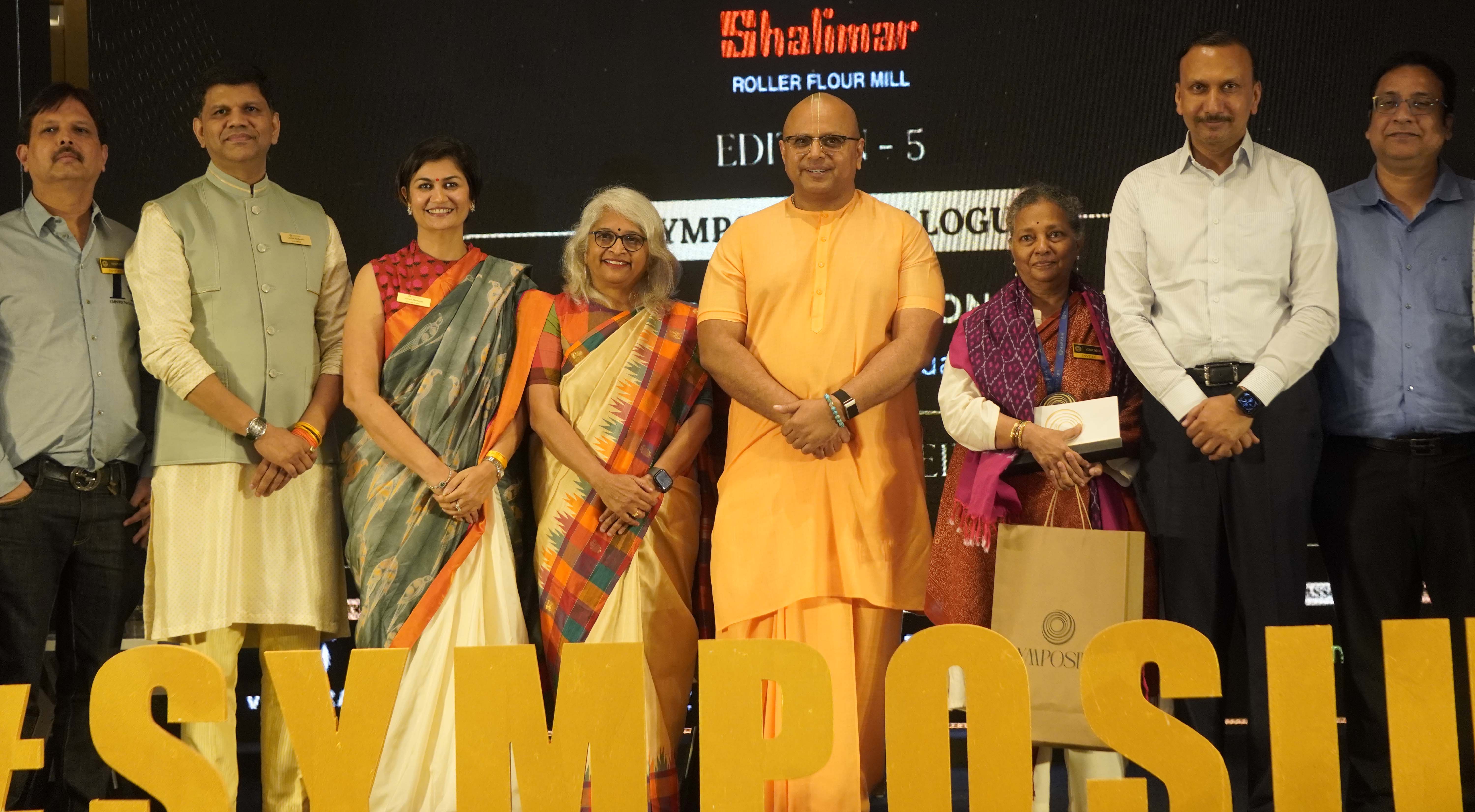
Hyderabad, Aug 20: In a unique conversation that brought together spirituality, psychiatry and contemporary perspectives on mental health, monk, motivational speaker and author Gaur Gopal Das and noted psychiatrist Dr. Pratima Murthy, former Director and Senior Professor of Psychiatry at NIMHANS, explored the role of families in building emotional resilience and stronger minds at a special Symposium Dialogue held at Avasa Hotel, Madhapur, on Wednesday evening.
Titled “Strong Families. Strong Minds.”, the dialogue brought spirituality and science together to examine how families can become safe spaces for emotional support, resilience and mental well-being.
The programme, which continued beyond 9 pm, was attended by more than 250 people, including senior bureaucrats, former police officials, business leaders, industrialists, policymakers and professionals from different sectors.
Among those present were Mr. Naveen Mittal, Special Chief Secretary, former Chief Secretary Mr. S.K. Joshi, former DGPs Anurag Sharma and Anjani Kumar, former Commissioner of Police A.K. Khan, FTCCI President K.K. Maheshwari, FTCCI Senior Vice-President Srinivas Garimella, Ms. Swathi of GreenCo, veteran business leader Raj Kumar Mallpani and several prominent members of Hyderabad’s business and professional community.
A White Paper emerging from the previous Symposium dialogue was presented to Mr. Naveen Mittal.
Speaking for nearly 90 minutes, Gaur Gopal Das combined humour, personal experiences and everyday examples to explore the relationship between family, relationships, resilience and mental well-being.
Opening with his characteristic wit, he observed that the evening was about “strong families and strong minds.” Referring to the fact that it was a weekday evening, he quipped that it was a “week evening, but not a weak family”, drawing laughter from the audience and setting a light-hearted tone for the serious conversation that followed.
He also challenged the conventional format of public speaking. “Stages are extremely boring,” he remarked, pointing out that a speaker can become isolated from the audience while standing on a stage. He subsequently stepped down and interacted with the audience, turning the session into a more personal conversation.
Using the analogy of an aircraft journey, Gaur Gopal Das spoke about uncertainty and the turbulence that is an inevitable part of life. “We need money to go up in a plane, but we need naseeb (luck) for the landing. The turbulence is not in our hands. So is life,” he told the audience.
With his characteristic wit, he observed, “No one looks better than their DP on Instagram and no one looks uglier than on an Aadhaar Card.” He said that the end of life is not in our hands and there was no point worrying about every turbulence along the way. “No plane has ever crashed because of turbulence. Planes are built to withstand such disturbances. They may cause difficulty and inconvenience, but they are part of the journey. So are the problems in our lives,” he said.
He urged the audience to focus on living rather than merely existing. “God gave us life not to die every day, but to live — not just exist. Enjoy every moment of life,” he said. Observing that people today were “living less and dying more,” he described ours as a “generation of fake smiles,” where people often have little time for one another. In many relationships, he said, couples may not share what they are going through with anyone; “only their pillows know what they have been going through.”
He emphasised that strong families help build strong minds, just as an expert pilot knows how to navigate through turbulence. The turbulence may be beyond our control, he said, but how we respond to it — and the people we turn to for support — can make all the difference.
Gaur Gopal Das emphasised that strong families create the emotional foundation for strong minds.
He spoke about the importance of communication and referred to Gary Chapman’s book on five love languages — words of affirmation, quality time, receiving gifts, acts of service and physical touch — as ways in which people express and receive affection differently.
Drawing from his own relationship with his father and family, he explained how emotional “deposits” made by family members over the years can create a strong support system during difficult times.
“If you did not invest in a relationship, you don’t get to withdraw,” he said, encouraging people to reflect on what they contribute to their relationships.
He suggested a simple personal exercise: asking oneself at the end of each day, “What did I deposit in my relationships today? What did I withdraw?”
He also stressed that “You can never grow without resistance,” explaining that challenges, when supported by a strong family environment, can contribute to resilience.
Strong families, he said, provide safe spaces where people can speak without fear of being compared, judged or lectured. Such spaces allow individuals to seek help rather than suppress their difficulties.
“Resilience is about seeking help. Repression is about rejecting a problem,” he said.
He urged people not to fight their battles alone, but to draw strength from their families and support systems. A strong family, he said, can make even difficult problems appear less overwhelming.
During a fireside conversation with Dr. Pratima Murthy, Gaur Gopal Das turned his attention to parenting and the changing dynamics between parents and children.
“We have schools for everything, but not for parenting,” he observed, pointing out that parenting is often treated as something people are expected to know instinctively.
He illustrated the point with a humorous story about a child who was asked how old his parents were. The child replied that they were the same age as him because they had been parents only since he was born. The example, he said, reflected the reality that parents are also learning the “ABCD of parenting” as their children grow.
He stressed that today’s children are growing up in a very different environment and that parents need to understand their children’s perspectives rather than simply impose their own experiences on them.
He illustrated the importance of understanding context with a simple calculation involving a child. When asked how much two plus two was, the child answered five. The teacher corrected him and, using examples such as potatoes and blueberries, explained that the answer was four. The child, however, then explained, “Sir, I have one mango in my bag. If you add that, it becomes five.”
The audience responded with laughter, but Gaur Gopal Das used the anecdote to make a larger point: both the teacher and the student were right from their respective perspectives. The teacher simply did not know about the unseen mango. He said that parents, teachers and families often make judgments based only on what they can see, without knowing the circumstances or experiences that may be influencing a person’s response. Understanding the unseen context, he suggested, is essential for empathy and meaningful communication.
The fireside conversation with Dr. Pratima Murthy brought together two different but complementary perspectives on human well-being — spiritual wisdom and contemporary psychiatry.
The discussion examined how families can remain emotionally connected in an age of increasing stress and isolation, how spiritual perspectives can complement mental-health approaches, and what individuals and families can do to develop resilience, compassion and emotional strength.
Dr. Pratima Murthy’s participation brought a mental-health perspective to the conversation, making the dialogue an intersection of lived experience, spiritual reflection and professional understanding of mental well-being.
Gaur Gopal Das later responded to questions from members of the audience, further extending the discussion into practical issues concerning relationships, parenting and emotional resilience.
Symposium also recognised individuals making a difference beyond conventional professional and institutional spaces.
Dr. Beena Chintalapuri, cognitive psychologist, Emeritus Professor at Osmania University and an Ashoka Fellow known for pioneering cognitive-behavioural rehabilitation programmes in Indian prisons, was felicitated for her work. A cheque of ₹ one lakh was presented to support and encourage her continuing mission.
Setting the tone for the dialogue Mr. Girish Mallpani, Founding Chairman, Symposium, said the conversation was particularly significant at a time when mental health, family relationships and emotional well-being have emerged as critical concerns across generations.
Gaur Gopal Das gave up coding to focus on coping, and moved from debugging software to helping people “debug” their lives and hearts. An engineer by training and a monk by choice, he has built a remarkable following of more than 26 million people online. His talks have a rare quality — they combine spirituality, wisdom and practical insights with humour, making complex issues of life and relationships relatable to a contemporary audience.
Ms. Shruti Malpani, Co-founder of Symposium, said the platform was designed to go beyond discussion and translate conversations into meaningful grassroots action. She highlighted The Symposium Impact initiative and its focus on recognising people working across sectors to create social change.
Beyond its dialogues, Symposium recognises exceptional grassroots leadership and enduring contributions to cross-sectoral pioneering and stewardship. At its previous edition, artists and activists Manveer Singh, known as “Plasticvalla,” and Dusharla Sathyanarayana, known as “Forestman,” were felicitated for their work. Their immersive and interactive exhibition outside the event venue added an artistic dimension to the conversations.
Wing Commander Asha Vashist (Retd.), CEO, Symposium, said the platform was conceived as a space where visionaries converge, ideas intersect and meaningful conversations take place — not merely to discuss problems, but to encourage reflection and inspire constructive change.
The evening concluded with the larger message that strong families can provide the emotional foundation for strong minds, and that conversations around mental health need to move beyond institutions and into homes, relationships and communities.