


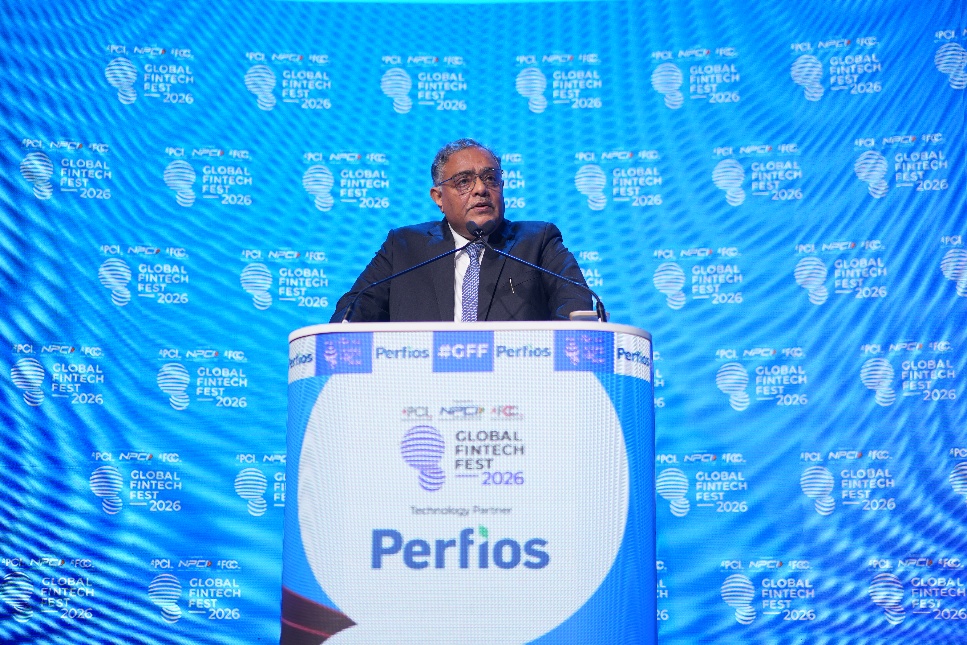
Bengaluru, 10 September 2026: “The next financial infrastructure must be intelligent enough to understand intent, programmable enough to coordinate value, resilient enough to withstand future threats, and inclusive enough to serve every citizen,” said Shri Ajay Kumar Choudhary, Non–Executive Chairman and Independent Director, National Payments Corporation of India (NPCI), delivering the keynote address at the 7th Global FinTech Fest (GFF) 2026.
Speaking on the theme “The Architecture of Trust: Moving Beyond Payments into Intelligence and Programmability,” Shri Choudhary said the financial system is entering a phase where systems are becoming more intelligent, assets and transactions more programmable, and digital trust itself is being redefined. He added that “The question is no longer whether new technologies will affect finance, but how effectively we navigate this transition, and capture the opportunities without losing control of the risks.”
Marking 10 years of UPI, Shri Choudhary highlighted that UPI processed more than 24.5 billion transactions worth Rs 29.8 lakh crore in August 2026 alone, through 752 participating banks. UPI has evolved from a payment interface into infrastructure embedded in everyday life, he said, crediting national leadership that placed digital payments at the heart of India’s development journey. He paid tribute to Hon’ble Prime Minister Shri Narendra Modi Ji’s consistent efforts in championing UPI globally, making it one of the most visible expressions of India’s technological capability and confidence.
Speaking on the future of financial infrastructure, Shri Choudhary outlined three key transitions that will define the next phase of transformation. The first, he said, is the shift from Instructions to Intent, where Agentic AI could enable systems to interpret objectives and act within authorised mandates. However, he stressed that human authority must remain fundamental to financial systems. “The objective should be bounded and accountable agency, not unlimited machine autonomy,” he said, adding that NPCI is examining protocols to identify and authorise digital agents within the UPI ecosystem while preserving interoperability and settlement finality.
The second is from Moving Money to Coordinating Value. Programmability can link the movement of money or assets to agreed conditions. He referred to NPCI‘s open-source enterprise blockchain platform, Drunix, designed to support tokenisation platforms, digital asset ecosystems and multi-organisation networks. Common standards and interoperability, he said, will be essential to preventing fragmentation.
The third is confidence that money will retain its value, transactions will complete as intended, data will be protected, and responsibility will remain identifiable when something goes wrong. It is also the movement from Present Security to Future Resilience. Shri Choudhary flagged that advances in quantum computing require financial institutions to prepare well before existing cryptographic protections are threatened. He described the shift toward post-quantum cryptography as “a long-term, ecosystem-wide exercise,” involving boards, regulators, banks, Fintechs and cybersecurity specialists.
He mentioned that the real transformation will emerge when intelligence, programmability, and trust operate together. He, however, cautioned that as these technologies converge; their risks may also become interconnected. He noted that “model risk can turn into payment or conduct risk, cloud dependence can create operational and sovereignty concerns, and errors in programmable conditions can become settlement problems”. Risk management must therefore follow the activity across the entire chain rather than assess each technology in isolation.
On sovereignty risk, he stressed that financial institutions must retain control and meaningful choice over critical technology, avoid excessive dependence on any single model, cloud or technology provider, preserve portability across providers, and build the skills and institutional capacity required to deploy and supervise new technologies responsibly. He added that “sovereignty is ultimately a combination of control, capability, choice and preparedness” and further noted that “at sovereign level, regional or global cooperation on the issue is another way forward.”
Concluding his address, Shri Choudhary emphasised that the true value of technology lies not merely in driving efficiency, but in enabling better decisions, stronger resilience, greater inclusion, and improved outcomes for society. Reflecting on ten years of UPI, he congratulated the leadership and staff of NPCI, and acknowledged the support of the Reserve Bank of India and the Government of India in the UPI journey over the past decade. Expressing confidence in the road ahead, he said, “NPCI will continue to provide leadership in the emerging, scalable and inclusive technological progress to redefine the finance of tomorrow.”