


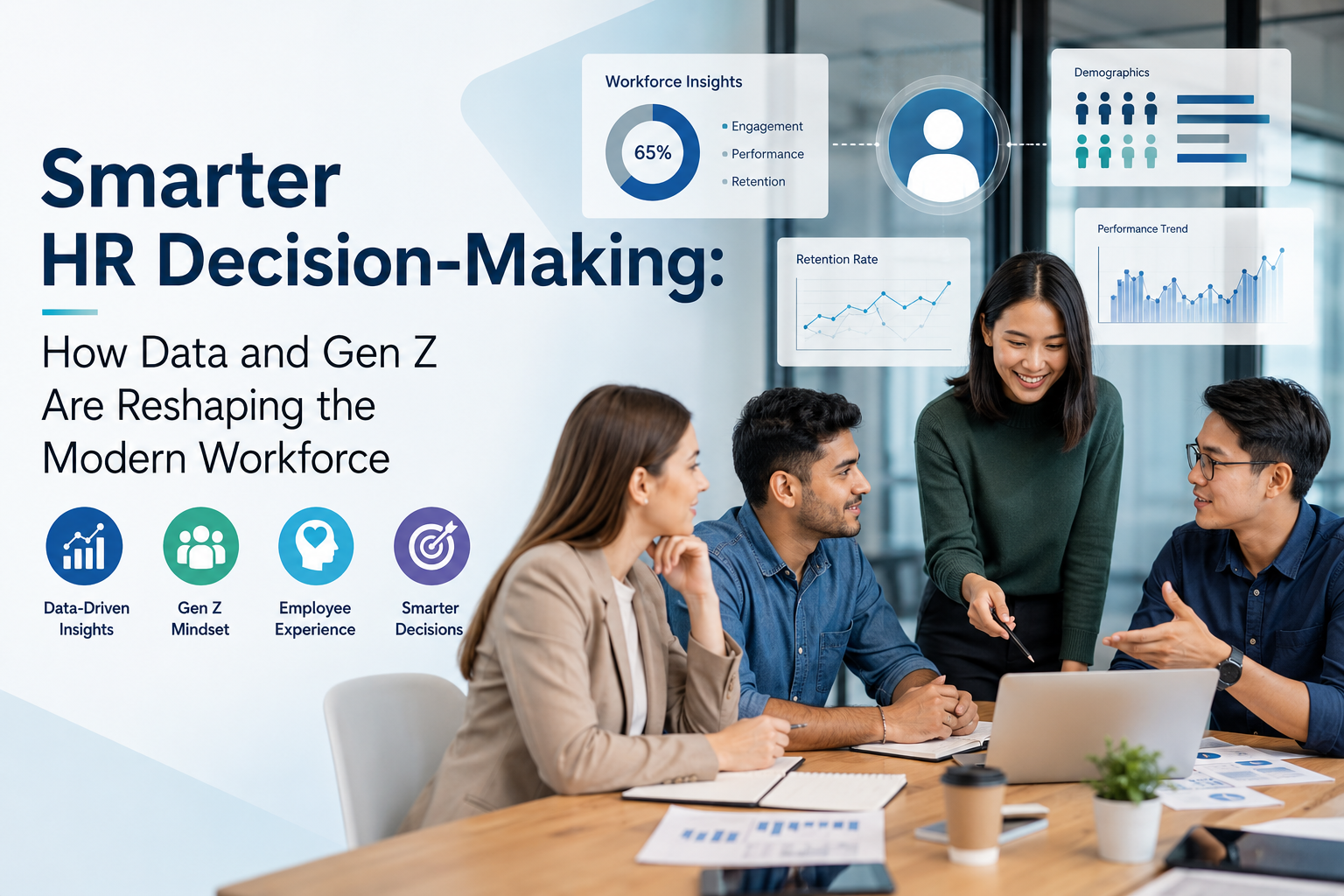
Aug 18: Human resources is moving well beyond hiring, payroll and employee administration. As workforce expectations change and businesses become more data-driven, HR teams are increasingly responsible for decisions that directly influence productivity, retention and business growth.
That includes decisions around remuneration and salary, benefits, workforce mobility, skills, employee wellbeing and workforce planning.
The challenge is no longer simply having access to employee data. HR professionals need reliable insights quickly enough to turn that information into action.
This is becoming particularly important as Gen Z reshapes workplace expectations, bringing greater emphasis on career development, financial security, flexibility, wellbeing and meaningful work.
Why Smarter HR Decision-Making Matters
Modern HR teams work with information from multiple areas of the employee lifecycle, including recruitment, remuneration, performance, attrition, benefits and skills.
Turning all of that information into a clear picture can be difficult when data is spread across different systems or requires extensive manual analysis.
Deloitte’s 2025 Global Human Capital Trends research highlights the importance of decision-making capabilities. It found that high-performing organizations were 22 times more likely to openly discuss how decisions are made, nine times more likely to teach decision-making skills and seven times more likely to provide tools that support higher-quality decisions.
For HR, this points to a broader shift: better workforce decisions require not only good data, but also the tools, skills and culture to use it effectively.
Gen Z Is Changing the HR Playbook
Gen Z is bringing new expectations into the workplace, making it increasingly important for HR teams to understand what different employee groups value.
Deloitte’s 2025 Gen Z and Millennial Survey, which included more than 23,000 respondents across 44 countries, found that Gen Z is focused on a combination of money, meaning and wellbeing. Learning and development also ranks among the leading reasons Gen Z chooses an employer.
The India findings make the trend even more relevant for Indian employers. Deloitte found that 94% of Gen Z respondents in India consider on-the-job learning helpful for career growth, while 85% of Indian Gen Z respondents said they already use generative AI at work.
These findings suggest that HR strategies built only around salary and traditional career ladders may not fully address what younger employees are looking for.
Smarter Remuneration and Salary Decisions
Reliable remuneration and salary data can help HR teams benchmark pay, identify gaps and maintain competitive compensation structures.
It can support decisions on:
- Salary adjustments
- Promotions
- Pay equity
- Compensation benchmarking
- Workforce budgets
For Gen Z, financial security remains an important consideration. Deloitte’s global survey found that 48% of Gen Z respondents said they did not feel financially secure, up from 30% in the previous year’s survey.
This makes compensation data particularly important. HR teams can combine salary information with retention, engagement and workforce data to better understand whether compensation structures are competitive and where adjustments may be needed.
Benefits Need to Reflect Changing Expectations
Salary is only one part of the employee value proposition.
Gen Z is also placing greater emphasis on wellbeing, flexibility, learning and purpose. Deloitte’s research found that 89% of Gen Z respondents consider a sense of purpose important to job satisfaction and wellbeing.
For HR teams, this means benefits decisions need to be informed by employee needs rather than assumptions.
Analyzing benefits participation, employee feedback and workforce demographics can help organizations understand which programs are delivering value and where changes may be required.
Career Growth Is Becoming a Data Point
Career development is particularly significant for Gen Z.
Deloitte found that 70% of Gen Z respondents globally said they were developing skills to advance their careers at least once a week, while 67% said they were developing skills outside working hours.
In India, the emphasis is even clearer: 94% of Gen Z respondents highlighted on-the-job learning as helpful for career growth.
This gives HR teams another area where workforce data can improve decisions.
Organizations can track skills, training participation, internal mobility and career progression to identify where employees need additional support.
Rather than waiting for employees to leave because they cannot see a future within the organization, HR can use these insights to identify development opportunities earlier.
Workforce Mobility Needs Better Visibility
Workforce mobility is also becoming more complex as companies operate across locations and adopt hybrid and distributed work models.
Mobility can involve relocation, role changes, internal transfers and flexible work arrangements.
HR teams can use workforce data to understand where talent is moving, which locations are attracting employees and where skill shortages may be developing.
For Gen Z, mobility can also mean having opportunities to move between roles, develop new capabilities and build a career without following a traditional linear path.
Workforce Planning Can Become More Proactive
Workforce planning cannot focus only on today’s headcount.
Organizations need to understand which skills they will require in the future, where talent gaps could emerge and how technology may change existing roles.
This is particularly important as Gen Z enters the workforce alongside experienced employees from older generations.
HR analytics can help organizations assess current capabilities against future requirements and determine whether they need to hire, reskill, redeploy or develop employees.
This makes workforce planning more proactive instead of reactive.
AI Is Changing HR Decision-Making
Artificial intelligence is adding another layer to workforce analytics.
AI can help HR teams process large volumes of information, identify patterns and support areas such as recruitment, skills planning, workforce forecasting and employee analytics.
The shift is already visible in HR roles. SHRM’s 2025 analysis examined 3.9 million unique HR job postings in the US over a decade and found rapidly growing demand for AI and data-driven technology expertise.
Gen Z is also becoming part of this transformation. Deloitte found that 85% of Gen Z respondents in India were already using GenAI in their day-to-day work.
For HR leaders, the implication is clear: workforce strategies need to account for both changing employee expectations and changing technology.
Data Alone Does Not Make Better HR Decisions
Having more data does not automatically lead to better decisions.
HR teams need to understand what is happening, why it is happening and what action should follow.
For example, if Gen Z employees show higher attrition, salary could be one factor. But the underlying issue could also involve career progression, management support, flexibility, workload or workplace culture.
Data can identify the pattern. Human expertise is needed to interpret it.
This is why smarter HR decision-making should combine workforce analytics with human judgment rather than treating technology as a replacement for HR professionals.
Building a Smarter, More Responsive HR Function
The future of HR will increasingly depend on the ability to connect reliable data with practical workforce decisions.
For HR leaders, this means looking beyond traditional metrics and developing a broader understanding of what drives employees across different generations.
For Gen Z, the evidence points toward a workforce that values financial security, learning, purpose and wellbeing alongside career progression.
Organizations that understand these priorities can make more informed decisions about remuneration, benefits, mobility, skills and workforce planning.
Ultimately, smarter HR decision-making is not about collecting more data. It is about turning the right data into timely, meaningful action.
With reliable insights and the right technology, HR professionals can work smarter, move faster and make more confident workforce decisions—while creating workplaces that are better equipped for the expectations of the next generation.