


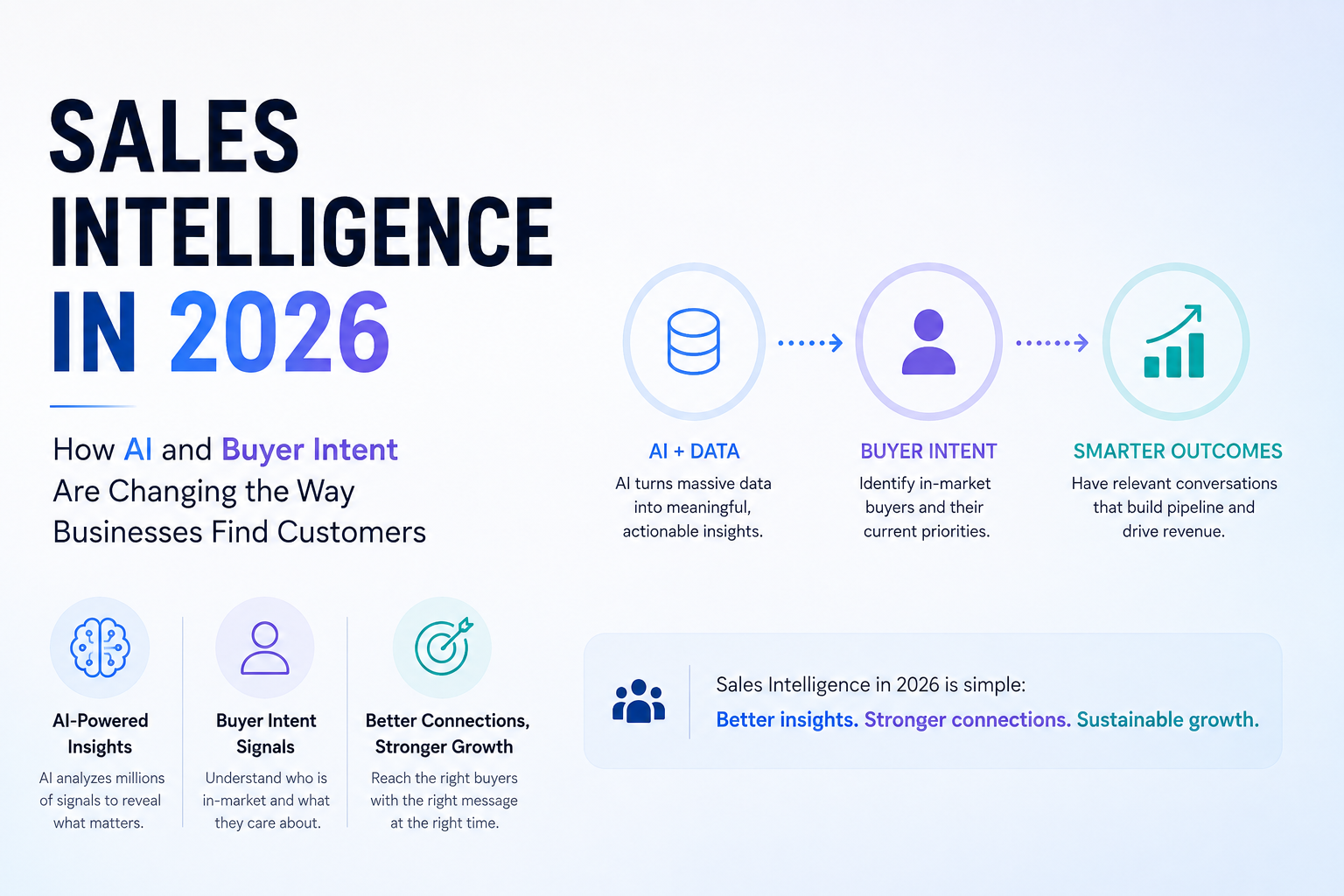
The way businesses sell is changing rapidly.
Sept 07: Today’s B2B buyers are more informed, more digitally connected and increasingly comfortable using AI before they ever speak to a salesperson. A Gartner survey of 645 B2B buyers, reported in May 2026, found that buyers used an average of seven information sources during a recent purchase, while 45% said they had used generative AI to research vendors and products. The survey also found that 67% preferred a sales-rep-free experience and 70% preferred a completely digital, self-service buying experience.
For sales teams, this represents a significant change.
The old approach of building a large contact database and reaching out to as many prospects as possible is becoming less effective. Businesses now need to understand which prospects are most likely to buy, what they may need and when they are most likely to be ready for a conversation.
This is where sales intelligence is becoming increasingly valuable.
In simple terms, sales intelligence is information that helps sales teams find better prospects and close deals more effectively. It brings together useful information about companies, decision-makers, market activity and buying behaviour, helping salespeople spend more time on opportunities that have genuine potential.
The focus is no longer simply on generating more leads.
It is about finding the right leads, understanding their intent and turning information into timely sales action.
Why Sales Intelligence Matters in Today’s Market
Having thousands of contacts in a CRM may look like a healthy pipeline, but numbers alone don’t guarantee sales.
A company may have hundreds of potential customers, yet only a small percentage may be actively looking for its product or service at a particular time.
Sales intelligence helps sales teams identify those differences.
It can highlight signals such as:
- A company expanding into a new market
- New funding or investment
- Hiring for specific positions
- Changes in senior management
- Adoption of new technology
- Increased website activity
- Engagement with specific products or services
- Research around a particular business problem
When several of these signals appear together, they can provide a stronger reason for a salesperson to start a conversation.
AI Is Making Prospect Research Faster
Artificial intelligence is one of the biggest trends shaping sales intelligence in 2026.
Salespeople traditionally spend considerable time researching companies before approaching them. AI-powered tools can reduce some of that manual work by analysing information and highlighting accounts that may deserve attention.
For example, instead of simply telling a salesperson that a company operates in the manufacturing sector, an AI-enabled system could highlight that the company has recently expanded production, hired operations staff and shown interest in automation.
That gives the salesperson something much more useful than a name and telephone number: context.
AI is not necessarily replacing the salesperson. It is helping the salesperson arrive better prepared.
Gartner’s research has also pointed to the potential of AI in sales. Its 2024 survey found that sellers who effectively partnered with AI were 3.7 times more likely to meet their sales quota than those who did not.
Buyer Intent Is Becoming a Key Sales Signal
One of the most important developments in sales intelligence is the growing focus on buyer intent.
Instead of asking only, “Who could buy from us?”, businesses are increasingly asking:
“Who may be looking for this right now?”
That distinction can significantly change how a sales team prioritises its pipeline.
Consider a company selling warehouse management software. Thousands of businesses may potentially need such a solution. But a company that has just opened a new warehouse, expanded its workforce and started researching warehouse automation could represent a much stronger opportunity.
Sales intelligence helps identify these kinds of signals.
It doesn’t guarantee that a prospect will buy. Instead, it gives sales teams more information to decide where to focus their time first.
B2B Buyers Are Doing More Research Before Speaking to Sales
The modern B2B buyer is increasingly independent.
Gartner’s 2026 research found that 67% of buyers preferred a sales-rep-free experience, while 70% preferred a completely digital, self-service buying experience. Yet 69% said they preferred to validate AI-generated insights with sales representatives.
That combination is important.
Buyers may not want a salesperson involved at the beginning of their research, but they still want expert input when they are closer to making a decision.
This changes the role of the salesperson.
Instead of simply explaining what a product does, sales professionals increasingly need to provide context, expertise, validation and solutions tailored to the customer’s situation.
Account-Based Selling Is Becoming More Data-Driven
Sales intelligence also fits naturally into the growing use of Account-Based Marketing (ABM) and Account-Based Selling (ABS).
Rather than marketing to a broad audience and hoping the right companies respond, businesses can identify a defined group of high-value accounts and build their sales and marketing efforts around them.
Sales intelligence can help identify:
- Which accounts fit the ideal customer profile
- Who the key decision-makers are
- What challenges the company may be facing
- What technologies it currently uses
- Recent business developments
- Relevant buying signals
- Previous interactions with the brand
This allows sales and marketing teams to work with a much clearer picture of their target accounts.
For high-value B2B products and services, that level of focus can be more useful than simply chasing a large number of low-quality leads.
The Right Lead Is More Valuable Than a Long Lead List
One of the biggest mistakes in sales is treating every lead equally.
Sales intelligence can help companies divide prospects according to their potential and level of engagement.
High-priority leads may have a strong business fit and clear buying signals.
Medium-priority leads may match the target profile but show limited current interest.
Long-term prospects may be suitable customers but have no immediate requirement.
This simple distinction can help salespeople spend more time on prospects with a stronger possibility of conversion.
Personalisation Needs to Go Beyond Using a Customer’s Name
Personalised sales communication has become common, but adding a prospect’s name to an email does not necessarily make the message personal.
Real personalisation comes from understanding the prospect’s business.
If a company has recently expanded its operations, a supplier can discuss how its solution could support that growth.
If a business has announced a sustainability initiative, a relevant technology provider can build its conversation around efficiency, energy management or sustainability.
The objective is not to make a sales message sound artificially personalised.
It is to make the conversation relevant to what the prospect is actually dealing with.
Sales and Marketing Need to Share Intelligence
Sales intelligence should not remain inside the sales department.
Marketing teams already collect valuable information through websites, content, email campaigns, events and social media.
Sales teams gather another layer of information through calls, meetings, proposals and customer feedback.
Bringing these insights together can provide a much clearer picture of what potential customers want.
For example, if marketing sees strong engagement around a particular industry topic and sales teams are hearing similar questions from prospects, the business can use that information to improve both its content and its sales approach.
Good Intelligence Starts With Good Data
There is one important rule businesses cannot ignore:
Bad data produces bad intelligence.
Outdated contact details, incorrect job titles, duplicate records and irrelevant companies can reduce the value of even sophisticated sales technology.
Businesses therefore need to regularly clean, verify and update their customer and prospect databases.
Privacy and responsible data use are equally important as companies adopt AI-powered sales tools.
Technology can process information quickly, but the quality of that information still determines how useful the resulting insight will be.
Sales Intelligence Is Moving Toward Real-Time Insights
Traditional sales databases are essentially snapshots.
A company that looked like an excellent prospect six months ago may have completely different priorities today.
It may have reduced its budget, changed leadership or postponed an investment.
At the same time, another company may suddenly become a strong opportunity after securing funding, expanding into a new market or announcing a major project.
Real-time sales intelligence aims to capture these changes as they happen.
This means sales prospecting is gradually moving from a one-time search for contacts to an ongoing process of identifying changing opportunities.
What Businesses Should Focus on in 2026
Companies don’t necessarily need the most complicated sales technology available. They need a clear strategy for turning information into useful sales decisions.
Define the Ideal Customer
Be specific about the companies most likely to benefit from your product or service. Industry, company size, location, business model and potential value can all help define the ideal customer.
Identify Meaningful Buying Signals
Look beyond contact information. Monitor business developments, engagement, technology adoption and other signals that may indicate a changing requirement.
Use AI Where It Saves Time
AI can assist with research, lead scoring, account prioritisation and repetitive tasks, allowing salespeople to spend more time on conversations and relationships.
Keep Data Updated
Regularly verify company information, contact details and account records.
Personalise Around Business Needs
Use available intelligence to understand a prospect’s business before approaching them.
Connect Sales and Marketing
Make sure both teams can learn from the same customer and market signals.
Measure Revenue, Not Just Activity
Track qualified leads, meetings, conversion rates, sales-cycle length and revenue instead of focusing only on the number of contacts or emails generated.
The Future of Sales Is About Better Information
Sales teams will continue to use technology, automation and AI, but the real advantage will not come from simply having more tools.
It will come from having better information and knowing what to do with it.
As buyers become more independent, AI becomes part of the research process and digital channels influence purchasing decisions, sales teams need to become more selective about where they spend their time.
The question is no longer simply:
“How many leads can we generate?”
It is:
“Which prospects are most likely to need us—and how can we approach them at the right time?”
That is the real value of sales intelligence.
It turns scattered information into useful insight, helping businesses identify stronger prospects, have more relevant conversations and improve their chances of closing a deal.
In 2026, the competitive advantage may not belong to the business with the biggest sales database. It may belong to the one that understands its prospects best.