


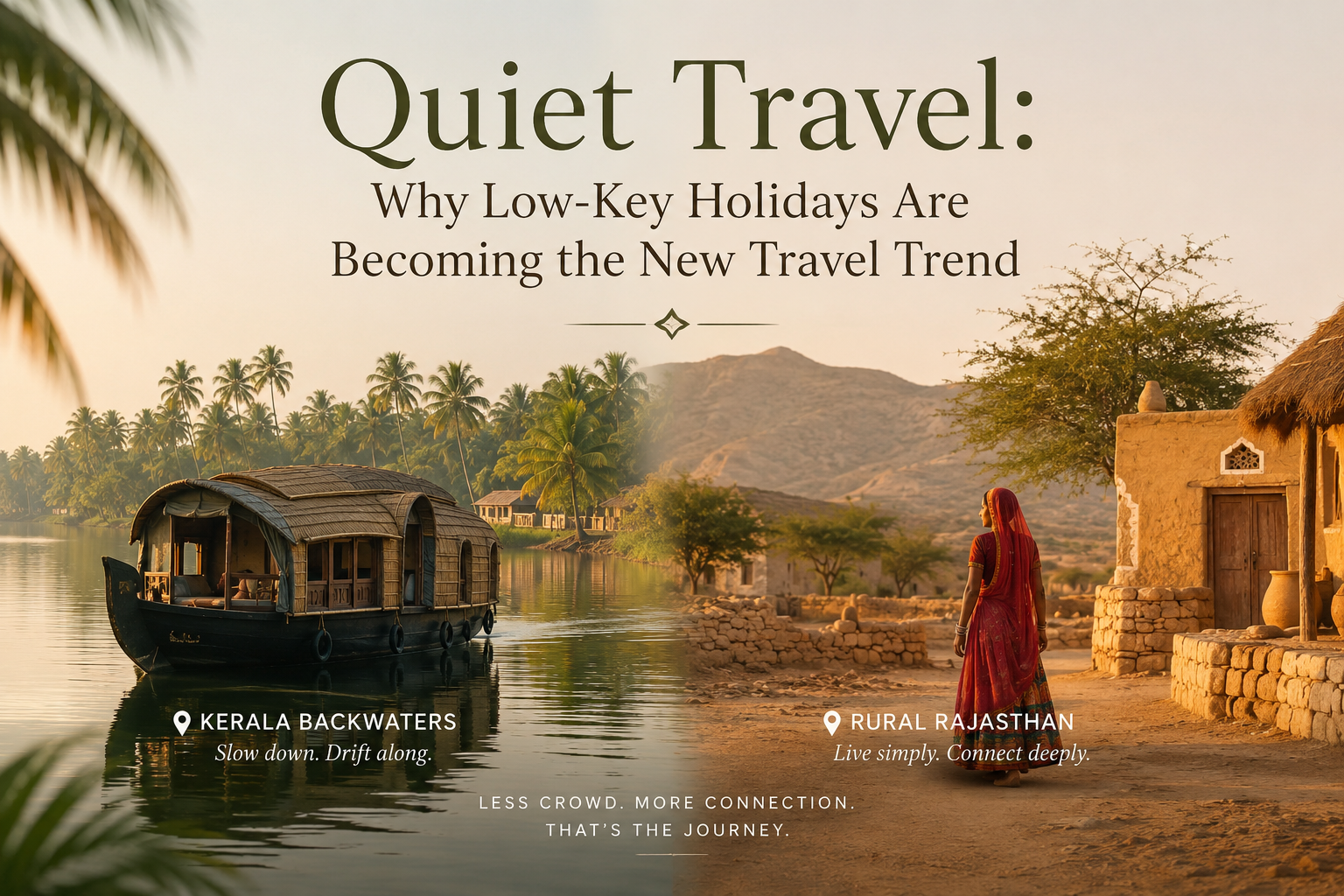
Aug 28: For years, holidays have been associated with packed itineraries, famous landmarks, busy beaches and a constant stream of photographs for social media. But a different approach to travel is gaining attention: quiet travel.
Instead of trying to see everything, travellers are choosing to do less. They are looking for peaceful destinations, slower mornings, uncrowded experiences, nature, local food and enough free time to simply switch off.
Quiet travel is not yet a formally measured tourism category, but it fits into several established travel trends around wellness, meaningful experiences, less-crowded destinations and JOMO, or the Joy of Missing Out. Expedia Group’s Unpack ’25 report, based on research involving more than 25,000 travellers across 19 countries, found that 63% of consumers said they were likely to visit a less-known and less-crowded destination on their next trip.
The broader wellness economy also provides an important backdrop. The Global Wellness Institute estimates that global wellness tourism reached $893.9 billion in 2024 and projects it to reach approximately $1.38 trillion by 2029.
Together, these trends suggest that travellers are increasingly interested in holidays that offer more than sightseeing. They want experiences that help them slow down, reconnect and return home feeling refreshed.
What Is Quiet Travel?
Quiet travel is not necessarily about complete silence or isolation. It is about travelling at a slower and more intentional pace.
A quiet holiday could mean staying in a small village instead of a crowded tourist centre, spending several days in one destination rather than changing hotels every night, or choosing a nature retreat instead of following a packed sightseeing schedule.
The emphasis is on quality rather than quantity.
A traveller might spend a morning walking through a forest, reading beside a lake, enjoying a long local breakfast or watching the sunset instead of rushing between multiple attractions.
Why Are Low-Key Holidays Becoming Popular?
Modern life is increasingly connected and fast-paced. Work notifications, social media, traffic and crowded urban environments can make it difficult to properly switch off.
Travel offers an opportunity to create physical and mental distance from everyday routines.
Expedia’s research provides evidence of this changing mindset. Its Unpack ’25 report identified JOMO Travel as one of the trends influencing holiday choices, with 62% of travellers saying JOMO travel reduces stress and anxiety.
This does not mean travellers are abandoning experiences. Instead, they may be becoming more selective about how they spend their time.
Quiet Travel Is Different From Traditional Luxury
Quiet travel does not necessarily mean expensive travel.
Luxury resorts may offer private villas, secluded beaches and personalised wellness programmes, but the same philosophy can be found in a modest homestay, countryside guesthouse or small coastal property.
The luxury is often time itself.
Having an unplanned afternoon, enjoying a quiet meal, taking a long walk or waking up without an alarm can feel more valuable than expensive amenities.
This is creating a broader interpretation of luxury travel: fewer crowds, greater privacy and more meaningful experiences.
Quiet Travel vs Slow Travel
The two concepts overlap, but they are not exactly the same.
Slow travel generally focuses on reducing the pace of a trip, staying longer in one place and experiencing destinations more deeply.
Quiet travel places greater emphasis on calm, low stimulation and mental space.
A quiet holiday can therefore be a form of slow travel, but the central objective is not simply spending more time somewhere. It is creating an environment where travellers can genuinely disconnect from the pressure to constantly do more.
Nature Is at the Centre of Quiet Holidays
Nature naturally lends itself to low-key travel.
Mountains, forests, lakes, beaches, rural landscapes and dark-sky locations provide environments where travellers can step away from urban routines.
Activities such as:
- Forest walks
- Stargazing
- Birdwatching
- Cycling
- Kayaking
- Meditation
- Nature photography
- Sunrise and sunset walks
can become the main experience rather than activities squeezed between sightseeing stops.
Booking.com’s 2025 Travel Predictions similarly highlighted growing interest in off-the-beaten-path experiences, wellness and nature-based activities, suggesting that travellers are increasingly looking beyond conventional tourism experiences.
The Rise of Less-Crowded Destinations
One of the clearest indicators of the quiet-travel mindset is the interest in alternatives to heavily visited tourist hotspots.
Expedia’s Unpack ’25 report calls these “Detour Destinations”—less-known places located near major tourist centres. The report found that 63% of consumers said they were likely to visit such a destination on their next trip.
This could be significant for smaller destinations.
Rather than competing directly with famous tourist cities, lesser-known locations can attract visitors by offering nature, local culture, authentic experiences and fewer crowds.
India Has Strong Potential for Quiet Travel
India has significant potential for low-key holidays because of its diverse landscapes and cultural traditions.
Travellers seeking slower experiences can explore:
Kerala Backwaters
Instead of rushing between attractions, visitors can spend several days on or beside the backwaters, combining local cuisine, village experiences and wellness activities.
Coorg, Karnataka
Coffee plantations, forested landscapes and homestays make the region well suited to travellers looking for a slower connection with nature.
Himalayan Villages
Smaller mountain communities can offer walking trails, local food, scenic landscapes and a break from urban routines.
Rural Rajasthan
Away from the major tourist circuits, rural Rajasthan offers opportunities to experience traditional food, crafts, village life and desert landscapes at a slower pace.
Northeast India
The region’s landscapes, biodiversity and cultural diversity offer significant potential for travellers seeking nature-led and less conventional experiences.
The opportunity is not necessarily to avoid India’s popular destinations but to experience them differently.
Digital Detox Is Becoming Part of the Experience
For some travellers, quiet travel also means reducing screen time.
A digital detox holiday may involve limiting social media, switching off notifications or choosing accommodation where the surroundings—not the Wi-Fi connection—are the main attraction.
Technology does not have to disappear completely. Smartphones can still be useful for navigation, photography and emergencies.
The difference is that technology becomes a tool rather than the centre of the holiday.
Hotels and Resorts Are Adapting
The growing interest in wellbeing and less-crowded experiences creates opportunities for the hospitality industry.
Hotels and resorts can respond by offering:
- Quiet zones
- Nature-based experiences
- Wellness programmes
- Digital detox packages
- Private dining
- Guided walks
- Meditation sessions
- Slow-food experiences
- Longer-stay packages
- Flexible itineraries
The most successful properties may be those that sell an experience of calm rather than simply adding “wellness” to their marketing.
Quiet Travel Does Not Mean Boring Travel
One misconception is that a low-key holiday must be uneventful.
In reality, quiet travel can offer highly engaging experiences.
Learning to cook a regional dish, walking through a plantation, observing wildlife, exploring a village or watching a meteor shower can create stronger memories than rushing through a conventional sightseeing itinerary.
The difference is that the experience is immersive rather than hurried.
The Business Opportunity Behind Quiet Travel
Quiet travel also creates a potential commercial opportunity for destinations and hospitality businesses.
Wellness tourism alone represented nearly $894 billion globally in 2024, according to the Global Wellness Institute. The organisation expects the sector to continue expanding through 2029.
Hotels and destinations can respond by creating packages built around genuine customer needs rather than simply using wellness as a marketing label.
A property could offer a three-night digital detox stay, a nature-focused weekend, a slow-food retreat or a flexible itinerary designed around rest.
For smaller destinations, quiet travel could also help distribute tourism beyond overcrowded hotspots and encourage visitors to spend more time within local communities.
What the Future of Quiet Travel Could Look Like
Quiet travel may influence mainstream tourism even if the term itself remains relatively new.
Travellers could increasingly prioritise:
- Fewer destinations per trip
- Longer stays
- Nature-based accommodation
- Wellness experiences
- Authentic local interactions
- Less-crowded attractions
- Flexible itineraries
- Digital detox
- Sustainable travel
- More personal time
The direction is consistent with wider travel research. Booking.com has identified growing demand for authentic, off-the-beaten-path experiences and a stronger connection between travel, wellness and nature.
Conclusion
Quiet travel represents a shift from travelling more to travelling better.
Instead of measuring a holiday by the number of attractions visited, travellers are increasingly interested in how they feel during and after the trip.
The evidence from Expedia’s research into JOMO and less-crowded destinations, combined with the rapid growth of wellness tourism, suggests that the desire for calmer and more meaningful travel experiences has a strong foundation.
For the tourism industry, the message is equally important: the next significant travel opportunity may not be the loudest, busiest or most crowded one.
It may be the destination that gives travellers something increasingly difficult to find in everyday life—time, space and permission to slow down.