


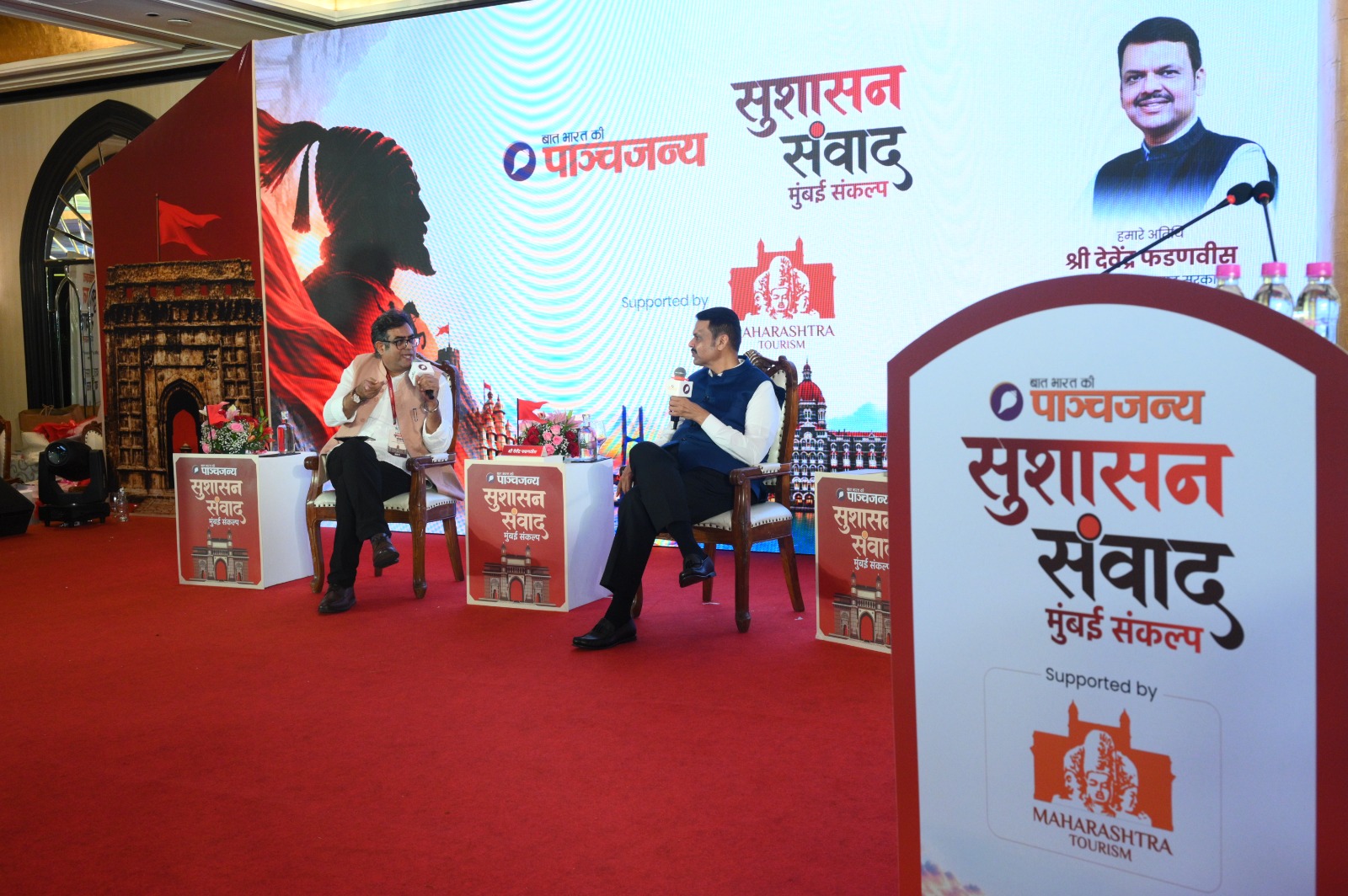
Panchjanya’s ‘Sushasan Samvaad – Mumbai Sankalp’ brought together prominent public figures, policymakers, thinkers, social leaders and experts at The Taj Mahal Palace, Colaba, Mumbai, for a dialogue on governance, leadership, social responsibility and India’s development journey.
The latest edition of Panchjanya’s dialogue series focused on the idea of sushasan, or good governance, and the role of institutions, leadership and citizens in shaping a stronger and more responsible India. The discussions also provided a platform for conversations around public life, culture, education, social responsibility and the changing aspirations of the country.
The event was attended by Maharashtra Chief Minister Shri Devendra Fadnavis, Maharashtra Governor Shri Jishnu Dev Varma, Shri V. Bhagaiah, Member, Akhil Bharatiya Karyakarini, Rashtriya Swayamsevak Sangh; Swami Nijatmanand Puri, Spiritual Director, Amrita Hospital, Faridabad; Dr. Chandraprakash Dwivedi, renowned filmmaker and director; Shri Ravi Kishan, Actor and Member of Parliament from Gorakhpur; Shri Nitish Bharadwaj, Actor; Shri Nitesh Rane, Cabinet Minister, Maharashtra Government; Shri Siddharth Patni, Secretary, Seemant Seva Foundation; Shrimati Chayaa Nanjappaand, Women Entrepreneur; and Shri Ashish Kumar Chauhan, Managing Director and CEO, NSE.
In his inaugural speech at the event, Shri Hitesh Shankar, Editor, Panchjanya, said, “Mumbai is a fitting venue for this dialogue. Its history stands as a living example that foreign invasions may challenge a nation, but they cannot weaken its spirit or its resolve to develop. Panchjanya’s endeavour through Sushasan Samvaad is to make a humble contribution towards finding new answers to the social questions before us through progressive and meaningful discussion. As India moves towards the vision of 2047, these conversations become even more significant. From understanding the changing influence of cinema and OTT platforms on society to asking whether education and healthcare should be driven purely by commercial considerations, we must examine the questions shaping our society with openness, responsibility and a long-term national perspective.”
Maharashtra Governor Shri Jishnu Dev Varma said, “Viksit Bharat is not merely about economic growth or an increase in monetary value. It is about ensuring the last-mile delivery of government policies and making their benefits reach the last person in society. The true meaning of Viksit Bharat will be realised only when every government policy reaches those for whom it is intended. This requires a well-coordinated partnership between the government and society, which is the essence of good governance. Above all, establishing trust between the government and the people is vital to making governance truly effective.”
Maharashtra Chief Minister Shri Devendra Fadnavis said, “Maharashtra has a long tradition of enterprise, innovation and public participation. The challenge before us is to combine these strengths with effective institutions and responsive governance as we work towards the next phase of the state’s development. We are bridging the gap through skill-based learning and industry-led educational institutions, while creating greater employment opportunities through new industries, support for startups and investments in high-demand, futuristic sectors such as electric vehicles. There is no difference between our promises and our intentions; our focus remains on translating our commitments into tangible outcomes. At the same time, humanity is facing grave societal challenges, including global climate change. Maharashtra is therefore working towards greater adoption of renewable energy and strengthening essential infrastructure such as water treatment plants, while pursuing development that is responsive to the needs of both people and the environment.”
The conversations at Sushasan Samvaad – Mumbai Sankalp also explored the relationship between governance and India’s wider social and cultural traditions. Speakers reflected on the importance of responsible leadership, institutional capacity, entrepreneurship, education and citizen participation in addressing the opportunities and challenges before the country.
The event also brought together voices from diverse fields, including public administration, politics, cinema, spirituality, business and social development. Shri V. Bhagaiah, Member, Akhil Bharatiya Karyakarini, Rashtriya Swayamsevak Sangh, also inaugurated a book based on the Shrimad Bhagavad Gita by Rajiv Tuli Ji of Suruchi Prakashan. Their participation underlined the need for wider conversations around governance that extend beyond government institutions and involve citizens and stakeholders from different sections of society.
Panchjanya has been developing a series of dialogue platforms across the country to bring contemporary national and social issues into public conversation. Sushasan Samvaad – Mumbai Sankalp adds Mumbai to this continuing effort and provides a platform to discuss the idea of good governance in the context of a rapidly changing India.
The programme was hosted by Shri Hitesh Shankar, Editor, Panchjanya, and Shri Arun Kumar Goyal, Managing Director, Bharat Prakashan (Delhi) Limited.