


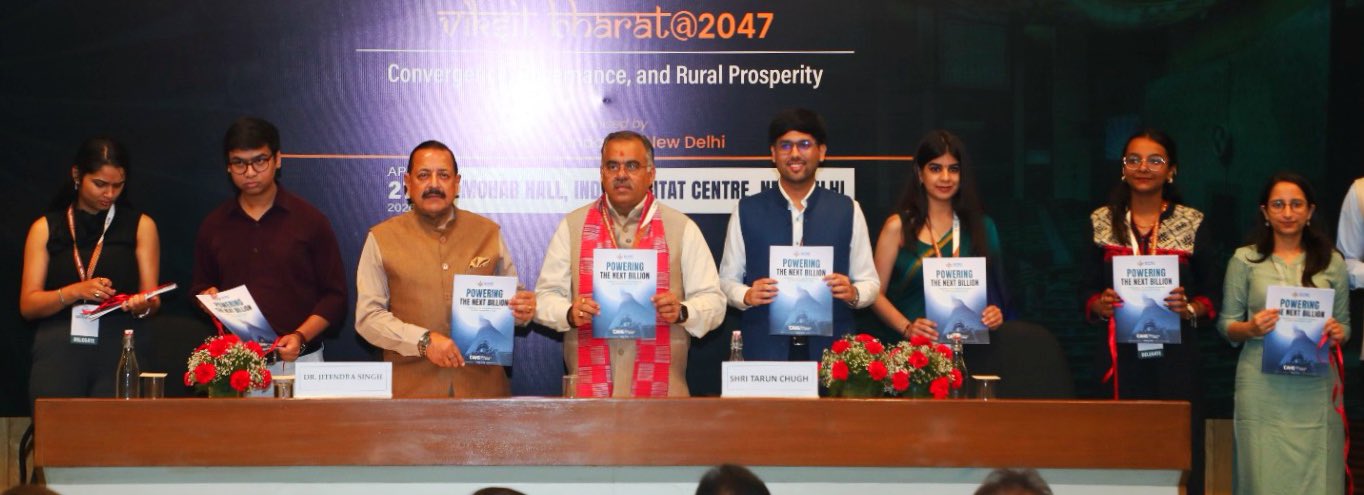
New Delhi, Apr 29: The Nation First Policy Research and Change Foundation (NFPRC) convened a workshop for parliamentarians and legislators on advancing rural development through convergence-led governance, institutional reforms, and data-driven approaches.
Titled “Transforming Rural India for Viksit Bharat@2047: Convergence, Governance, and Rural Prosperity”, the workshop was held at the India Habitat Centre and saw participation from Members of Parliament, Members of Legislative Assemblies, and policy experts from across the country.
The discussions focused on improving rural development outcomes through coordinated implementation mechanisms, with key themes including rural asset creation, land governance reforms, data-driven monitoring, and strengthening livelihoods.
NFPRC Chairperson Tarun Chugh, in his welcome address, emphasised the need for outcome-oriented planning and institutional coordination, along with leveraging data to enhance service delivery at the grassroots level.
A session led by Dr. Bhagwat Karad centred on rural employment and asset creation through convergence and saturation approaches. It highlighted the role of initiatives such as VB-G RAM (Gramin), along with digital tools like Direct Benefit Transfer (DBT) and geotagging, in improving transparency and implementation efficiency. Issues such as wage payment delays, infrastructure linkages, and the need for integrated planning at the Gram Panchayat level were also discussed.
Rajya Sabha MP Sudhanshu Trivedi conducted a session on digital communication strategies for legislators, outlining practical approaches to communicate governance outcomes across platforms such as X, Instagram, Facebook, and WhatsApp, with a focus on structured content, timely dissemination, and countering misinformation.
Former IAS officer B K Agarwal spoke on reforms in rural land governance, highlighting the importance of digitisation and transparency in improving property rights, enhancing scheme targeting, and enabling financial inclusion. He also underscored the role of legislative oversight in addressing implementation gaps and strengthening inter-agency coordination.
Highlighting the significance of NFPRC’s research, Union Minister Dr. Jitendra Singh stated “The identification of 49 brownfield thermal sites for Small Modular Reactor (SMR) in the NFPRC’S report is the kind of targeted research that accelerates deployment”.
NFPRC’s also launched a report, “Powering the Next Billion,” which identifies 11.2 GW of retiring coal capacity as a viable pathway for accelerating Small Modular Reactor (SMR) deployment by leveraging existing grid infrastructure, water resources, and workforce, while minimising delays and avoiding land acquisition challenges.
The event concluded with a call for strengthening convergence across schemes, deepening data-driven governance, and fostering sustained collaboration between legislators, policy practitioners, and research institutions.
Delivering the vote of thanks, NFPRC Board Member Mansa Mohan expressed appreciation to the speakers and participants and reiterated the Foundation’s commitment to fostering continued policy dialogue and legislative engagement.
NFPRC said it will continue its engagement through workshops, thematic consultations, and ongoing legislative support initiatives aimed at advancing rural transformation and contributing to India’s long-term development goals.
