


Gurugram, July 17: The Lambda Quantitative Strategies Association successfully concluded the sixth edition of the Indian Institutional Quant Conference on July 17 at the Taj City Centre, Gurugram, marking the second time the conference has been hosted in the national capital region. The day-long event convened a curated group of global academics, institutional practitioners, regulators and technologists to examine the evolving frontiers of quantitative and systematic investment in India.
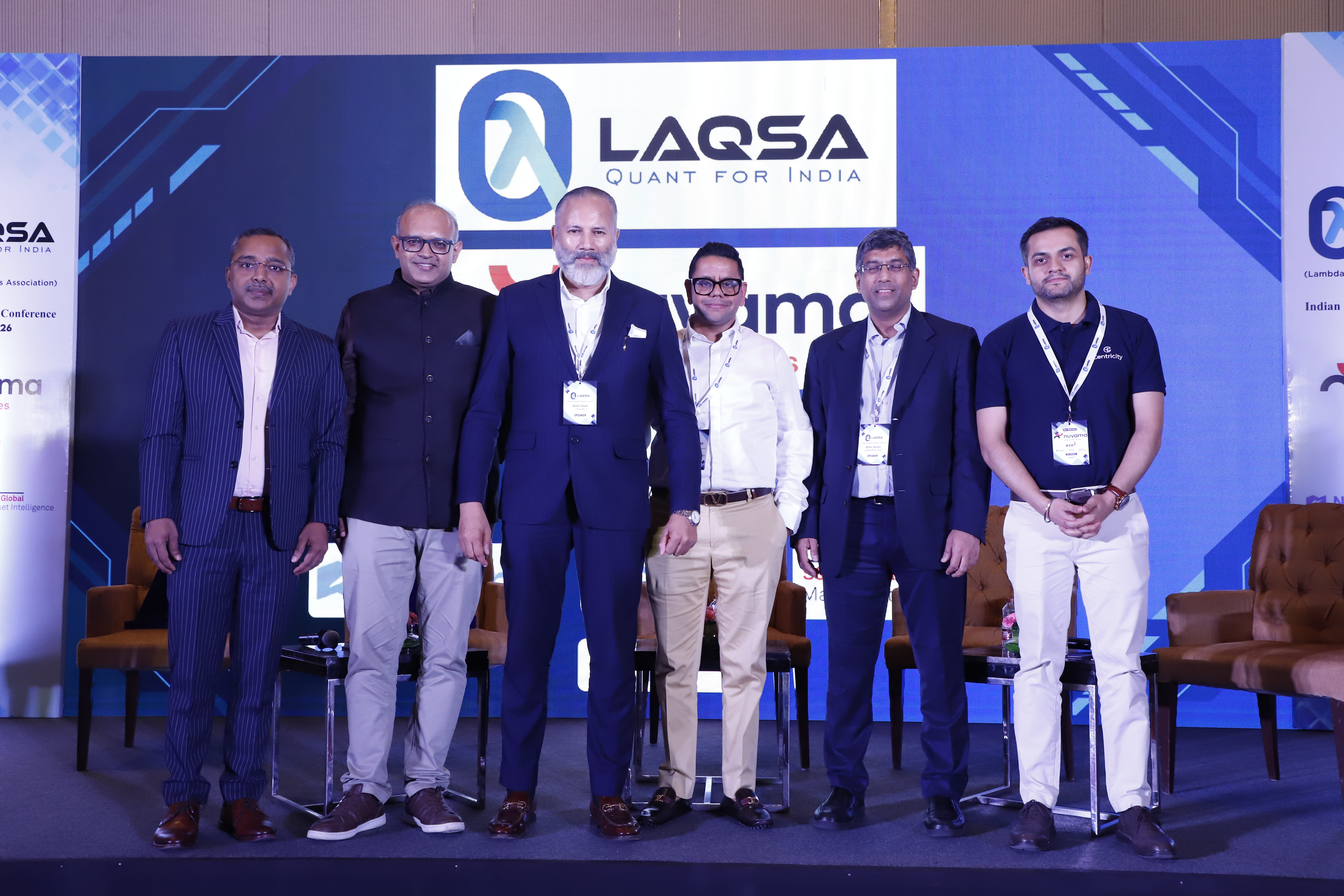
Various top financial services organisations like Nuvama Asset Services, BSE, Nubra, LSEG, S&P Global Market Intelligence, and CFA Society India supported the event through sponsorships, with Nuvama returning as the title sponsor.
With a meticulously put-together agenda, the sixth IIQC featured high-impact panels, fireside chats and technical presentations, bringing together leaders from Asset Management Companies, Family Offices, Policy Makers, Global Research Firms, and Academia.
The conference began with a welcome address by LAQSA co-founders Rishi Kohli, Pankaj Mani (RealWorldRisk,Wilmott), and Arvind Mathur , setting the stage for a day dedicated to rigorous, data-driven debate.
Other notable speakers included Prof. Chetan Ghate – Member of the Prime Minister’s Economic Advisory Council, Sunil Ramrakhiani – Chief Business Officer at BSE, Prof. Sandeep Juneja – Founding Director of the Safexpress Centre for Data, Learning and Decision Sciences at Ashoka University, Lalit Taneja – Director of the GARP Delhi (India) Chapter, and Prof. Miquel Noguer I Alonso – NYU Courant, Tandon School of Engineering and Columbia University.
A highlight of the conference was a session on “Agentic AI in Quant: Practical Applications” by Prof. Miquel Noguer I Alonso of NYU Courant, Tandon School of Engineering, and Columbia University, examining how autonomous AI agents and multi-agent systems are reshaping portfolio management and systematic trading – a conversation that sits at the very centre of where global quant finance is heading. Complementing this was a session on “Practical Uses of AI/ML and Alternative Data for India vs. Global Experience”, featuring Balakrishnan Ilango of LSEG and Aditya Sharma of S&P Global Market Intelligence, which surfaced critical divergences between global AI adoption and the data availability and regulatory constraints unique to Indian markets.
The post-lunch agenda addressed the growing structural relevance of Specialised Investment Funds , with a dedicated panel featuring Rishi Kohli, Amit Goel , Vinayak Magotra, and Puneet Jain . The panel explored the accelerating appetite among Indian ultra-high-net-worth individuals and family offices for systematic allocations through SIFs – a product category that has rapidly moved from niche to mainstream in institutional conversations across India.
The regulatory outlook for quantitative strategies was examined through a global comparative lens by Dr S.N. Ghosh, while Prof. Chetan Ghate, Member of the Prime Minister’s Economic Advisory Council, provided critical macroeconomic context through his presentation on the structural challenges of economic policymaking at scale.
Pankaj Mani, Co-Founder, LAQSA, expressed his thoughts on the event, saying,
“IIQC Delhi Edition reflected how quickly India’s institutional quant conversation is moving from strategy design to implementation, and from ‘best practices’ to technical rigour. The sessions on Regulating the Quant Ecosystem, Agentic AI in Quant, and Forex Strategies sparked exactly the kind of candid, practitioner-led dialogue we want to build across the ecosystem.”
Rishi Kohli, Co-Founder, LAQSA, added while wrapping up the event,
“Bringing IIQC back to Delhi for the second time was important to us, because the city sits at the centre of India’s institutional markets governance. This sixth edition reinforced that India’s quant community is expanding in both depth and maturity – linking global experience with India-specific market realities and strengthening the network of professionals building systematic capabilities.”
As the Indian financial landscape continues to evolve, the distinction between traditional and quantitative investing is increasingly blurring. This edition of IIQC illustrated that whether through the practical deployment of Agentic AI, the structural growth of SIFs, or the application of alternative data to Indian markets, systematic investing is rapidly becoming an institutional imperative. By successfully convening this diverse coalition of thought leaders, LAQSA has once again reaffirmed its position as the defining catalyst for India’s transition into a more sophisticated, data-centric financial era.