


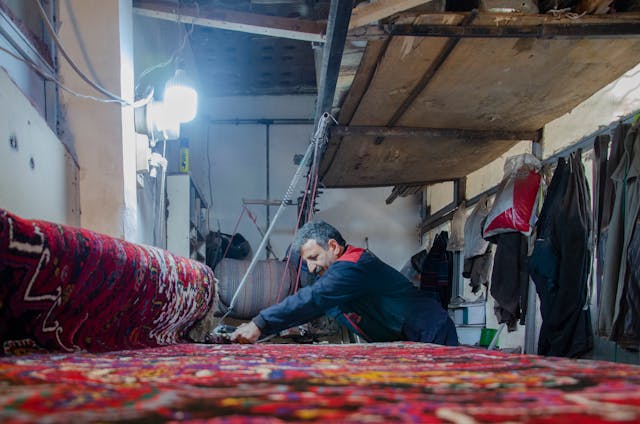
India’s handmade rug and carpet industry stands as one of the most distinctive examples of how traditional craftsmanship can evolve into a globally competitive export ecosystem. Rooted in centuries-old weaving practices and supported by a vast artisan base of nearly 2 million workers, the sector today represents a powerful blend of cultural heritage, rural employment, and international trade strength.
With an estimated 8% share of the global handmade rug market, India has emerged as one of the world’s leading exporters of hand-knotted and hand-tufted carpets, supplying premium décor markets across Europe, the United States, the Middle East, and Asia.
A Heritage Industry Evolving into a Global Supply Chain
Unlike machine-driven textile production, India’s handmade rug industry is built on human skill, patience, and generational knowledge. Each carpet can take weeks to several months to complete, depending on design complexity and weaving technique.
What makes the Indian model globally unique is its dual capability:
- High-end bespoke luxury carpets for niche global buyers
- Large-scale export production for commercial and hospitality sectors
This rare combination allows India to remain competitive across both artisanal and industrial segments of the global décor market.
Government Focus: Strengthening Exports, Skills, and Global Visibility
In recent years, the Government of India has intensified its focus on the handicrafts and carpet sector as part of broader export promotion and rural livelihood strategies.
Key policy directions include:
1. Export Promotion and Global Market Expansion
Efforts are being made to improve India’s visibility in international markets through participation in global trade fairs, buyer–seller meets, and export facilitation platforms under the Ministry of Textiles ecosystem.
2. Skill Development and Artisan Training
Training programs are being expanded to upgrade weaving skills, introduce modern design techniques, and improve productivity while preserving traditional craftsmanship.
3. Financial and Institutional Support
Credit access and financial inclusion mechanisms are being strengthened for artisan clusters and small weaving units to support working capital needs and production stability.
4. Branding “Made in India” Carpets
A stronger focus is being placed on positioning Indian handmade carpets as premium, ethical, and sustainable luxury products in global markets.
Artisan Empowerment: The Core of Industry Strength
A defining feature of India’s rug sector is its deep reliance on rural artisan communities. The industry not only preserves traditional skills but also generates stable livelihoods in regions where industrial employment opportunities are limited.
Organisations such as Jaipur Rugs have played a transformative role by building direct-to-weaver models that eliminate intermediaries and ensure fair income distribution.
These models also support:
- Women-led artisan participation
- Home-based weaving clusters
- Long-term skill development ecosystems
- Direct global market linkage
Bhadohi and India’s Weaving Geography
India’s carpet production is concentrated in key artisanal clusters:
- Bhadohi (Uttar Pradesh): Known globally as the “Carpet City of India,” it remains the largest production and export hub.
- Jaipur (Rajasthan): A centre for design innovation, artisan training, and product diversification.
- Kashmir: Renowned for premium hand-knotted luxury carpets with intricate detailing.
These hubs collectively form a decentralised yet highly efficient production network that supports global demand.
Sustainability: The New Competitive Advantage
Sustainability is becoming a central pillar of India’s handmade rug industry. Manufacturers are increasingly adopting:
- Natural wool and silk
- Organic and low-impact dyes
- Recycled fibres, including PET-based yarns
- Environmentally conscious production methods
This shift aligns with rising global demand for ethical and eco-friendly luxury products, especially in European and North American markets.
Design Evolution: Tradition Meets Global Aesthetics
Indian artisans are increasingly blending traditional motifs—such as Mughal and Persian patterns—with modern global design trends including:
- Minimalist Scandinavian styles
- Abstract contemporary art patterns
- Neutral-toned luxury aesthetics
This adaptability has helped Indian carpets remain relevant in fast-changing global décor markets.
India’s Unique Competitive Edge
What sets India apart is its unmatched combination of:
- Large-scale artisan workforce
- Deep cultural craftsmanship
- Flexible design adaptation
- Cost-efficient global supply chains
- Ethical, human-centric production models
This balance allows India to deliver both authenticity and scalability—two qualities rarely found together in global manufacturing systems.
Conclusion: A Sector Poised for Global Expansion
India’s handmade rug industry is no longer just a traditional craft sector—it is a globally integrated, policy-supported, and innovation-driven export ecosystem.
With continued government support, rising global demand for sustainable luxury products, and strong artisan empowerment models, the sector is positioned for sustained expansion in the coming years.
At its core, India’s carpet industry remains a living example of how heritage craftsmanship, when supported by modern policy and global markets, can evolve into a powerful engine of rural development and international trade leadership.