


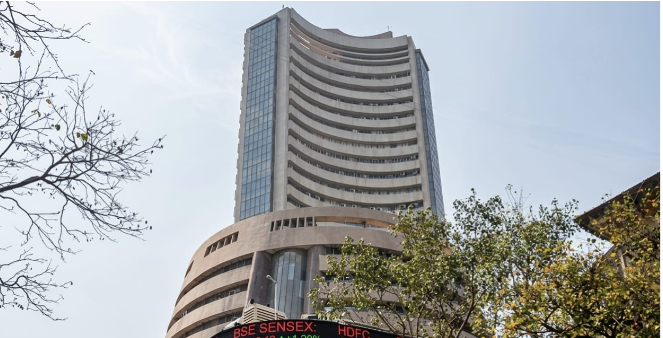
Mumbai, Sep 19: Indian stock markets went through another roller-coaster week, with investors moving between caution and bargain hunting as global interest-rate concerns, elevated crude oil prices, geopolitical tensions and foreign fund outflows continued to influence sentiment.
The week did not follow a straight-line trend. Markets opened with strong buying in some sectors, faced heavy selling in the middle of the week and then attempted a recovery toward Friday. By the end of the week, however, the broader picture remained cautious, with the Sensex falling 0.65 per cent and the Nifty declining 0.22 per cent. This marked the sixth consecutive weekly decline for the Sensex, its longest such losing streak since 2020.
Friday provided some relief after the recent selling pressure. The Nifty 50 gained 75.80 points, or 0.33 per cent, to close at 23,346.40, while the Sensex ended almost flat at 74,294.96, down 19.63 points, or 0.03 per cent. Softer crude prices and buying in selected stocks helped the market recover, although weakness in IT and several Tata Group stocks limited the gains.
A Week of Sharp Swings
The mood changed quickly from one trading session to another.
At the beginning of the week, investors showed renewed interest in IT stocks, helping both benchmark indices open higher. The Sensex gained nearly 0.8 per cent at the opening, while the Nifty rose about 0.76 per cent.
That optimism did not last. A sharp sell-off followed as investors became increasingly concerned about crude oil, global bond yields and geopolitical developments. The Sensex at one stage lost more than 700 points, while the Nifty slipped below the 23,200 level.
The market then attempted to stabilise. Buying emerged in banking, FMCG, energy and selected large-cap stocks, allowing the indices to recover part of their losses. By Friday, the recovery had gathered some momentum, although it was not strong enough to erase the week’s losses.
This uneven movement showed that investors were not abandoning equities altogether. Instead, they were becoming more selective, moving money between sectors and individual stocks depending on their exposure to oil prices, interest rates, global demand and domestic factors.
IT Stocks Remain Under Pressure
The information technology sector was one of the most closely watched areas during the week.
IT stocks initially helped lift the market, but profit-taking and renewed concerns over global technology spending later brought selling pressure. On Friday, IT shares remained among the weaker areas of the market even as the broader Nifty recovered.
The weakness in technology stocks also had a larger impact on the Sensex because several major IT companies carry significant weight in the index.
The contrasting performance of the two benchmarks was therefore important. While the Sensex remained under pressure, the broader Nifty managed to recover with support from banking, energy and insurance stocks.
Banking and Financial Stocks Provide Support
Banking and financial stocks emerged as an important source of stability during the recovery.
Buying in large private banks and selected financial companies helped absorb some of the selling pressure elsewhere. The financial sector’s relative resilience also helped the Nifty recover during the latter part of the week.
This sector rotation was significant because it showed that investors continued to look for domestic-facing businesses even while remaining cautious about sectors more directly exposed to global economic uncertainty.
Metals and Realty See Fresh Buying
Metal and real estate stocks also attracted attention toward the end of the week.
The recovery in metal stocks came as investors looked for value after the recent correction. Realty stocks also saw renewed buying, supported by expectations around domestic demand and continued interest in the country’s infrastructure and construction activity.
The movement was not uniform across the market, however. Some stocks delivered strong gains while others continued to face selling pressure, highlighting the importance of company-specific developments in an otherwise volatile environment.
Tata Stocks Become a Major Market Focus
One of the important domestic developments during the week was heightened uncertainty surrounding Tata Group-related developments.
Several Tata stocks came under pressure, including TCS, Tata Chemicals and Titan, contributing to weakness in major indices. The selling added to pressure already being created by weaker IT stocks and foreign investor activity.
The impact was particularly visible in the Sensex because of the presence of several Tata companies among its heavyweight constituents.
Foreign Selling Remains a Concern
Foreign institutional activity continued to be an important factor behind market volatility.
Foreign investors sold shares worth ₹3,208.76 crore on September 17, while domestic institutional investors bought equities worth ₹3,617.75 crore on the same day, according to NSE data cited by Upstox. Foreign investors had sold around ₹17,810 crore worth of Indian equities during September up to September 18.
Domestic institutional buying has therefore played an important role in absorbing part of the foreign selling.
The difference between the two flows has become a key feature of the market. While overseas investors have remained cautious because of global yields, currency considerations and geopolitical risks, domestic institutions have continued to provide liquidity and support during periods of heavy selling.
Crude Oil Remains the Biggest External Pressure Point
Oil continued to be one of the most important drivers of market sentiment.
Brent crude remained above $100 a barrel, although prices eased toward the end of the week. On Friday, Brent was around $103.41 a barrel, while WTI was around $101.47.
For India, expensive crude has wider implications. Higher oil prices can increase the country’s import bill and put pressure on inflation, the rupee and corporate costs. Industries such as transportation, aviation, logistics and manufacturing can feel the impact through higher fuel and operating expenses.
The easing of crude prices toward the end of the week consequently offered some relief to investors and helped improve risk appetite.
Global Markets Also Had a Difficult Week
Indian equities were not alone in facing volatility.
Global markets were affected by the combination of changing interest-rate expectations, rising bond yields and oil-price movements. The US 10-year Treasury yield moved back towards the 5 per cent level, increasing pressure on risk assets.
US markets ended Friday with a mixed performance. The S&P 500 gained 0.2 per cent, the Nasdaq rose 0.4 per cent, while the Dow Jones declined 0.2 per cent. For the week, the S&P 500 slipped 0.1 per cent, the Dow fell 1.7 per cent and the Nasdaq gained 0.7 per cent.
The Nasdaq’s relative resilience was supported by technology and semiconductor stocks, while broader markets remained sensitive to rising yields and inflation concerns.
European and Asian markets also experienced a turbulent week as investors assessed the direction of global monetary policy. Reuters reported that global equities ended the week with mixed movements as central banks remained focused on controlling inflation.
What the Week Tells Investors
The week’s market behaviour tells a more complicated story than simply saying that the Sensex and Nifty fell.
There was selling pressure, particularly in IT and selected heavyweight stocks. At the same time, there was fresh buying in banking, energy, metals, realty and selected broader-market stocks.
There was also a clear difference between foreign and domestic investors. Foreign selling continued to weigh on sentiment, while domestic institutional buying helped prevent a deeper correction.
Similarly, global uncertainty did not completely stop investors from looking for opportunities. The recovery in the Nifty toward the end of the week suggests that investors were willing to buy stocks that had fallen sharply, particularly when crude prices and global yields showed signs of easing.
Looking Ahead
The coming week is likely to remain closely linked to developments in crude oil, US Treasury yields, global interest-rate expectations, foreign institutional flows and geopolitical developments.
Investors will also continue watching the performance of individual sectors, particularly IT, banking, metals, energy, real estate and automobiles. Corporate developments and the continuing IPO activity could further influence the flow of money between the primary and secondary markets.
The latest week’s performance therefore reflects a market caught between two forces: global uncertainty on one side and domestic liquidity and selective buying on the other.
For businesses and investors, the message from the market is clear: volatility is spreading across sectors, but the movement is not uniform. While some companies and industries are facing pressure from higher costs, global demand and interest rates, others are finding support from domestic demand, infrastructure activity and bargain buying.
As a result, the Indian market’s next move will depend not only on the headline direction of the Sensex and Nifty, but also on how oil prices, global yields and foreign fund flows evolve in the days ahead.