


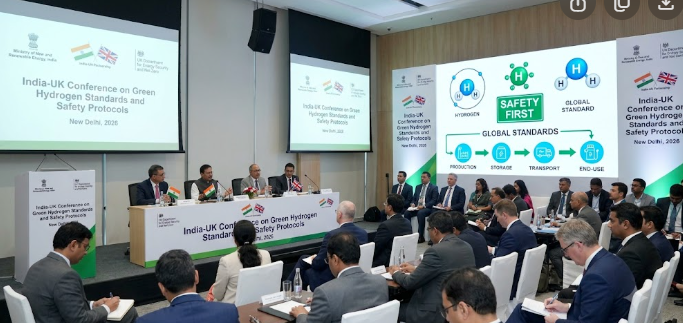
Representational Image
India and the UK are stepping up cooperation in green hydrogen as both countries look to create safer, more reliable and commercially viable clean-energy systems.
The latest push came with the India-UK Conference on Green Hydrogen Standards and Safety Protocols, held in New Delhi on February 27, 2026. The conference brought together government officials, regulators, industry representatives, researchers and technical experts to discuss the safety and standards needed to expand green hydrogen across India.
The cooperation is part of a wider India-UK effort on clean energy. The two countries have been working together on energy-transition priorities, including green hydrogen, through their bilateral energy dialogue and technical cooperation. In February 2025, the two sides discussed progress in trade missions focused on offshore wind and green hydrogen, along with technical assistance and investment opportunities.
The latest conference did not announce a new agreement or MoU being signed. Instead, India and the UK reaffirmed their commitment to strengthen cooperation on standards, regulatory capacity and safety frameworks for the hydrogen sector.
The main objective is to ensure that green hydrogen can move from pilot projects and early investments to large-scale commercial use without compromising safety. Discussions covered the entire value chain, including production, storage, transportation and end-use applications.
For India, the timing is important. The National Green Hydrogen Mission was launched in January 2023, with the broader objective of developing green hydrogen as a clean energy source, building domestic supply chains and creating a globally competitive hydrogen industry.
Under the mission, India is targeting 5 million tonnes of annual green hydrogen production capacity by 2030. The government also wants to develop supporting infrastructure, including pipelines, storage facilities, transportation systems and distribution networks.
The conference focused on one of the biggest requirements for achieving these targets — common and dependable safety standards.
India’s Petroleum and Explosives Safety Organisation discussed regulatory requirements, risk assessment and hazard management, while the Bureau of Indian Standards highlighted the development of standards aligned with international practices.
Experts also examined new technologies that could improve hydrogen safety, including advanced sensors, digital monitoring and artificial intelligence-based systems. Safe plant design, transportation, storage and emergency-response systems were also part of the discussions.
For businesses, these developments could be significant. A clearer regulatory environment can reduce uncertainty for companies planning investments in electrolysers, renewable power, hydrogen storage, transport infrastructure, testing facilities and safety technologies.
The opportunity also extends beyond hydrogen production. Equipment manufacturers, engineering companies, technology providers and infrastructure developers could become important parts of the emerging hydrogen economy.
At the same time, India needs stronger demand from industries such as steel, fertilisers, chemicals, shipping and heavy transport to make large-scale green hydrogen projects commercially sustainable.
The India-UK partnership could help address some of these challenges by encouraging the exchange of technical knowledge, safety practices and international standards. It could also help Indian companies prepare for global markets as demand for low-carbon fuels grows.
India is simultaneously expanding its clean-energy base. The country is pursuing green hydrogen alongside renewable energy, sustainable fuels and other low-carbon technologies as part of its broader energy-security and energy-transition strategy.
The objective now is to build an ecosystem in which production, safety, infrastructure, domestic manufacturing and demand grow together. For investors and businesses, regulatory clarity and internationally recognised safety practices could make the sector more attractive for long-term investment.
The February conference therefore marks another step in the India-UK clean-energy relationship. While the event was not a new treaty-signing ceremony, its focus on common standards, safety and regulatory cooperation could play an important role in helping India scale up green hydrogen and build a stronger position in the global clean-energy market.