


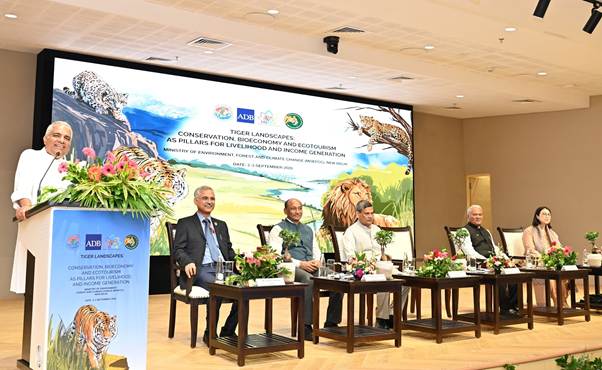
New Delhi, September 2, 2026: India is seeking to broaden the approach to tiger conservation by linking wildlife protection with local livelihoods, sustainable economic activity and community participation. Union Environment Minister Bhupender Yadav on Wednesday inaugurated a two-day international workshop in New Delhi that brings together conservation experts, development institutions and representatives of tiger-range countries to examine how tiger landscapes can support both ecological security and income generation.
The workshop, titled “Tiger Landscapes: Conservation, Bioeconomy and Ecotourism as Pillars for Livelihood and Income Generation,” is being jointly organised by the International Big Cat Alliance (IBCA), Asian Development Bank (ADB) and National Tiger Conservation Authority (NTCA). Discussions will focus on treating tiger habitats as forms of natural capital and assessing the economic value of ecosystem services such as water security, carbon sequestration, climate regulation, biodiversity protection and livelihood support.
Yadav said India’s experience under Project Tiger demonstrates that protecting the tiger cannot be separated from conserving the wider landscape in which the species survives. Forests, grasslands, rivers, prey populations, wildlife corridors and communities are all interconnected, he said, calling for a transition from a species-centric model to integrated landscape management. He also highlighted nature-based solutions, innovative financing and community-led ecotourism as potential tools for creating sustainable economic opportunities while strengthening conservation outcomes.
The Minister also called for greater recognition of traditional and indigenous knowledge in environmental policymaking, particularly across countries of the Global South. He urged the IBCA to facilitate the exchange and documentation of local knowledge and integrate it into strategies covering conservation, bioeconomy and ecotourism. Against the backdrop of desertification, declining soil moisture and deteriorating soil quality, Yadav said tiger landscapes could play a wider role in building ecological resilience while enabling communities to participate in sustainable development.