


Aug 18: India’s startup story is no longer just about how many new businesses are being created. It is increasingly about whether entrepreneurs can find the right support when they need it.
Over the past decade, the country has built a wide network of programmes covering funding, incubation, mentoring, credit, intellectual property, government procurement, market access and scale-up support.
The ecosystem has grown significantly. Government data reported in June 2026 put India’s startup ecosystem at around 2.3 lakh startups and nearly 25 lakh jobs, with more than half of startups emerging from Tier-II and Tier-III cities.
That scale brings a new challenge.
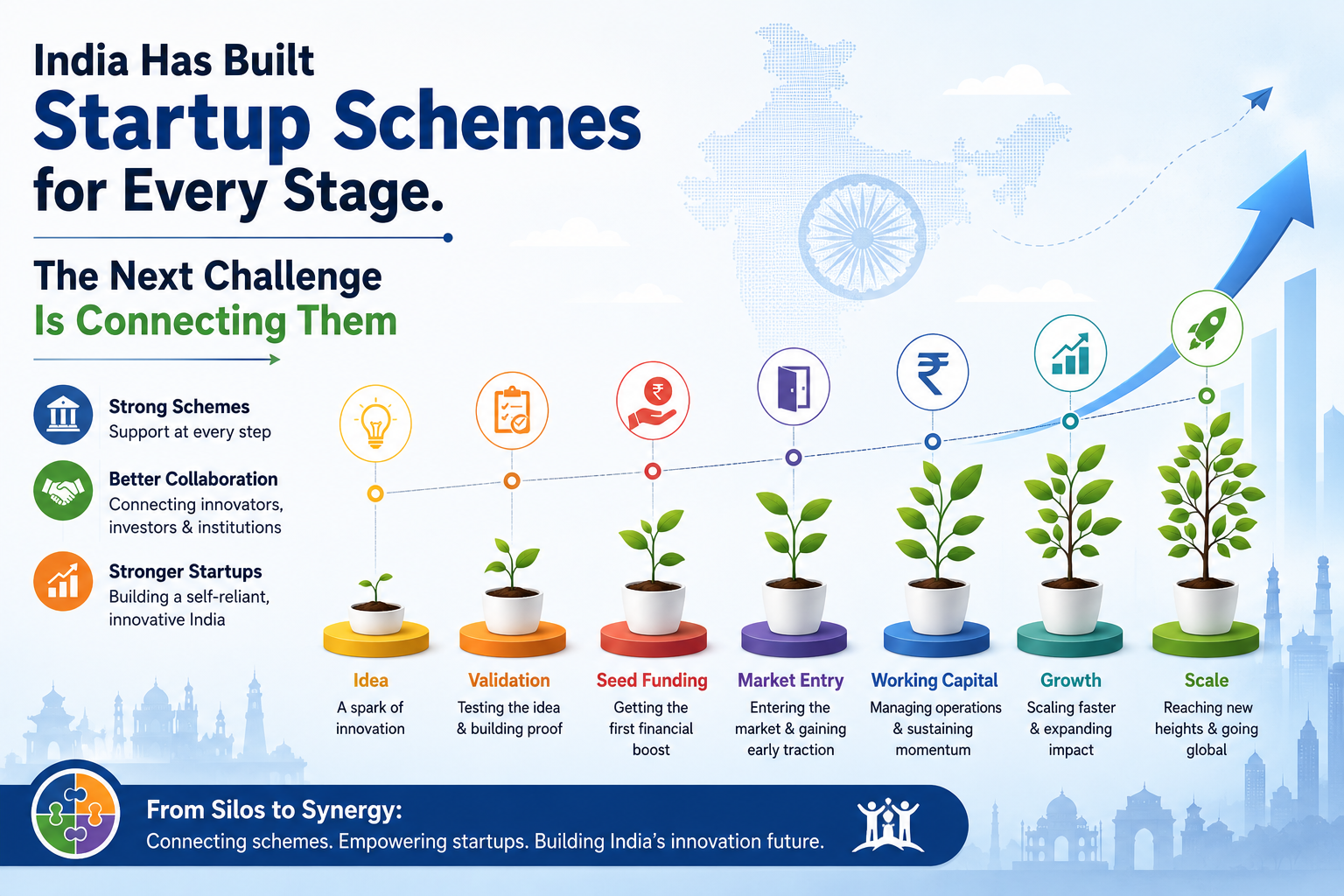
India may not need simply introduce more startup schemes. It needs stronger connections between the schemes that already exist.
India’s Startup Support System Has Expanded
The growth of Startup India shows how much the ecosystem has changed.
DPIIT-recognised startups increased from around 500 in 2016 to 1,57,706 by December 2024. These startups had reported creating more than 17.28 lakh direct jobs, while over 51% of recognised startups were coming from Tier-II and Tier-III cities.
By June 2026, the government reported around 2.3 lakh startups and nearly 25 lakh jobs.
The shift is significant. Entrepreneurship is no longer concentrated only in Bengaluru, Mumbai, Delhi-NCR and a handful of other major startup centres.
More founders are building businesses from smaller cities and across a wider range of sectors.
That makes accessibility and navigation increasingly important.
There Is Support for Almost Every Stage
The June 2026 Startup Schemes Playbook reflects the breadth of India’s support system.
The playbook includes a Startup Lifecycle Map and a five-question decision tree to help entrepreneurs identify relevant programmes. It covers areas ranging from proof-of-concept and seed funding to credit, intellectual property, procurement, market access and scale-up.
The Startup India ecosystem also includes the Startup India Seed Fund Scheme, which supports activities such as proof-of-concept development, prototyping, product trials, market entry and commercialisation.
The pieces are there.
The bigger question is whether entrepreneurs can move smoothly from one piece to another.
Entrepreneurs Think About Problems, Not Schemes
A founder rarely thinks in terms of government departments.
They think in terms of business problems.
- How do I validate my idea?
- Where can I find funding?
- How do I build my prototype?
- How do I find customers?
- Where can I get working capital?
- How can I protect my intellectual property?
- How can I access government procurement?
- What support is available when I am ready to scale?
There are programmes addressing many of these questions.
But an entrepreneur should not have to understand the structure of government programmes to find the right answer.
The Next Challenge Is Navigation
The government’s decision to include a “Find Your Scheme in 5 Questions” tool in the 2026 Startup Schemes Playbook is a useful indication of where the ecosystem is heading.
As the number of programmes increases, helping entrepreneurs navigate them becomes increasingly important.
The next step could be moving from scheme discovery to scheme continuity.
Instead of simply identifying which programme a founder qualifies for, the system could also indicate what support might be relevant at the next stage.
For example:
Idea → Validation → Seed Funding → Market Entry → Working Capital → Growth → Scale
A founder receiving seed support could be guided towards market-access opportunities. A business gaining traction could be directed towards working-capital support or investor networks. A growing company could be shown relevant procurement, export or scale-up opportunities.
The goal would not necessarily be to create another scheme.
It would be to make the journey between existing schemes easier.
What This Could Mean for a First-Time Founder
Consider a first-time entrepreneur developing a technology product.
At the beginning, the founder may need incubation and mentoring. Once the idea is validated, seed funding could help develop a prototype.
After the first customers arrive, the business may need working capital and market access. As revenue grows, the focus could shift towards hiring, larger financing and investor connections.
The entrepreneur’s needs change as the business grows.
A connected support system would recognize that progression and help the founder understand what comes next.
That could save time and reduce the risk of entrepreneurs missing programmes simply because they did not know they existed.
Central and State Support Need Better Links
The coordination challenge is also important because entrepreneurship support exists at both central and state levels.
Startup India provides information on state and Union Territory startup policies alongside central government programmes.
For an entrepreneur, however, these administrative boundaries may not matter much.
A startup in Kochi, Bengaluru, Ahmedabad or Pune may potentially have access to several layers of support.
What matters is whether the entrepreneur can understand how those programmes fit together.
A more connected digital system could show founders which central and state initiatives may complement each other, rather than forcing them to search across multiple platforms.
Tier-II and Tier-III Growth Makes Accessibility More Important
The growing contribution of smaller cities makes this issue even more relevant.
More than 51% of DPIIT-recognised startups were coming from Tier-II and Tier-III cities as of December 2024.
For entrepreneurs outside established startup hubs, access to information and networks can be just as important as access to capital.
A founder may qualify for an incubation programme, credit facility or procurement opportunity but never apply simply because they are unaware of it.
Better digital navigation could help reduce this information gap.
The goal should be simple: access to support should depend less on knowing the right people and more on meeting the right eligibility criteria.
Mentorship Can Bridge the Gaps
Funding is only one part of building a company.
Entrepreneurs also need help with customers, hiring, financial management, technology, compliance and expansion.
Mentorship can therefore become an important link between different stages.
For example, an entrepreneur receiving early-stage funding could simultaneously receive guidance on market entry, financial planning and preparing for future investment.
This would make support more continuous instead of ending when an individual programme ends.
Success Should Be Measured Across the Entrepreneurial Journey
Better coordination could also change how government programmes are evaluated.
The number of applications, approvals and beneficiaries is useful, but it does not necessarily show whether businesses are progressing.
More meaningful measures could include:
- Businesses moving from idea to commercialisation
- Startups progressing from seed funding to follow-on investment
- Revenue growth after receiving support
- Jobs created
- New markets entered
- Government contracts secured
- Businesses progressing from early traction to scale
These measures could help policymakers identify where entrepreneurs are dropping out of the pipeline.
If thousands of businesses receive early-stage support but relatively few reach scale, for example, the issue could be a lack of growth capital, market access, skills or mentorship rather than a shortage of startup schemes.
India Does Not Need to Start From Scratch
India already has many of the building blocks needed for a strong entrepreneurship ecosystem.
There are programmes for funding, credit, incubation, mentoring, intellectual property, procurement, market access and growth.
The 2026 Startup Schemes Playbook itself reflects this breadth.
The next phase does not necessarily have to be about adding more programmes.
It can be about making existing programmes work better together.
Better digital discovery, clearer eligibility information, personalized recommendations and stronger links between central and state initiatives could make the system easier for entrepreneurs to navigate.
Connecting the Dots Could Be India’s Next Startup Opportunity
India’s startup ecosystem has come a long way. With around 2.3 lakh startups and nearly 25 lakh jobs, it is now operating at a scale where coordination matters more than ever.
The next challenge is not simply creating another scheme whenever a new entrepreneurial problem emerges.
It is making existing support easier to discover, easier to access and easier to move through.
An entrepreneur should be able to progress from idea to enterprise, enterprise to growth and growth to scale without having to understand the administrative architecture behind every programme.
India has built many of the pieces.
Now, the opportunity is to connect them.
That shift—from individual schemes to a more connected entrepreneurial journey—could make India’s startup ecosystem not only larger, but also more accessible and effective for the entrepreneurs it is designed to support.