


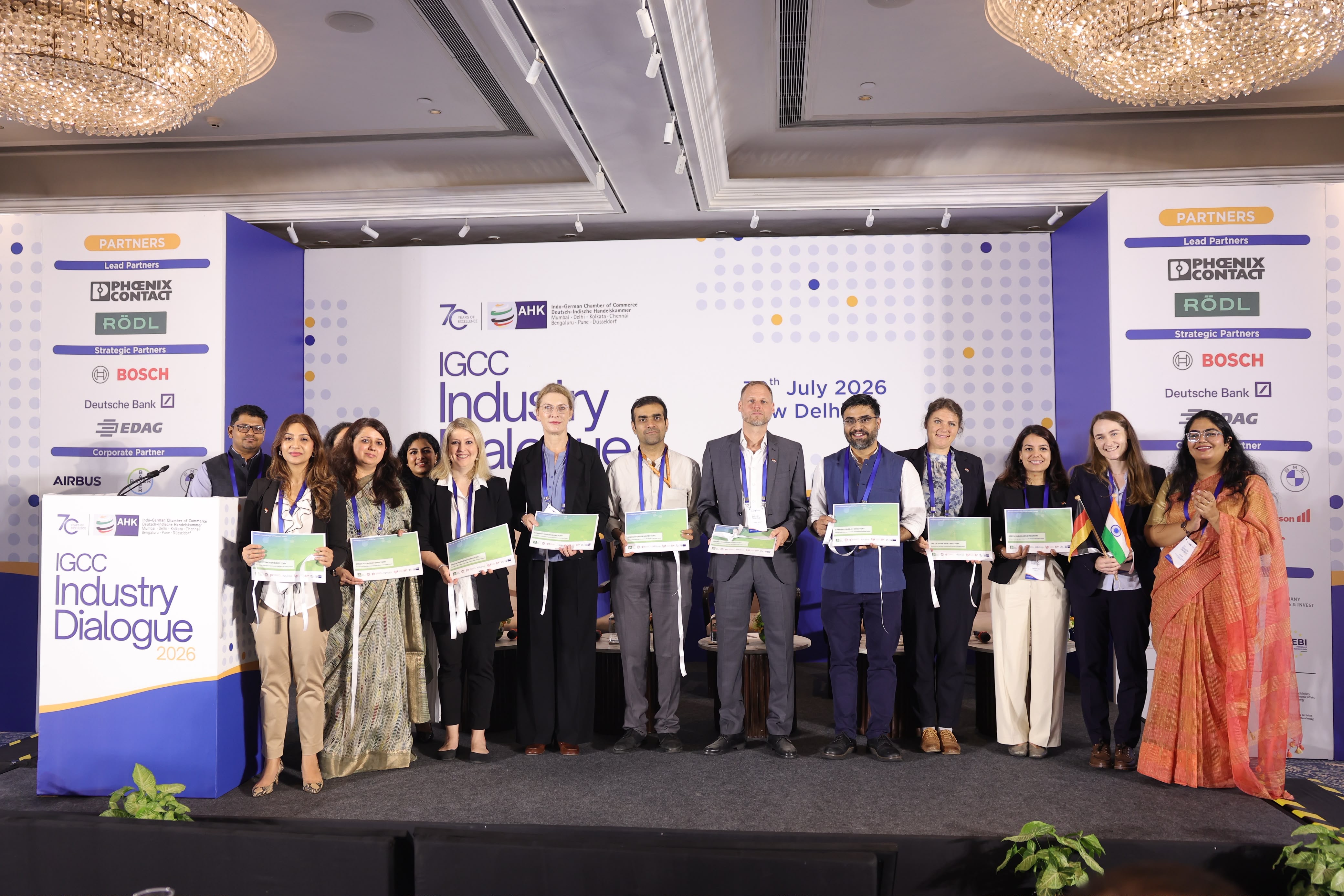
New Delhi, July 31: The Indo-German Chamber of Commerce (IGCC) organized the IGCC Industry Dialogue 2026 at Taj Mahal, New Delhi on 30 July 2026, bringing together senior government officials, business leaders, and industry stakeholders to discuss important areas of bilateral economic engagement and identify priority sectors for commercial collaboration.
The dialogue commenced with remarks from Jan Noether, Director General, IGCC, marking seven decades of the Chamber’s role in facilitating bilateral commerce.
“The IGCC stands at the intersection of ambition and implementation. Today’s dialogue reaffirmed what we have long observed: German and Indian companies are united not only by shared market interests, but by a common commitment to unlocking opportunities in the energy transition, advanced manufacturing, digitalisation, and emerging technologies. Our role is to create platforms where these shared ambitions translate into lasting partnerships. The calibre of participation—from senior government representatives to industry leaders across sectors—underscores the growing depth and maturity of the Indo-German economic partnership.”- Jan Noether, Director General, Indo-German Chamber of Commerce (IGCC)
Industry Perspectives: The Next Decade of Indo-German Trade and Investment
Guruprasad Mudlapur, Managing Director of Bosch Limited and IGCC Board Member, presented industry perspectives on the next decade of Indo-German trade and investment landscape, addressing opportunities in manufacturing, technology, and infrastructure development, particularly in electric vehicular ecosystems and green technology sectors.
Sanjay Mehta, Head of Chairman’s Office South Asia for Motherson Group, contributed perspectives on the long-standing association between Indian and German companies, emphasizing precision engineering, green technology initiatives, and deep institutional ties with the European Union.
Keynote Address
H.E. Dr. Philipp Ackermann, German Ambassador to India and Bhutan, delivered the keynote address, emphasizing the strategic importance of sustained Indo-German partnership across trade, investment, and technological advancement. His remarks highlighted 75 years of diplomatic relations and focused on priority areas including renewable energy, green hydrogen, artificial intelligence, the EU-India Free Trade Agreement, and the growing investment of the Indian private sector in Germany.
“Germany and India are redefining what bilateral partnership means in a competitive global economy. Today’s dialogue demonstrates that when government and industry align on prioritiesrenewable energy, semiconductors, advanced manufacturing; we accelerate economic cooperation. Diplomatic engagement and industrial collaboration must move in tandem. Events
like the IGCC Industry Dialogue create the space for this alignment, enabling Germany and India to shape the next decade of global competitiveness.”
– H.E. Dr. Philipp Ackermann, German Ambassador to India and Bhutan
Address by Guest of Honour
Shri Amardeep Singh Bhatia, Secretary, Department for Promotion of Industry and Internal Trade (DPIIT), Government of India, addressed the gathering as Guest of Honour, underscoring
the strategic importance of Indo-German industrial collaboration. He outlined how the EU-India Free Trade Agreement will facilitate growth across trade, investments, and partnerships, while emphasizing government interventions for manufacturing diversification. Shri Bhatia highlighted opportunities for German companies across railways, pharmaceuticals, and chemical
engineering, and stressed the importance of diversifying supply chains and adopting German best practices within India’s industrial ecosystem.
Driving the Energy Transition
The theme highlight was the Launch of the Green Hydrogen Directory 2026, a comprehensive mapping of German companies with interest in the green hydrogen sector in India. The directory
serves as a practical reference for Indian and German stakeholders by showcasing German companies across the green hydrogen value chain that are interested in collaborating and exploring opportunities in the Indian market. We hope this publication will facilitate new partnerships, business exchanges and technology collaboration between our two countries.
Keynote Address: Driving the Energy Transition
Dr. Prasad Chaphekar, Director, Ministry of New and Renewable Energy (MNRE), Government of India, delivered a keynote address on hydrogen energy market evolution and green methanol development. He addressed regulatory challenges, including fragmentation due to lack of electron-to-molecule links, and emphasized the importance of stakeholder networking for system efficiency. Dr. Chaphekar outlined successful price benchmarking through hydrogen and ammonia auctions, development of safety standards and pilot projects in steel and transport, and incentives including transmission charge waivers and port-based hub development.
The panel discussion on ‘Driving the Energy Transition’ brought together leading experts from government, industry, financial institutions, and international development organisations to
explore the key enablers of India’s clean energy transition. Sanjay Sharma, Director (Solar), Solar Energy Corporation of India Limited (SECI); Dr. Ritwick Ghosh, Senior ManagerHydrogen Energy, NTPC Limited; Ritesh Mattoo, Vice President – Sales & Marketing, EDAG India; and Stefan Kliesch, Head – Energy, KfW Development Bank, shared perspectives on advancing renewable energy, green hydrogen, technology innovation, and the critical role of transmission grid financing and deployment in enabling large-scale renewable energy integration. The discussion highlighted SECI’s shift towards integrated and technology-agnostic tendering models that increasingly incorporate hybrid renewable energy, energy storage, and green hydrogen while prioritising dispatchability to meet evolving grid requirements while KfW highlighting its continued support for renewable energy, transmission infrastructure, and energy storage projects in India. NTPC highlighted the importance of resilient supply chains and EDAG emphasised the potential of Indo-German cooperation in accelerating clean energy innovation and deployment. Moderated by Eva Meschede, Private Sector Advisor, Indo-German Energy Forum (IGEF-SO) Support Office, the session reaffirmed that closer collaboration between policymakers, financiers, technology providers, and industry will be essential to accelerate India’s transition to a resilient, integrated, and future-ready energy system. EU-India Free Trade Agreement: Strategic Perspectives A dedicated session examined implications of the EU-India Free Trade Agreement for bilateral commerce and broader economic integration through perspectives from government and business leadership.
Alexandre Callegaro, Minister Counsellor and Head of Economic and Global Affairs, German Embassy, presented the European perspective on the EU-India trade discussions, emphasizing that trade agreements provide business certainty. He highlighted the market scale encompassing one-third of global trade and the agreement’s comprehensive coverage of products and services. Mr. Callegaro outlined comparative advantages from German technological strengths and Indian workforce capabilities, and addressed challenging areas including carbon border adjustment mechanisms. He identified potential export sectors including garments, auto parts, telecom, pharmaceuticals, chemicals, and medical devices.
Sonia Prashar, Secretary General, Federation of European Business in India (FEBI), outlined sectoral priorities and business community expectations from the agreement. Ms. Prashar
presented key findings from the FEBI Business Sentiment Survey, which detailed that 95% of European businesses are interested in trading with India. She also highlighted that a vast majority of the European businesses in India report profitability. And hence, India represents a strategic priority for European businesses rather than merely a potential market.
Shri Darpan Jain, Additional Secretary, Ministry of Commerce, Government of India, the Chief Negotiator part of the EU-India FTA Negotiations. He emphasized alignment with India’s trade
policy objectives and the role of bilateral commerce in broader Indo-European strategic engagement. He underscored the importance of trade agreements in providing business certainty and outlined India’s export potential across services sectors including telecom and business services. Shri Jain also detailed German export opportunities to India across transport, information technology, business services, Global Capability Centres, research and development, and professional services, with reference to actionable plans and projects that support enhanced bilateral trade.
Technology, Trust and Transformation
A panel discussion was organised on “Technology, Trust & Transformation,” which discussed
various aspects of strengthening technology collaboration and co-innovation between India and
Germany.
Moderated by Shivendra Singh, Vice President and Head of Global Trade Development at NASSCOM, the session brought together industry leaders Shankar G Rao (Vice President & CIDO, Bosch India), Bikas Kumar Singh (Vice President & Head of Government Affairs, SAP India), Neha Sharma (Head of Office- Delhi & NCR, Rödl India), and Vivek Mahajan (Vice President Technical Marketing- Asia Pacific, Infineon Technologies).
The panel addressed key priorities surrounding AI governance and sovereign technology, highlighting the need for shared standards that ensure safety, transparency, and data sovereignty across industrial systems. Panelists also examined the role of the India–EU Free Trade Agreement in enabling cross-border digital trade and service flows while maintaining ecosystem interoperability.
In addition, the discussion focused on the evolution of German Global Capability Centres (GCCs) in India into centers for advanced engineering and product innovation. The leaders also outlined collaborative opportunities across semiconductor design, manufacturing, and Industry 4.0, noting that deepening bilateral tech partnerships will be key to building resilient supply chains and competitive technology ecosystems over the next three years.