


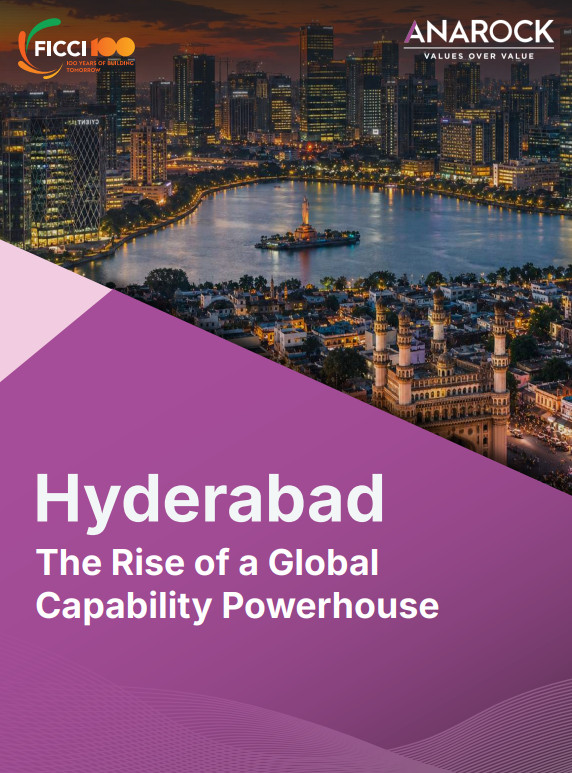
Hyderabad, Sep 10: Hyderabad is rapidly transitioning from a traditional IT-ITeS destination into a diversified global capability powerhouse, with the city’s expanding Global Capability Centre ecosystem emerging as a major driver of office demand, talent creation and commercial real estate growth, according to a new report titled ‘Hyderabad: The Rise of a Global Capability Powerhouse’ by Anarock Research & Advisory and FICCI. It was unveiled by knowledge partners Anarock at the FICCI India Next Growth Frontier Hyderabad 2035: India’s Global Capability Capital conference held in the city today.
GCCs, IT-ITeS firms, BFSI, flex operators and allied services will have a significant impact on Hyderabad’s future commercial real estate landscape, with approx. 8-12 Mn sq ft of additional office demand over next 3-5 years.
The city could also see:
- 50-70 additional GCCs across technology, engineering, BFSI, life sciences, analytics, consulting and digital operations.
- 2-3 Mn sq. ft. of potential flex and managed workspace demand, particularly across western Hyderabad and established IT corridors.
- 75,000+ high-skilled jobs potentially generated through GCC expansion, technology-led sectors and higher-value corporate functions.
- Greater occupier preference for Grade A, ESG-compliant, amenity-rich and technology-enabled offices, supporting premium rentals for institutional-quality assets.
Currently, with 515+ GCCs employing more than 3 lakh professionals, Hyderabad now accounts for nearly 20% of India’s GCC base. The city added 70+ new GCCs in FY25 – the highest among the major GCC destinations – Bengaluru, Pune, and Chennai – underscoring its growing attractiveness to multinational enterprises seeking technology, engineering, BFSI, life sciences and other high-value capabilities.
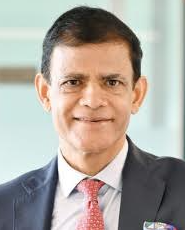
Anuj Puri, Chairman – Anarock Group, says,
“This GCC expansion is already translating into significant real estate demand in the city. The report highlights that GCC office leasing in Hyderabad increased from 1.9 Mn sq. ft. in 2021 to 4.5 Mn sq. ft. in 2025, while the city recorded 3.05 Mn sq. ft. of GCC absorption in H1 2026 alone. The sustained leasing momentum reflects the deepening of Hyderabad’s GCC ecosystem and the increasing preference of global enterprises to establish larger and more sophisticated operations in the city.”
From Back-office Destination to Global Hub
“Hyderabad’s GCC proposition is broadening well beyond conventional IT-ITeS functions,” says Mr. V V Rama Raju, Chairman, FICCI Telangana State Council and Founder & Managing Director, Gaja Engineering. “Technology and software remain core demand drivers, but the ecosystem has expanded significantly across BFSI, pharma and life sciences, semiconductors, aerospace and defence, automotive and engineering, healthcare, consumer and retail, and media and sports technology.”
Leading global enterprises have established or expanded operations covering functions such as AI/ML, cloud engineering, product development, cybersecurity, financial analytics, fintech, regulatory operations, drug development analytics, clinical data, chip design, R&D, embedded systems and digital transformation.
This sectoral diversification is making Hyderabad less dependent on any single occupier segment while simultaneously increasing the quality and complexity of office demand.
Office market gains from GCC momentum
Hyderabad’s broader office market is already showing signs of a healthier demand-supply balance. The city currently has approx. 125 Mn sq ft of Grade A office stock, accounting for around 15% of India’s Grade A office inventory, with another 36 Mn sq ft of upcoming supply.
Despite office completions moderating from a peak of 17.1 Mn sq ft in 2022 to 3 Mn sq ft in H1 2026, occupier demand has remained resilient. Net office absorption stood at 8.5 Mn sq ft in 2025 and 5.2 Mn sq ft in H1 2026.
At the same time, vacancy declined from 26.3% in 2025 to 23.5% in H1 2026, pointing towards improving utilisation of available office stock.
The city’s average office rental value currently stands at around INR 75 per sq ft per month, below the pan-India average of INR 96 per sq ft per month, providing occupiers with a relative cost advantage.
|
Parameter |
Hyderabad |
Bengaluru |
Pune |
Chennai |
|
Total GCCs |
515+ |
880+ |
475+ |
280+ |
|
New GCCs (FY25) |
70+ (highest) |
30–35 |
15–20 |
12–15 |
|
Prime Office Rent |
INR 95–115/sft/mo |
INR 110–140/sft/mo |
INR 80–105/sft/mo |
INR 65–90/sft/mo |
|
Office Stock |
~125 Mn sft |
~215 Mn sft |
~90 Mn sft |
~75 Mn sft |
|
IT Workforce |
~1 Mn |
~2 Mn |
~0.8 Mn |
~0.75 Mn |
|
STEM Graduates/Year |
400,000+ |
500,000+ |
350,000+ |
300,000+ |
|
Key GCC Sector Strength |
Tech, BFSI, Pharma, Semi |
Tech, ER&D, AI, Fintech |
Auto ER&D, BFSI, Mfg |
Auto, Mfg, BFSI, Health |
|
Approval Timeline (TS-iPASS) |
15 days (guaranteed) |
30–60 days (variable) |
30–45 days |
30–45 days |
|
Key Differentiator |
BFSI growth, pharma cluster, cost advantage |
Deepest ER&D, AI research talent |
Automotive ER&D, BFSI fintech |
Cost, mfg engineering, auto |
Western Hyderabad to remain the principal growth engine
The western corridor, comprising HITEC City, Gachibowli, Financial District and Kokapet, is expected to remain at the heart of Hyderabad’s commercial expansion. These locations combine established Grade A office inventory, infrastructure, talent accessibility, and institutional investment, while the continued development of the Financial District–Kokapet corridor is expected to strengthen Hyderabad’s ability to accommodate large-format occupiers.
Rental values have already moved upward across key micro markets:
- In H1 2026, Grade A rents in HITEC City stood at INR 75-115 per sq ft per month, compared with INR 750-110 per sq ft per month in H1 2025.
- Madhapur rentals increased to INR 90-110 from INR 85–100 in a month per sq ft while Gachibowli moved to INR 60-90 from INR 55-85 per sq ft per month.
Hyderabad’s next phase of growth
The city’s evolution is increasingly being shaped by the shift in GCCs from traditional support functions towards R&D, engineering, analytics, digital and corporate functions. This transition is expected to strengthen Hyderabad’s position as a location for global innovation and decision-making rather than simply a cost-efficient offshore base.
The combination of a deep technology talent pool, competitive occupancy costs, established infrastructure, a growing BFSI and life sciences ecosystem, and expanding Grade A office supply is expected to sustain Hyderabad’s attractiveness to global occupiers.
As GCCs continue to scale and diversify, Hyderabad’s office market is likely to witness sustained demand through 2029, with the western corridor emerging as the city’s strategic commercial cluster.