


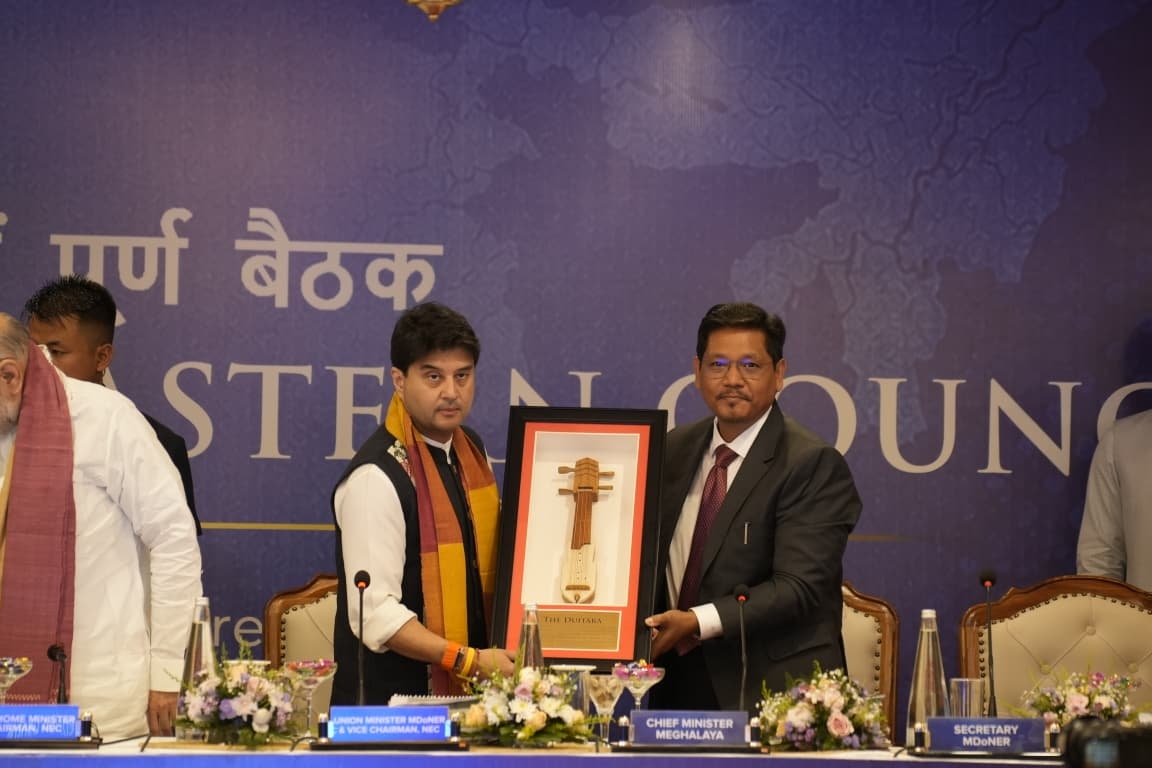
June 18: The North Eastern Council’s Plenary rotates through the region’s capitals by convention. This year, the 73rd session came to Shillong and on the surface, that is all it was: a turn in the cycle, a conference hall booked, a city dressed for dignitaries. But conventions have a way of revealing more than they intend. Because what unfolded on June 4 was not simply Meghalaya playing host to a regional gathering. It was Meghalaya shaping one. Chief Minister Conrad K. Sangma arrived not with a wish list but with a roadmap. The state’s development record informed the conversation. Its ideas about tourism, connectivity and regional cooperation were woven into the day’s agenda. The venue and the argument were in the same place. Shillong did not merely provide chairs and conference hall. It came with a point of view. The session, chaired by Union Home Minister Amit Shah, brought together the Governors and Chief Ministers of all eight northeastern states alongside senior figures from the Ministry of Development of North Eastern Region. The agenda was expansive: tourism, infrastructure and connectivity, investment promotion, agriculture and horticulture, sports, self-reliance in food production, handloom and handicrafts. Cutting across each of these was the North East Vision Plan 2047, the long-term roadmap that seeks to reframe the entire region not as a frontier to be managed but as a hub of economic growth, innovation and cultural vitality. It was, in the words of Union Minister for Development of North Eastern Region Jyotiraditya Scindia, an effort to “connect, converge and catalyse.”
Chief Minister Conrad K. Sangma chaired the high-level task force on Northeast tourism, one of several sectoral panels constituted by the Ministry to drive coordinated action across state lines. His presentation made the case for something that might seem obvious in retrospect but has proved elusive in practice that the eight northeastern states are more powerful as a single destination than as competing ones. Chief Minister Conrad K. Sangma argued that the Northeast must market itself collectively, allowing tourists to move across state boundaries as part of a seamless regional experience rather than treating each state as an isolated attraction. That argument strategic, outward-looking and grounded in empirical observation about how tourism markets actually function reflects the kind of thinking that has come to define his approach to governance more broadly. It is worth pausing on that point because Chief Minister Conrad K. Sangma’s leadership style has rarely been the loudest in the room. He does not trade in the rhetoric of grievance that has sometimes characterised northeastern politics nor does he rely on dramatic gestures. Since first taking office in 2018 and through his re-election in 2023, what Chief Minister Conrad Sangma has built is a record of delivery i.e. sustained, consistent and substantive enough to have changed the conversation around Meghalaya entirely. The numbers offer a starting point. Chief Minister Conrad K. Sangma has cited that Meghalaya’s economy has doubled over the last five years with capital investment increasing fourfold since 2018. The state’s first IT park operates at capacity and the demand for the second has already drawn interest from national and international firms. Tourism, perhaps the most visible symbol of Meghalaya’s changed position, now has over 150 projects under active development, including the Shillong ropeway, a skywalk and the Rain Museum at Mawsynram. A Destination Management Organisation has been launched to professionalise planning and coordination. The Shillong Airport runway expansion, described by the government as a potential game changer for international access, has been awarded with a 15-month completion timeline. The visitor target of 1.8 million annually reflects a state that has stopped underselling itself.
Entrepreneurship has been another sustained focus. The CM-ELEVATE programme which offers up to 75 per cent subsidy across 14 sectors, drew more than 29,000 applications within its first two months. The PRIME incubation programme has supported nearly 4,400 beneficiaries and helped launch 240 enterprises through four cohorts. Meghalaya was recognised as the top performer state at the National Startup Awards in consecutive years. These are not footnotes in a press release rather they represent a deliberate effort to shift the economic base away from dependence on government employment and toward community anchored enterprise. On sports, the story is similarly long in the making. Meghalaya has secured the hosting rights for the 39th National Games in 2027, the biggest multi-sport event the state has ever hosted. The government has launched a Sports Action Plan running to 2032 and a dedicated Chief Minister’s Football Mission. A new Integrated Multipurpose Indoor Hall has been inaugurated in Shillong. These investments are not merely about athletic infrastructure, rather they are about visibility, confidence and the creation of a generation of role models in a state with an exceptionally young demographic.
What is notable about all of this, in the context of the NEC Plenary, is that Chief Minister Conrad Sangma arrived in that room not as a supplicant seeking central allocation but as a peer contributing to the region’s collective roadmap. The task force model itself where each Chief Minister leads a panel and collaborates with counterparts across states is a structural acknowledgement that the Northeast’s challenges require regional solutions. Chief Minister Conrad Sangma’s observation that the NEC is evolving from a funding agency into a policy institution is significant. It reflects an understanding that what matters now is not just what resources flow to the region but how those resources are directed and what ideas shape that direction. He made a related point in March, addressing the Act East Business Show in Shillong, when he argued that Meghalaya’s proximity to Bangladesh, BBIN nations and ASEAN markets positions it as a natural hub for trade and commerce, if the political will and infrastructure can be aligned. That same instinct for positioning, for thinking about Meghalaya’s place in a larger system, is evident in his advocacy for Bangladesh trade revival through border haats, his hosting of the North East India Infrastructure Summit and Exhibition on June 11 and 12 and his articulation of a USD 150 billion economy vision for the state by 2047.
There is a particular kind of leadership that does not seek applause for every step forward. Chief Minister Conrad Sangma has largely governed that way, setting targets, building systems and letting results accumulate quietly. The young entrepreneur in Tura accessing a 75 per cent subsidy through CM-ELEVATE, the athlete in Shillong training in a newly built facility ahead of the 2027 National Games, the tourist footfall increasing from 12 lakhs in 2018 to over 16 lakhs today, none of them may know the policy architecture behind what they are experiencing. But they are experiencing it. And across sectors as different as tourism, sports, technology and trade, the pattern is consistent enough to suggest not a series of fortunate coincidences, but a governing philosophy applied with patience and purpose. Chief Minister Conrad Sangma himself has framed it plainly that Meghalaya will not wait to be discovered. It will build until it cannot be ignored. What the 73rd NEC Plenary revealed, perhaps more than any single decision taken in the session hall, is that that moment may already be here. Meghalaya did not attend that gathering as a small state hoping to be heard. It arrived as a state with something to say, a tourism roadmap for the entire region, a track record of entrepreneurship, a National Games on the horizon, an infrastructure summit in the pipeline and a Chief Minister who had thought carefully about all of it. For a state that has spent much of its modern history navigating questions of identity, autonomy and underdevelopment, that shift in posture is not incidental. It is, under Chief Minister Conrad Sangma’s watch, the most significant thing that has changed. The Northeast is moving toward 2047 with ambition. And for the first time in a long while, Meghalaya is not following that conversation. It is helping to lead it.
|
|