


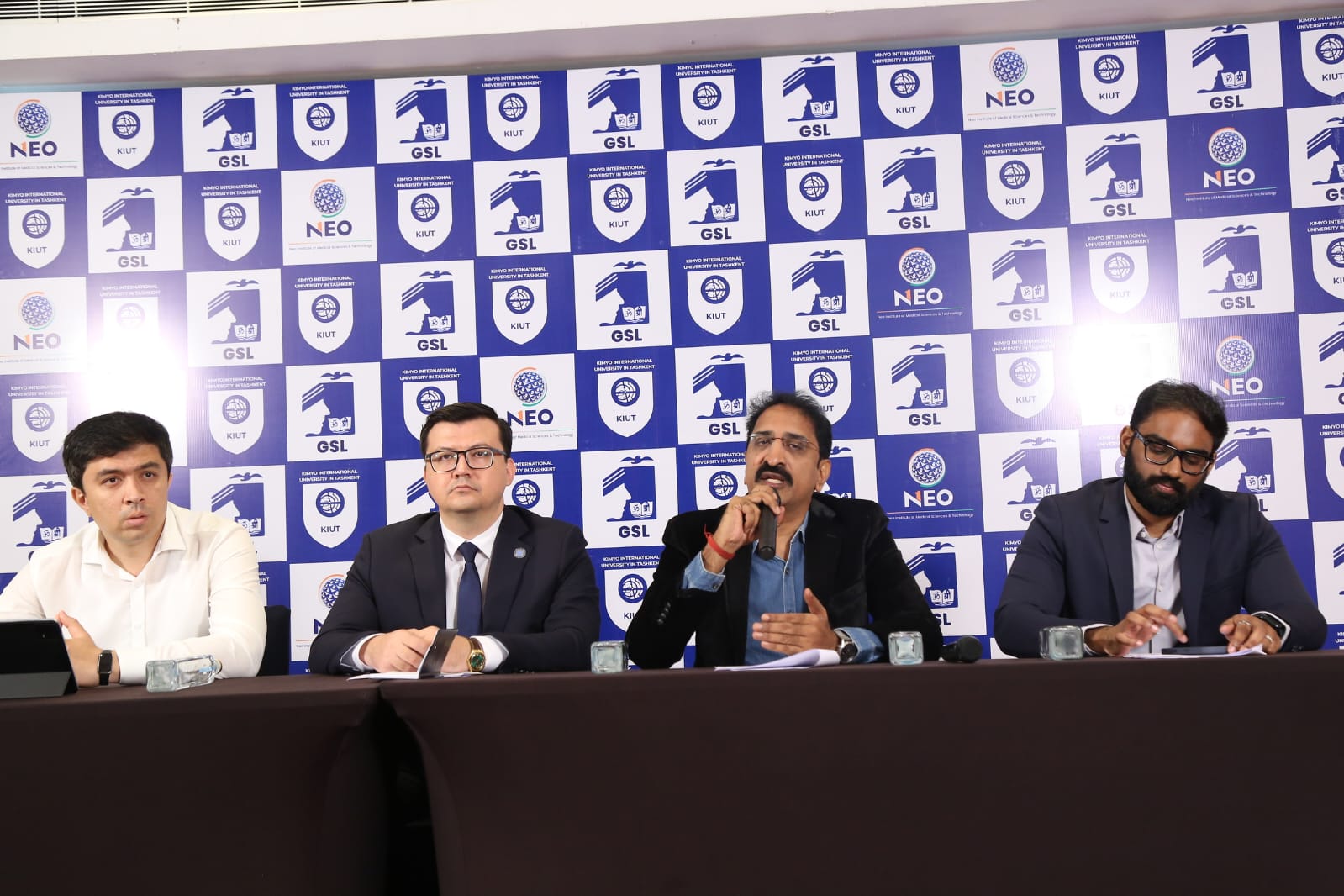
Hyderabad, June 30: Emerging from the recommendations of the International Medical Education Conclave 2026—where medical educators, healthcare leaders, international academic delegates and students came together to discuss the future of international medical education in the era of evolving NMC regulations—the GSL Group, Kimyo International University in Tashkent (KIUT) and NEO Institute of Medical Sciences and Technology today announced The Integrated MBBS Programme, a new institution-led India–Uzbekistan academic model designed to redefine how Indian students pursue medical education abroad.
The launch comes at a decisive moment for the lakhs of Indian students who pursue medicine abroad each year. More than 20 lakh candidates sit NEET for roughly one lakh MBBS seats, and private seats can cost ₹70 lakh to ₹1.5 crore — pushing tens of thousands overseas. But that pathway has grown risky. Fewer than one in four foreign medical graduates clears the mandatory Foreign Medical Graduate Examination (FMGE): NBEMS data show pass rates of just 18.61% in June 2025 and 23.37% in December 2025. The National Medical Commission (NMC) has tightened oversight under the Foreign Medical Graduate Licentiate (FMGL) Regulations, 2021; in an alert note dated 1 April 2026 it cautioned students and named several foreign institutions of concern — citing over-admission, teaching not fully in English and inadequate clinical training — warning that those who choose non-compliant colleges may be unable to register and practise in India. Against this evolving regulatory backdrop, experts at the International Medical Education Conclave reached a common conclusion: international medical education must move beyond traditional recruitment-driven models towards structured institution-to-institution academic collaborations that place quality, compliance, student support and long-term educational outcomes at the centre. The Integrated MBBS Programme has been developed as a direct response to that vision.
The programme also builds on Uzbekistan’s strong recent performance in the FMGE. According to the latest National Board of Examinations in Medical Sciences (NBEMS) December 2025 results, Uzbekistan recorded a 40.37% FMGE pass rate, ranking fourth globally and the highest among the major destinations chosen by Indian medical students. While licensing outcomes ultimately depend on the quality of the individual institution rather than the country alone, these results demonstrate that well-governed medical education ecosystems in Uzbekistan can produce strong academic outcomes.
It was against this backdrop that the conclave’s experts, joined by foreign and Indian medical students, converged on one conclusion: international medical education must move from an unregulated, agent-led model to an institution-led, NMC-aligned one. The Integrated MBBS Programme is the direct response — built by three institutional partners. KIUT, Uzbekistan’s first private university and one of its largest, brings a multidisciplinary academic base spanning medicine, engineering, business, education and the arts. GSL brings an NMC-recognised Indian medical ecosystem with three decades of academic and clinical service. And NEO the international academic-collaboration and healthcare institution associated with the GSL ecosystem — is the strategic architect that conceived the model, brought the two universities together, and is responsible for its academic governance, quality and NMC alignment in India.
Unlike conventional overseas admission arrangements, where institutional engagement often begins and ends with recruitment, the Integrated MBBS Programme establishes a long-term academic partnership in which KIUT, GSL and NEO collectively contribute to curriculum enhancement, academic quality, faculty collaboration, student mentoring, clinical exposure and licensing-examination preparedness throughout the student’s educational journey. Students earn their General Medicine (MBBS degree) at KIUT in Uzbekistan, where the General Medicine programme is delivered and awarded. Alongside it, they gain something most overseas students never get — structured academic support from an Indian medical ecosystem across all six years: an India-based foundation programme, supplementary classes, cadaveric anatomy and Smart-Lab simulation, clinical observerships at GSL‘s 1,300-bed teaching hospital and its network of hospitals, faculty mentoring, a digital medical library, and dedicated FMGE/NExT preparation. This Indian engagement enriches the journey; the degree itself remains entirely KIUT’s.
Programme Highlights
* General Medicine (MBBS) degree awarded by KIUT
* NMC/FMGL-2021 aligned academic pathway
* India-based Foundation & Supplementary Programme
* Cadaveric anatomy exposure
* Smart-Lab simulation training
* Clinical observerships within the GSL healthcare ecosystem
* Faculty mentoring and academic support
* Digital medical library and learning resources
* FMGE/NExT readiness support
* Student welfare and continuous academic mentoring
The partnership’s central message is borne out by the data: FMGE outcomes depend far more on the institution and the quality of training than on the destination country, with pass rates varying sharply from one university to another. Strong institutions — those with structured curricula, rigorous assessment and real clinical exposure — consistently outperform. The Integrated MBBS Programme is built to deliver exactly those conditions.
Dr. Ganni Bhaskara Rao, Chairman, GSL Group, said: “For three decades, GSL and NEO has built doctors, not just degrees. Indian families deserve an overseas pathway they can trust — with the same academic rigour, clinical depth and accountability we expect at home. That is what this partnership delivers.”
Prof. Akmal Allakuliev, Rector, Kimyo International University, said: “As Uzbekistan’s first private university, Kimyo is proud to partner with one of India’s most respected medical ecosystems. The degree is delivered here, to international standards — and this collaboration adds an extra layer of academic support that puts our students’ competence and licensing success first.”
Dr. B. Divya Sunitha Raj, Director, NEO, said: “Every Indian student carries two dreams — to study MBBS abroad, and to also train in an Indian medical institution. NEO exists to make both possible, responsibly by building and safeguarding the academic ecosystem around them.”
Dr. Shokhjahon Elmurodov, Director of International Cooperation, KIUT, said: “This is not recruitment; it is collaboration between institutions. From a foundation programme in India to faculty exchange and clinical observerships, students are supported at every step and all three partners share responsibility for their success.”
The three institutions stated that the launch marks the beginning of a long-term India–Uzbekistan academic partnership aimed at setting higher benchmarks for international medical education through regulatory compliance, academic excellence, clinical competency, faculty collaboration, research and innovation. The collaboration is expected to continue evolving through additional academic initiatives, institutional exchanges and future healthcare partnerships.