


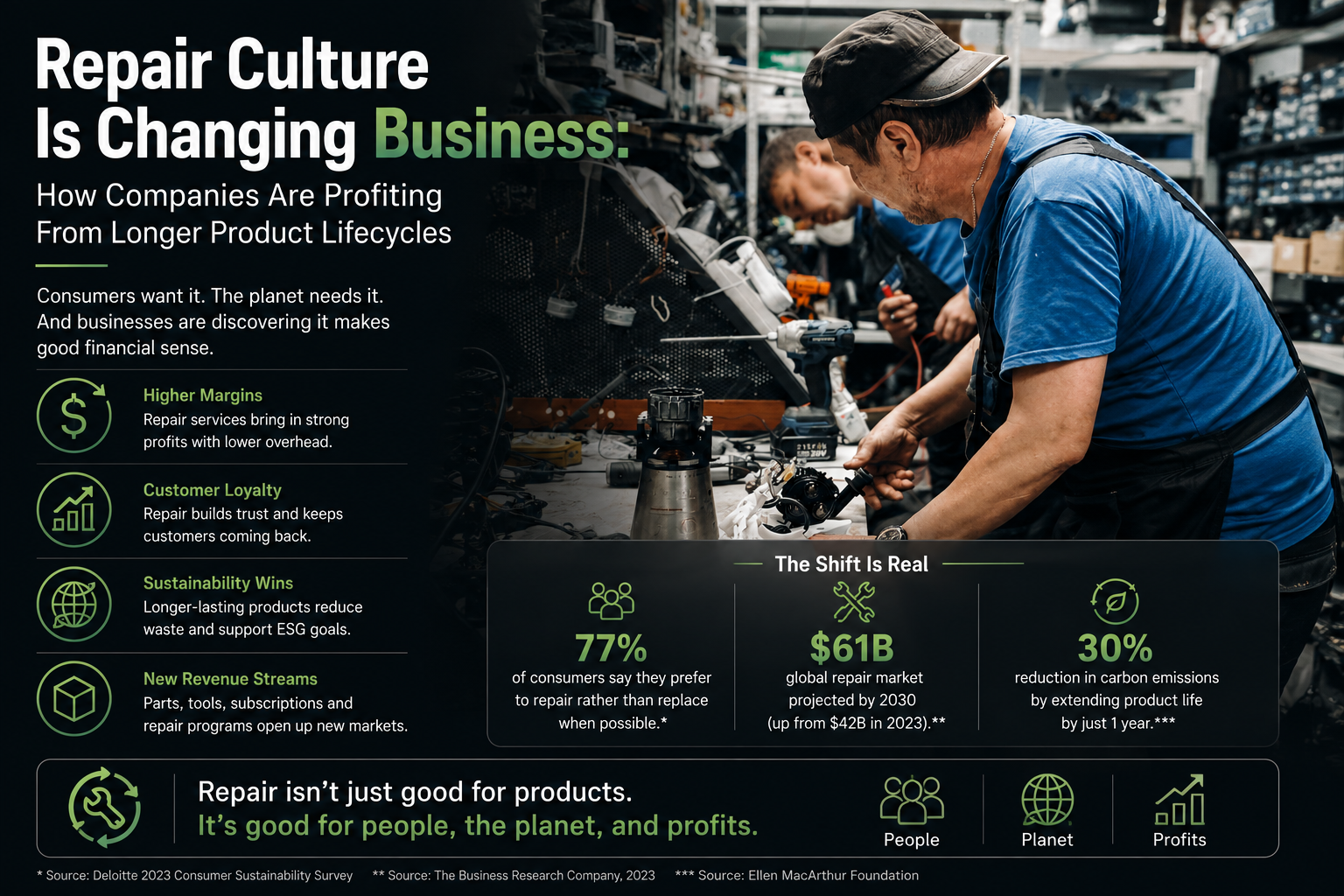
Aug 25: For years, businesses built around physical products have followed a familiar cycle: design, manufacture, sell and replace. Consumers bought new smartphones, appliances, electronics and other products when older ones stopped working or appeared outdated.
But that model is facing a gradual shift.
As consumers become more conscious about costs, waste and product longevity, repair is moving from an after-sales service to a potential business opportunity. Companies are increasingly being pushed to think beyond the initial sale and consider what happens to a product throughout its entire lifecycle.
For businesses, this creates opportunities in repair services, spare parts, refurbishment, resale and maintenance while potentially strengthening customer relationships.
Repair Is Becoming a Strategic Business Opportunity
Repair was traditionally treated as something companies provided when a product failed. Today, it can become part of a broader commercial strategy.
A manufacturer can potentially generate value after the initial sale through:
- Repair services
- Replacement parts
- Maintenance programmes
- Extended warranties
- Refurbishment
- Trade-in programmes
- Resale
- Upgrades
This changes the traditional relationship between a company and its customer.
Instead of:
Sell → Replace → Sell again
the model can become:
Sell → Maintain → Repair → Refurbish → Resell → Reuse
That creates more opportunities to engage with the customer while extending the useful life of the product.
Consumers Are Showing Greater Interest in Repairability
The business case becomes stronger when consumers actively value repair.
A 2025 study by the Nuremberg Institute for Market Decisions, based on surveys of 14,000 consumers across seven countries, found that more than 75% of respondents wanted electrical appliances to become easier to repair. The study also found that lower costs and reduced effort could encourage consumers to repair products more frequently.
This suggests that repairability is not simply an environmental preference.
It can influence the way consumers evaluate products.
For businesses, that means durability and repairability could increasingly become selling points.
Repairability Could Become a Competitive Advantage
When consumers compare similar products, price and features are no longer the only considerations.
They may also ask:
- Can the product be repaired?
- Are spare parts available?
- How much will a repair cost?
- Can the battery or key components be replaced?
- Does the company provide long-term support?
A product designed to last longer can therefore differentiate itself from products designed around frequent replacement.
This could be particularly important for expensive electronics, appliances, tools and other products where consumers have a strong financial incentive to extend the ownership period.
Right-to-Repair Is Changing the Business Landscape
Regulation is accelerating the shift.
The European Union’s right-to-repair rules began applying from 31 July 2026, requiring manufacturers of certain repairable products covered by EU rules to provide repair under specified conditions. The measures also include access to spare parts and repair information, while consumers who choose repair instead of replacement during the relevant guarantee period can receive an additional year of legal guarantee. The European Commission estimates the measures could generate €4.8 billion in growth and investment in the EU.
For businesses, this represents more than a compliance issue.
It signals a broader shift towards products that are designed, supported and managed for longer lifecycles.
India Is Also Moving Towards Greater Repairability
The conversation is relevant to Indian businesses as well.
In May 2025, India’s Department of Consumer Affairs announced a proposed Repairability Index framework for smartphones and tablets, with manufacturers expected to self-declare repairability based on defined scoring criteria.
At the consumer level, after-sales service remains an important part of the equation.
A 2025 Counterpoint Research survey of smartphone users in India found that 43% of respondents considered repair costs somewhat high to very high, while only 61% had their issue resolved during the first service-centre visit.
The findings highlight an important business opportunity: making repair more affordable, accessible and efficient could become a differentiator in competitive product categories.
Repair Can Strengthen Customer Loyalty
Repair can also influence how customers perceive a brand.
A company that helps customers maintain and repair products instead of immediately pushing them towards replacement can build a stronger long-term relationship.
Consider a customer who purchases an appliance and receives:
- Accessible service centres
- Affordable spare parts
- Transparent repair pricing
- Long-term maintenance support
- Reliable technical assistance
That customer experience can influence the next purchase.
Repair can therefore become more than an operational cost. It can become a customer-retention strategy.
Refurbishment Opens a Second-Life Market
Repair also creates opportunities beyond the original customer.
A repaired smartphone, laptop, appliance or piece of equipment can potentially be refurbished and sold to another customer.
This creates a second-life market in which companies can generate additional revenue from products that would otherwise have been discarded.
For electronics businesses, this could become particularly relevant as consumers become more comfortable with professionally refurbished products.
The business model can look like:
New product → Customer → Return → Repair → Refurbish → Resale
Rather than viewing returned products as a cost, businesses can potentially treat them as recoverable assets.
Repair Data Can Improve Product Design
Repair operations can also provide companies with valuable information.
Every repair can reveal something about a product.
Businesses can identify:
- Frequently failing components
- Common customer complaints
- Parts that are difficult to replace
- Average product lifespan
- Common causes of damage
- Repair costs
- Recurring service issues
That information can feed back into product development.
If a particular component repeatedly fails, engineers can redesign it in the next generation.
Repair therefore has the potential to become a source of product intelligence, rather than simply an after-sales expense.
Businesses Need to Design for Repair
The shift towards repair also starts before the product reaches consumers.
Companies may increasingly need to consider repairability during the design process.
That can involve:
Modular design: Individual components can be replaced without discarding the entire product.
Accessible batteries: Batteries can be replaced rather than forcing customers to replace an otherwise functional device.
Spare-parts availability: Customers and repairers can obtain essential components for longer periods.
Easier disassembly: Products can be opened and repaired without unnecessary complexity.
Longer software support: Hardware longevity becomes less useful if software and security support end prematurely.
These choices can increase the useful life of a product while also creating opportunities for companies to build services around it.
The Economics of Repair Still Matter
Repair culture does not mean every product should automatically be repaired.
Businesses have to consider the economics.
A low-cost product may be more expensive to repair than replace. Labour, logistics, parts inventory and technician availability can all increase repair costs.
The challenge for companies is therefore to develop repair models that are convenient for consumers and commercially viable for the business.
This could involve regional service hubs, authorised third-party repair networks, mobile technicians, subscription-based maintenance or automated diagnostics.
Repair Can Become Part of a Circular Business Model
Repair also fits into the broader circular economy.
Research published in Circular Economy and Sustainability in 2025 found that financial considerations, product attachment and perceived repairability influence consumer repair decisions across electronics, clothing and furniture. The study also identified high repair costs and perceptions of unrepairability as barriers, particularly for electronics.
For businesses, this reinforces an important point: making products repairable is only one part of the equation.
Companies also need to make repair affordable, convenient and easy to access.
From Product Sales to Product Lifecycles
The biggest change may be in the way companies think about revenue.
The traditional model focuses heavily on the initial transaction.
A repair-oriented model asks what other value can be created after that transaction.
A company could earn through:
Initial sale + maintenance + repair + parts + refurbishment + resale
This does not necessarily eliminate new-product sales. Instead, it creates additional commercial opportunities around products that remain in use for longer.
Repair Could Become the Next Brand Differentiator
As consumers become more conscious of value and regulators place greater emphasis on durability and repairability, companies may increasingly compete on how long their products can remain useful.
The strongest brands may not simply be those that persuade customers to upgrade frequently.
They could be the companies that make products durable enough to keep, affordable enough to repair and valuable enough to recommend.
Repair culture is therefore more than an environmental movement.
It could represent a shift in the business model itself—from selling replacements to managing product lifecycles.
The key question for companies is no longer simply:
“How do we sell the next product?”
It is increasingly:
“How can we create value throughout the entire life of the product?”