


Sept 04: Janmashtami has always been a festival of devotion, but look a little closer at the celebrations and another story emerges. Homes are being decorated, children are dressed as Krishna, sweet shops are preparing special menus, artisans are making idols and matkis, and online platforms are filling up with festive products. What begins as a religious celebration quickly becomes a busy period for dozens of small and large businesses.
There is a larger retail trend behind this. A 2026 NielsenIQ (NIQ) report on festive commerce in India describes festive occasions as important moments for consumer spending and e-commerce growth, highlighting the growing role of digital shopping, premium products and event-led purchases. That shift is significant for festivals such as Janmashtami, where traditional buying is increasingly being combined with online discovery and convenience.
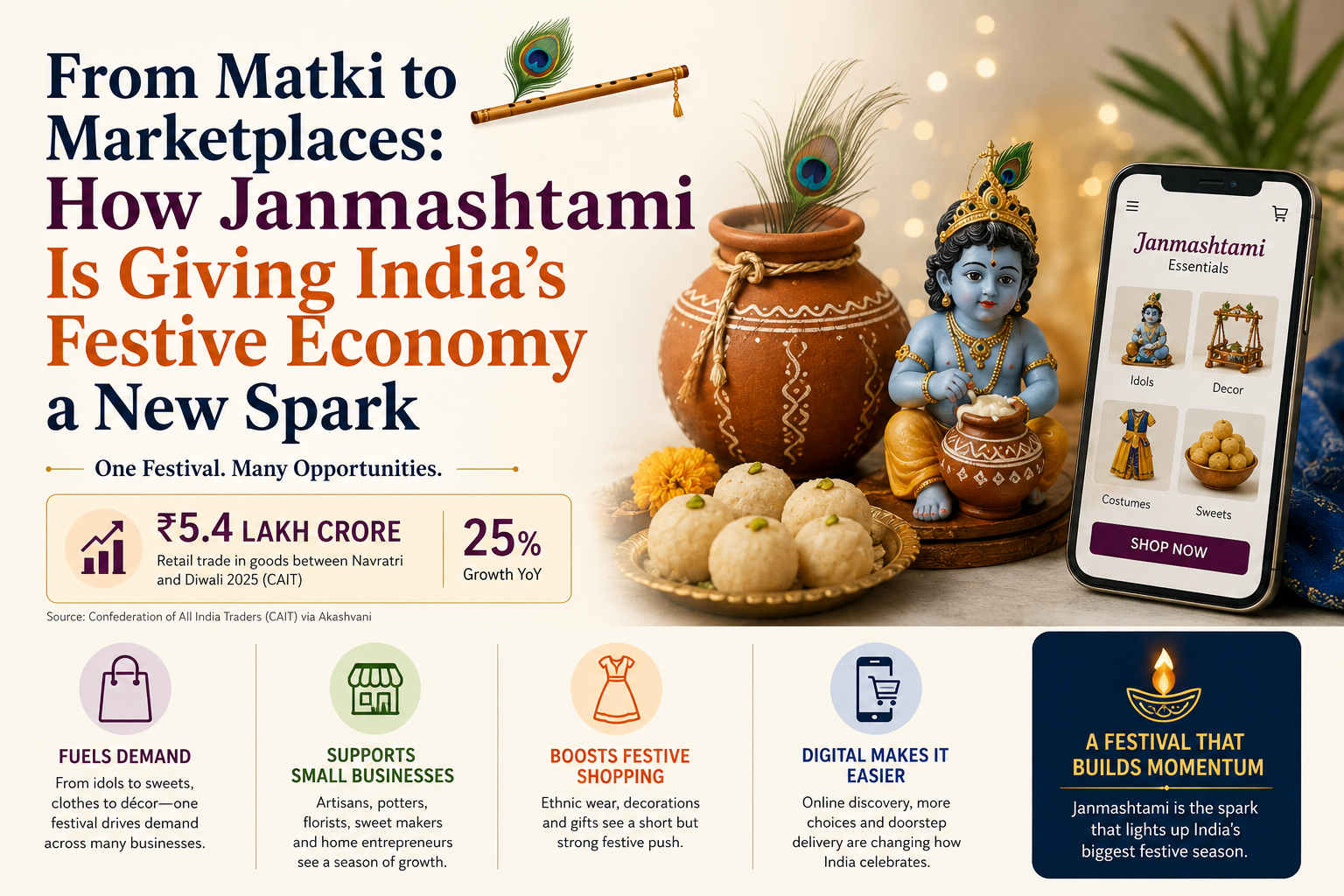
The opportunity becomes clearer when Janmashtami is viewed as the opening act of India’s wider festive shopping season. According to data reported by Akashvani from the Confederation of All India Traders (CAIT), India’s retail trade between Navratri and Diwali in 2025 reached ₹5.4 lakh crore in goods and ₹65,000 crore in services, with overall turnover rising 25% from the previous year. Janmashtami is considerably smaller than this peak period, but it arrives early enough to give businesses a valuable opportunity to build festive momentum.
That makes Janmashtami more than a religious occasion from a retail perspective. It is an early test of consumer appetite for festive products, new shopping formats and seasonal experiences.
The Shopping Basket Behind the Celebration
The average Janmashtami shopping list can be surprisingly long.
There may be a Krishna idol, a small jhula, flowers, decorative items, clothes for the deity, lights and accessories. Then come sweets, milk, fruits and ingredients for bhog. Families celebrating at home may also buy new clothes, children’s costumes and decorations for a small jhanki.
Each purchase supports a different part of the local economy.
The florist gets an order. The sweet shop prepares more boxes. The artisan selling handmade decorations gets another customer. A neighbourhood clothing store sees demand for traditional wear. An online seller gets an order for a Krishna costume or home décor item.
That is the quiet strength of the festive economy: one celebration can create demand across many different businesses.
The Festive Home Is Becoming a Bigger Market
The way people celebrate at home is changing too.
Urban families may not have the space for elaborate traditional setups, but smaller homes have not meant smaller celebrations. Instead, consumers are creating compact Krishna corners, miniature Gokul scenes and decorated jhankis.
This has created a market for products that are easy to use and easy to store.
Reusable backdrops, miniature swings, artificial flowers, fairy lights, peacock-feather decorations and festive décor are convenient options for households that want a festive look without spending days putting everything together.
For small businesses, that creates an opportunity to sell products that combine tradition with modern design.
Sweets, Dairy and the Taste of Tradition
Food remains at the heart of Janmashtami.
The association of Lord Krishna with milk and butter gives dairy products a special place in the celebration, while sweets such as peda, ladoos and makhan-mishri remain popular across many households.
Sweet shops and food businesses are responding by giving traditional products a contemporary makeover.
Festive boxes, attractive packaging, pre-booked orders and customised hampers allow familiar sweets to move beyond the family dining table and into the gifting market.
For younger consumers, this is particularly relevant. They may want traditional flavours and rituals, but they also value convenience, presentation and the ability to order without making a separate trip to the market.
Janmashtami Gives Ethnic Fashion a Festive Push
The festival also brings a short but visible burst of demand for ethnic clothing.
Children dressed as Krishna and Radha remain a familiar part of school and community celebrations. Families also look for kurtas, sarees, lehengas and other traditional outfits for temple visits and gatherings.
For fashion retailers, the opportunity goes beyond a single day’s sales.
Festive collections can be promoted through short-form videos, influencer content and online storefronts. A small boutique that once depended entirely on local customers can now reach shoppers in other cities.
This is where Janmashtami’s traditional character meets India’s increasingly digital consumer economy.
Small Businesses Are at the Heart of It
Perhaps the most interesting part of the Janmashtami economy is that much of it happens at the grassroots level.
Think of the potter making matkis, the artisan creating Krishna idols, the florist putting together garlands, the tailor stitching children’s costumes or the home entrepreneur preparing festive hampers.
These businesses may not make the headlines, but festivals can be important revenue periods for them.
Seasonal demand gives small sellers something they often struggle to get during ordinary weeks: a concentrated period when customers are actively searching for specific products.
The Marketplace Has Moved to the Phone
The festive shopping experience is no longer confined to crowded markets.
A consumer looking for a Krishna idol can browse several designs online. Someone searching for a children’s costume can compare prices. A family planning a celebration can order decorations without visiting multiple shops.
NIQ’s research into India’s festive commerce highlights the growing importance of digital channels in the country’s shopping landscape. Festive occasions can bring additional consumers and categories into e-commerce, while changing expectations around convenience and product choice.
But this does not mean the neighbourhood market is losing its relevance.
In many cases, the two are working together. Consumers may discover products online and buy locally, or visit a physical shop after checking prices and designs on their phones.
Even Last-Minute Shopping Is Going Digital
There is another change that is harder to miss: the rise of quick commerce.
Festivals are full of last-minute needs. Perhaps the flowers were forgotten. Maybe guests are arriving and more sweets are required. Or the decorative lights stop working just before the celebration.
Fast-delivery platforms can fill these gaps.
The development reflects a broader change in Indian shopping habits. Digital channels are no longer reserved for major purchases; they are increasingly becoming part of everyday and immediate consumption.
Gifting Is Getting a Personal Touch
Festive gifting is changing in much the same way.
The traditional box of sweets still has its place, but consumers are increasingly interested in gifts that feel more personal. A Janmashtami hamper might combine sweets with dry fruits, artisanal products, décor or other lifestyle items.
For D2C brands and small businesses, festivals provide an opportunity to create limited-edition products and packaging without having to completely reinvent their businesses.
The idea is simple: people may be buying because it is a festival, but they still want the purchase to feel like them.
What Janmashtami Means for Brands
For brands, Janmashtami offers something more valuable than a short sales window: an opportunity to understand how consumers respond to festive storytelling.
The strongest campaigns do not necessarily need to sell a product with a religious message. They can build around familiar ideas such as family, childhood memories, tradition, celebration and togetherness.
A fashion brand can showcase festive dressing. A food company can reinterpret traditional flavours. A home décor business can present simple Krishna-themed spaces. A D2C brand can create a limited-edition festive collection.
The digital environment makes these campaigns even more flexible.
Short videos can demonstrate decorations. Influencers can showcase festive looks. Regional-language content can connect with specific markets. User-generated content can turn customers themselves into part of the campaign.
For smaller businesses, this can be particularly useful because festive marketing no longer requires the budgets associated with traditional mass advertising.
Janmashtami Is the Beginning, Not the Main Event
The real economic significance of Janmashtami becomes clearer when it is placed within India’s wider festive calendar.
After Janmashtami comes a succession of major celebrations, eventually building towards the enormous shopping period around Diwali.
This makes the festival an early opportunity for businesses to observe consumer behaviour.
Are shoppers responding to premium products? Are they choosing smaller, affordable purchases? Are they buying online or visiting physical stores? Are traditional products still winning, or are consumers looking for modern interpretations?
The answers can help retailers refine their strategy for the larger festive months ahead.
Tradition Is Creating New Products
One of the most fascinating things about the festive economy is that tradition itself is becoming a source of new products.
A traditional matki becomes a decorative piece.
A Krishna idol becomes a handcrafted home accent.
A familiar sweet becomes a premium gift box.
A child’s Krishna costume becomes a seasonal fashion product.
A traditional jhanki becomes a ready-to-assemble home décor kit.
The rituals remain familiar, but the products surrounding them keep changing.
The New Festive Consumer
Today’s Indian consumer is looking for a balance.
They want tradition, but they also want convenience. They want attractive products, but they remain conscious of price. They may prefer handmade products while still expecting the ease of online ordering.
That puts the focus on businesses that can bring together heritage, affordability, convenience and good design.
For small sellers, digital platforms can provide visibility. For established brands, festivals offer an opportunity to connect with consumers emotionally. And for e-commerce companies, every festival creates another reason for customers to open an app.
The Business Story Behind Janmashtami
Janmashtami shows that India’s festive economy is not built only around Diwali’s big-ticket purchases.
It is created through hundreds of smaller celebrations, each generating its own wave of demand.
A family buying flowers, a parent ordering a Krishna costume, a customer picking up a box of peda or an artisan selling a handmade matki may seem like small transactions individually. Together, they form part of a much larger consumption cycle.
That is what makes Janmashtami interesting from a business perspective.
The festival remains deeply rooted in faith and tradition. But around that tradition, a modern economy has grown—one that stretches from local markets and family-run shops to D2C brands, marketplaces and quick-commerce apps.
For businesses, the lesson is clear: India’s festive economy is no longer concentrated around a handful of major shopping days. It is becoming a longer, more digital and more personalised consumption journey—and Janmashtami is one of the first sparks.
From a handmade matki sold by a local artisan to a festive hamper ordered through a smartphone, the journey of Janmashtami reflects the larger transformation taking place across India’s consumer economy.
The festival may celebrate the birth of Krishna, but for India’s businesses, it can also mark the beginning of the festive season’s next big opportunity.